

Claire McGowan's forensic psychology series with a side order of Northern Ireland history
- Oct 31, 2025
- 5 min read
Updated: Nov 2, 2025

Claire McGowan grew up in a small village in Northern Ireland. She earned a degree in English and French from Oxford then moved to London to work in the charity sector. Her first novel was published in 2012 and she has been writing full time ever since.
I'm a huge fan of McGowan's Paula Maguire series. I've read all six books, one published each year from 2013 until the wrap up in 2018. Paula Maguire is a forensic psychologist specialising in missing persons cases. The books combine strong characterisation, well-crafted crime stories, and the history of Northern Ireland. There is a thread about her mother's disappearance when Paula was young that is woven throughout the books that is deeply tied to the Troubles and The Disappeared. This thread is finally resolved in the last book in the series. The books provide a fascinating look at unhealed wounds post-Troubles and modern cross border cooperation (and lingering animosities). There is plenty of insight provided into the complexities of culture, politics and religion in Northern Ireland.
Paula is a fascinating character, both personally and professionally. The forensic psychology angle elevates the books above the standard crime narrative. Paula is likeable as she is empathetic and inherently flawed, continually making mistakes and missteps. She's a character I warmed to from the get go, and McGowan kept me invested in her journey for the whole six books. Paula's personal life develops as the series wears on and there's enough going with the people who orbit her world to add further layers to the books. Paula's search for answers about her mother provides a vehicle for McGowan to educate the reader about The Troubles and I have found this element of the series disturbing, saddening and compelling. I suggest reading the books in order as each one builds on the previous and the context around Paula's life and her search for her mother are key factors in each story.
There are also a bunch of standalone novels in Claire McGowan's collection. You can read my review of the books I have read here. Below is my review of the Paula Maguire series.
Paula Maguire series | Published 2013-2018
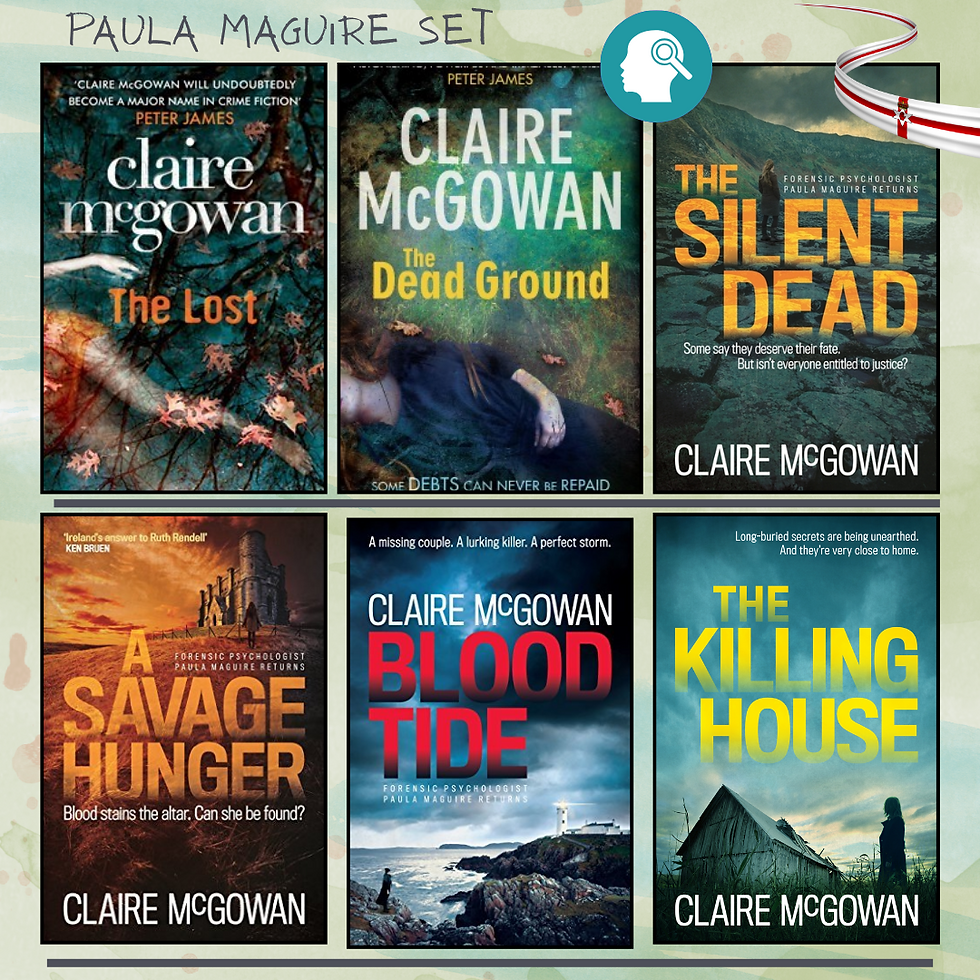
We first meet Paula in 2013's The lost although there is a novella that I haven't read, Controlled explosions (2015), that explores Paula's schooling years and gives some context to her history in Northern Ireland. The lost sets up the series well, as Paula returns home from London, to the small (fictional) town on the border between Northern Ireland and the Republic of Ireland, to assist the local police department in their investigation of the disappearance of two teenage girls near the border. The case has links to two other disappearances 20 years ago. The subject matter is dark, but McGowan handles it sensitively, crafting a strong story with lots of interesting stuff about the political, cultural and religious complexities of modern Northern Ireland. The book is a suitable set up for the series, with a major event in Paula's personal life at the end of the book that entices the reader to want more.
Book 2 in the series is The dead ground, published in 2014. This time, the action is set just before Christmas where a newborn baby goes missing from the hospital and later a woman is found in a remote stone circle with her stomach cut open. Another child is taken and another pregnant woman goes missing. Again, religion plays a part in a case involving pregnancy and abortion, at a time when Paula is struggling with a decision of her own in this regard. McGowan doesn't pull any punches with the dark and disturbing case and again, she shines a light on Northern Ireland's recent history that makes for a compelling and emotional read.
The halfway point of the series is book 3, The silent dead, published in 2015. This one is very much a Northern Ireland story, centring on terrorist activity during the Troubles resulting in the deaths of sixteen people. It's a tough read in some respects, depending on your political views, but one that challenges you to consider potentially morally grey areas in contexts where people have long suffered from oppression. The idea of moral justice dispensed by the ordinary folk is explored in The silent dead. The book is somewhat bleak, but it's such a well-constructed, insightful story that it is worth the emotional journey, I think. There is further exploration of Paula's mother's disappearance and the key relationships in Paula's personal life - with her father, PJ, her teenage boyfriend, Aidan, and colleague-intermittent-lover, British detective, Guy - are cemented in book 3.
Book 4, A savage hunger (2016), sees Paula involved in the disappearance of the daughter of a Home Office Life Peer, Alice Morgan. A holy relic - the bones of a saint - have also disappeared. Due to Alice's father's high profile, the police are under enormous pressure to find Alice, and when a connection to a cold case makes things murky, Paula becomes entangled in a complex case while dealing with personal complexities of her own. It feels like McGowan really does build momentum as the series progresses and each book is better than the previous one. A savage hunger is a gripping read that takes you on a journey through love, loss and vengeance in a country that has firsthand experience with all those things. It is apt that McGowan has 'hunger' in the title book 4 as this idea - IRA hunger strikes, religious fasting, and eating disorders - at its core. There are further developments in Paula's personal life and in her quest to find her mother that provide just enough of a backdrop to support the crime element.
Blood tide (2017), book 5, is one of my favourites in the series. The story is set on the fictional Bone Island, where Paula spent childhood holidays. Paula is called in to investigate the disappearance of a young couple during a violent storm and soon finds herself clashing with the island community who don't take too kindly to an outsider. Blood tide is dark, moody and atmospheric, with a touch of horror. The book is a slight departure from the others, but I loved the island setting, the brewing storm, and the strange things going on that eventually are eventually explained. A top-notch thriller in terms of plotting and execution, with just a hint of Paula's ongoing search for answers and peace in her personal life.
I assume due to the way book 6, The killing house (2018), wraps up that it is the final book in the series. This one is my top pick of the six as the missing persons case is intricately linked to Northern Ireland's history and The Troubles. The book really does show just how long a shadow The Troubles has cast over Northern Island and how bleak and violent those times were. Paula finally gets the answers she is looking for about her mother's disappearance. The killing house takes the reader on a tense, emotional journey to its conclusion, but one that I found quite satisfying. The book is fast-paced and had me on the edge of my seat as the action unfolded. I'd grown to love Paula over the series and was deeply invested in the outcome of her story. I was quite sad to see the series come to an end, and to me, that is a mark of masterful storytelling and characterisation.
Series rating: ⭐⭐⭐⭐⭐


Comments