Free: A deeply personal story of Albania in transition

A little bit of background📃
I had seen all the buzz for Lea Ypi's memoir of her life in Albania as the country transitioned from communism to democracy. My fascination with Eastern Europe and life behind the Iron Curtain continues, so I eagerly jumped into Free.
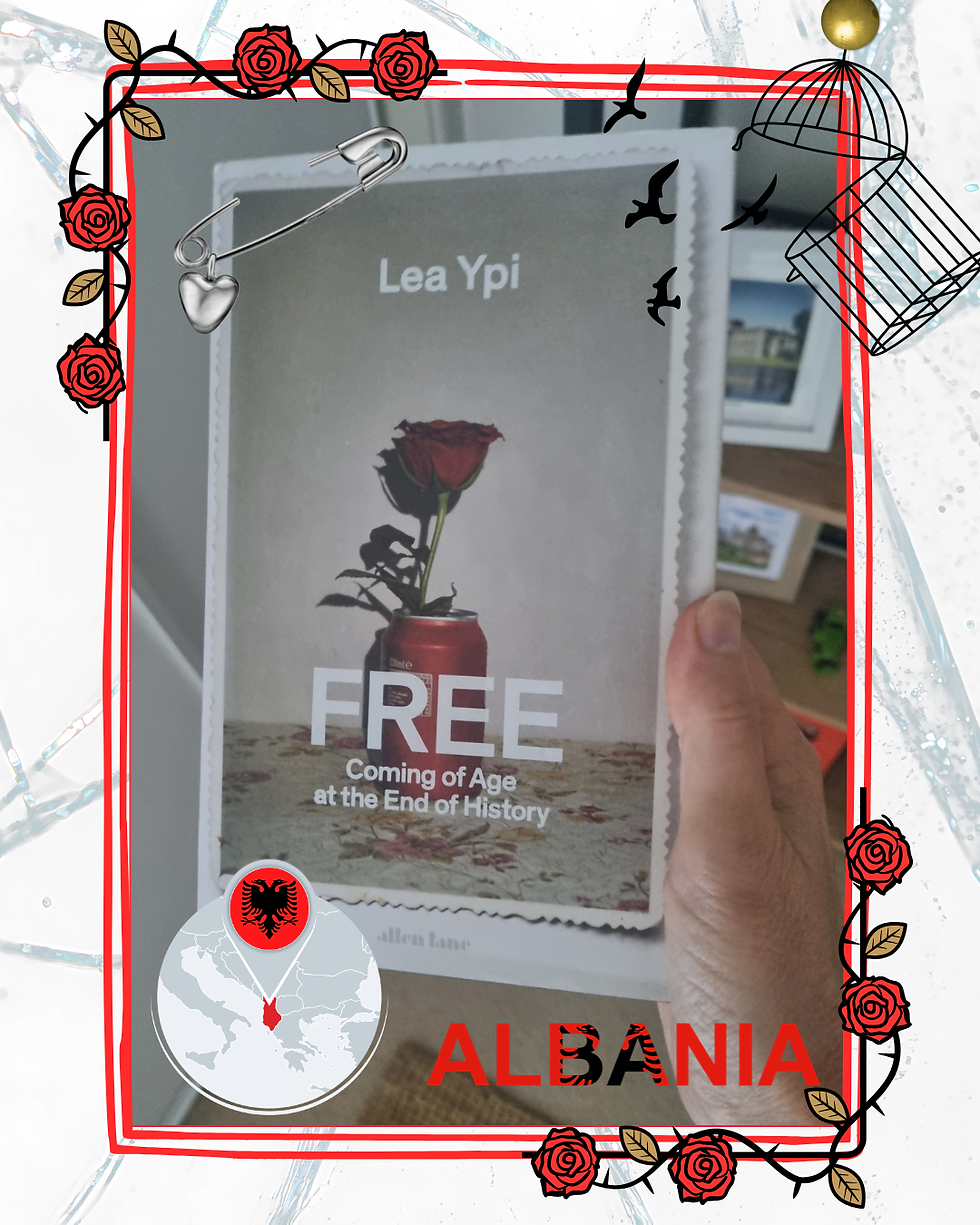
Free: Coming of age at the end of history | Published October 2021 | Read June 2026
The author✏️
Lea Ypi (born 1979) is an Albanian academic and author. She grew up in both communist and post-communist Albania, her parents later becoming involved in democratic politics. Their historical Muslim faith was repressed during communist rule, although Ypi is now agnostic. Ypi's paternal great-grandfather was briefly Albania's Prime Minister in the 1920s and her grandfather (his son) was imprisoned by Albania's communist government for 15 years. Professor Ypi has published two books on her family history and continues to research political theory, Marxism, and critical theory. She is considered to be one of the world's top thinkers and is currently a Professor of Politics and Philosophy at the London School of Economics.
The subject matterℹ️
Lea Ypi was born in 1987 so was eleven when Albania, once a Soviet-style socialist state, became a new free market democracy. Free is a story of Albania told through the eyes of a precocious, inquisitive and rather charming child who transitions into adulthood just as her country is transitioning. The chapters on Lea's early life reveal the complexities and often absurdities of communist rule through her childish eyes. She accepts what she is told about "one's biography" (the boundaries of class and other past associations) and "going to and graduating from university" (being imprisoned and then released by the regime). The book provides unique insight into life under a socialist system without it being a critique and without evoking pity from the reader. It is simply the life Lea lived, and she masterfully captures the tapestry of the daily realities of Albania at that time.
The book is about Lea's coming of age but it is also about her political education and the aftermath of Albania's transition. Lea must make sense of life once lived behind a veil that is now embracing freedom. Yet this idea of freedom brought chaos, economic hardship, and organised crime. She takes the reader through the murky waters of Albania's 1990s transition period and builds an unsettling yet remarkably poignant picture of what led to the 1997 civil war. Ypi astutely analyses the concept of freedom from a Western perspective, the human costs of reform, and the contradictions inherent in these new freedoms Albanians experienced that were marred by difficulties and mired in hypocrisy. While the book is strong on memoir and Lea's experiences, it also asks the reader to reflect on how both socialist and democratic systems and traditions interpret and enact freedom and dignity.
My thoughts on the book💭
You might think it odd that a story of life in socialist Albania could be laced with humour, but Lea Ypi manages to pull it off amidst the insight and nuance of the evocation of her experiences. She has a dry wit that breathes heart and soul into her ordinary existence and into some of the absurdities of communist rule. She beautifully captures the people who orbit her world with wit and insight. The book feels so unashamedly authentic and I loved being let into Lea's world. I especially loved being part of Lea's eccentric and clever family. They used a code to hide the repression of an authoritarian regime and it was fascinating to see what it meant to Lea to have that veil lifted. She says:
I learned the truth when it was no longer dangerous but also at a time when I was old enough to wonder why my family had lied to me for so long. Perhaps they didn't trust me. But if they didn't, why should I trust them? In a society where politics and education pervaded all aspects of life, I was a product of both my family and m country. When the conflict between the two was brought to light, I was dazzled. I didn't know where to look and what to believe.
There are so many gems in the book that infuse seemingly small moments with meaning. One that stands out to me is Lea's story of - weirdly - Coca Cola, and the euphoria and symbolism of being lucky enough to have an empty can of Coke to display on the top of one's television. I also loved the way she wrote about tourists in Albania. At one point she describes them as having their hair cut at the border "on behalf of our state - a modest price paid by world travellers to visit a country whose own citizens travelled the world only in thought."
My only criticism is that the epilogue feels too short. I would have liked to better understand Lea's educational journey and political awakening after she left Albania to study in Italy. The below quote does give some explanation, but I think I wanted more, to properly see her passage from teenager in the early days of the new Albania to a professor of politics and philosophy.
My family equated socialism with denial: the denial of who they wanted to be, of the right to make mistakes and learn from them, to explore the world on one's own terms. I equated liberalism with broken promises, the destruction of solidarity, the right to inherit privilege, selfish enrichment, cultivating illusions while turning a blind eye to injustice.
My key learnings🪴
I only knew the basics of Albanian history going into the book, so Free was a huge education for me. I appreciated Ypi's thoughtful and nuanced reading of the personal and the political. Her refreshing honesty was a joy to read, from her childhood spent not questioning socialism (and being shielded from its repressive elements by her parents) to her stance on the flaws and deficits of the so-called freedom of neoliberalism and democracy. Ypi asks the reader to question what it means to be free, as they journey through the discombobulation she and her fellow Albanians felt as one life was stripped away to be replaced by another, a new life that did not deliver on its promises. Ypi does not defend repression but she also refuses to see capitalism as the panacea for all ills. She recounts the horrific experiences of Albanians, now supposedly free to leave their country, who were refused entry into Italy and Greece or were mistreated or trafficked. Ypi questions how the walls that keep Albanian migrants out of supposedly free countries differ from those the socialist regime that kept them in Albania.
In sum📝
Free is one of the most insightful, original and beautifully-written books I have read in a long time. I am sure I will read it many times more and I'm honoured to have the book in my personal library. Lea Ypi is a natural storyteller and a remarkable woman, and she taught me much about her homeland and about what it means to be free.
Rating: ⭐⭐⭐⭐⭐



Comments