Surveillance in Stasiland: When everyone is watching
Updated: Sep 10

A little bit of background📃
A friend recommended another of Anna Funder's books to me and that led me to Stasiland. It didn't take much convincing for me to add the book to my library, though. I have always had a fascination with all things Eastern Europe, life behind the Iron Curtain, and particularly the short history of East Germany. I was in Berlin in 1996, only a few years after the Wall came down. That experience left a huge impact on me. I'd recently read Katja Hoyer's brilliant, Beyond the Wall, so I was keen to see Anna Funder's take on life behind that Wall.
Stasiland: Stories from behind the Berlin Wall | Published June 2003 | Read June 2026

The author✏️
Anna Funder (born 1966) is an Australian author, born in Melbourne to medical parents. She spent her childhood in San Francisco and Paris where her father was pursuing post-doctoral work in endocrinology. Anna graduated dux of her Melbourne school and later studied English Literature, German and Law at undergraduate level and Creative Writing at Masters level. She is a Doctor of Creative Arts and she studied at the Free University in Berlin in 1987 on a DAAD Scholarship. Anna is fluent in French and German and began her professional life in International Law. Her brother is a Rhodes Scholar who wrote a book about the evacuation of Gallipoli through the eyes of their great-grandfather, the engineer responsible for building the pier at ANZAC Cove. Impressive stuff!
The subject matterℹ️
Stasiland was conceived by Anna Funder when she was working at a television station in Berlin in 1996, having previously studied in West Berlin in 1987. The book is part memoir of her experiences of bringing to life stories from the former East Berlin and the stories of the people themselves. Funder meets Miriam Weber, who tried to escape to the West as a teenager, Frau Paul, who was separated from her baby when the Wall went up overnight, Julia Behrend whose life was scrutinised simply for having and Italian boyfriend, and Klaus Jentzsch, a legendary East German rocker who was censored and eventually exiled. Funder also meets a bunch of former Stasi men. Her book traces their stories, providing a snapshot of both the victims and the perpetrators of Stasi control.
My thoughts on the book💭
Stasiland won the 2004 Samuel Johnson Prize for Best Non-fiction Published in the English Language and was a finalist in a bunch of other literary awards. I'm going to pinch a comment I saw on a Goodreads review of Stasiland as it so nicely sums up how I feel: "The hardest books to review are those that you almost love." There is a lot to (almost) love about Stasiland. I felt strongly Funder's intentions and desire to get the people's stories out there. You have to give her props for the bravery she displayed in her attempts to find people to interview and to pursue their often harrowing stories. As a German scholar and an Australian plonked into the newly-unified Germany in the late 1990s, she makes a genuine stab at trying to understand both victim and perpetrator experiences in East Germany and the effect of Stasi control on ordinary people. That Funder lived in Berlin while she researched and wrote the book adds another layer of authenticity. The book's cover is grey and the whole vibe of the book matches the colour. It's so very, very bleak, much like the sadness of Miriam, Julia and Frau Paul's stories.
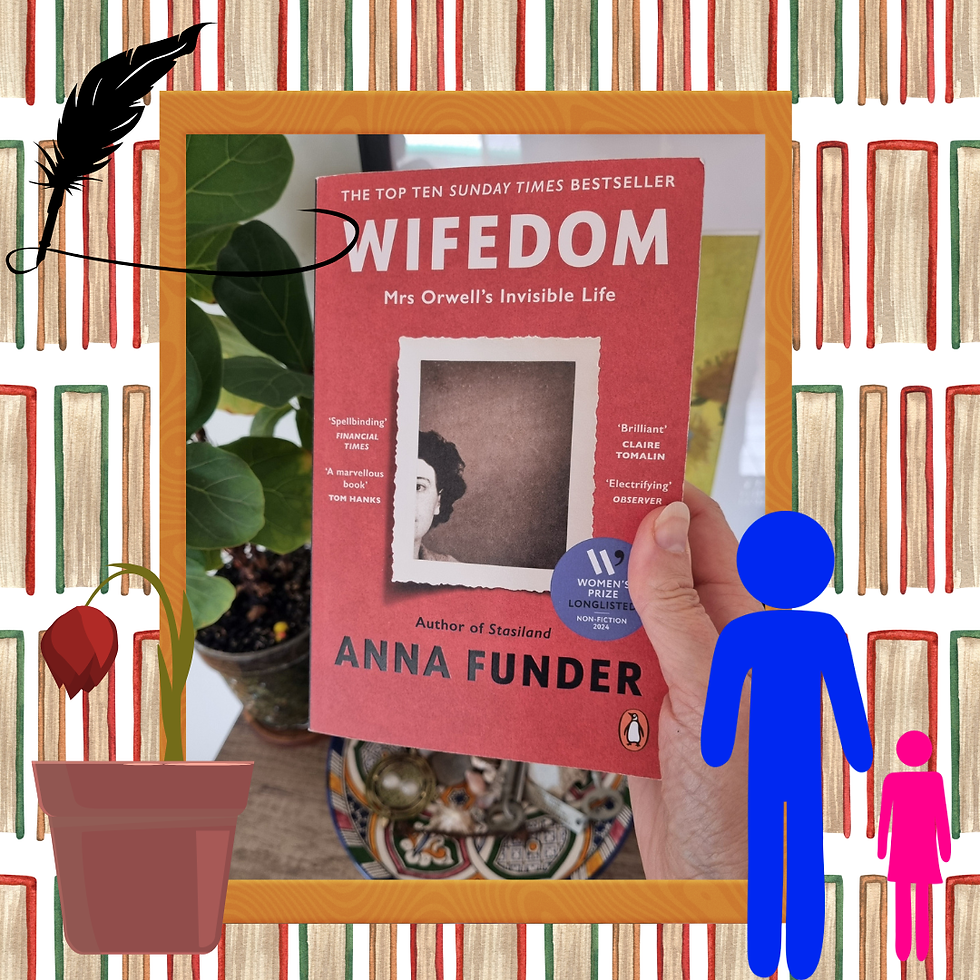
The book is a part memoir and part collection of stories of real people who lived behind the Berlin Wall. Funder's book on the erasure of George Orwell's wife is similarly written, a mix of two genres and a blending of Anna's voice and that of her subjects. This is both a blessing and a curse, as the narrative often gets bogged down in Anna-ness and this has the effect of diluting the power of the people's stories. The book doesn't feel a particularly objective nor balanced account of the GDR. It sat for me in quite stark contrast to Katja Hoyer's book, in that the stories were presented outside of the context of the geopolitical situation and outside of the complexities of life under the East German regime. Perhaps Funder could have written a separate memoir on her experiences of working and living in Berlin at that pivotal watershed time for Germany and kept the "behind the walls" stories for a book of their own. The stories themselves were interesting yet they often were a little swallowed up in Funder's explanations of how she obtained them.
I paid to see Anna Funder speak during her 2026 Australian author tour, hosted by Thinkable Events. This was my first time at an author evening and I wasn't sure what to expect. I loved nerding it out with all the other audience members and I felt a connection to Anna then, having read two of her books. I must admit, though, that I was expecting a little more insight from her. The discussion of Stasiland seemed to centre more on Anna's experience than the people she wrote about in the book. That jibes with my feelings about the book, too.

My key learnings🪴
The stories Funder researched and presented in Stasiland taught me much about the depth of Stasi surveillance, the consequences for stepping out of line, and the endless rules that might seem odd to us now. One thing that stood out to me was learning that it was perfectly legal to apply to leave the GDR. Throughout the country's short history, many people were allowed to cross over to West to start a new life. However, applications to leave meant that you were suspected of wanting to leave and this was a punishable crime. Wild.
Berlin is a grey and bleak place. The whole vibe of Funder's experience living in her grimy flat and seeking out her interview subjects was super depressing. I remember Berlin from our 1996 visit, the same year Funder was working there, as an eclectic, eccentric city on the verge of a new era after the recent reunification. This sense of hope amongst the rubble of the fall of Wall is not conveyed in Funder's book.
In sum📝
I absolutely "almost love" Stasiland and I have struggled with my rating. The book overall is fascinating, but I would have loved to read more stories of people's experiences behind the Wall and less Fundering about. The book is still an important piece of work that shines a light on life in the GDR and on stories that are not often told.
Rating: ⭐⭐⭐⭐


Comments