Wifedom: What (who) George Orwell left out of his life and work

A little bit of background📃
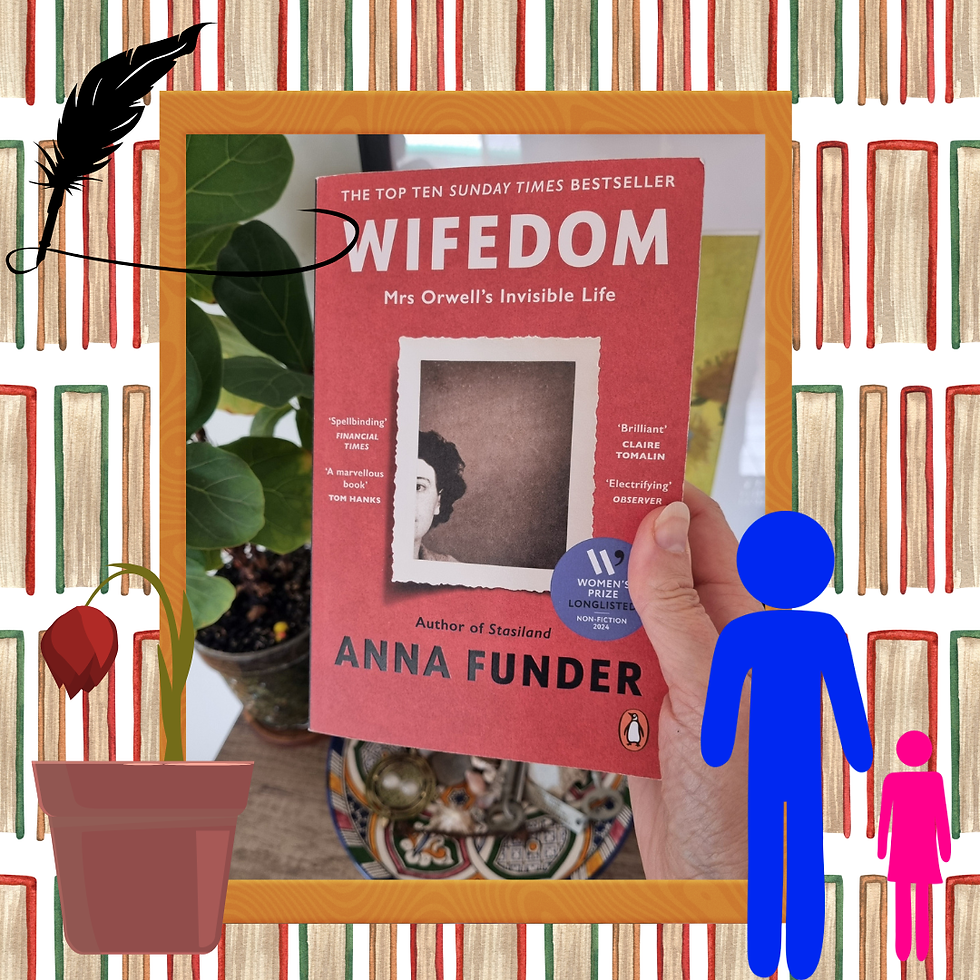
A friend recommended Wifedom to me. I have since read another of Anna Funder's books, Stasiland: Stories from behind the Berlin Wall. I had no idea about the story of George Orwell's first wife, Eileen O'Shaughnessy, which I guess is the whole point of Funder's book, that Eileen is completely invisible from Orwell's life and work. I will say right up front that if you love George Orwell's writing and want to preserve a certain image of him, then definitely DO NOT read Wifedom. It made my hackles rise on the regular!
Wifedom: Mrs Orwell's invisible life | Published July 2023 | Read June 2026
The author✏️
Anna Funder (born 1966) is an Australian author, born in Melbourne to medical parents. She spent her childhood in San Francisco and Paris where her father was pursuing post-doctoral work in endocrinology. Anna graduated dux of her Melbourne school and later studied English Literature, German and Law at undergraduate level and Creative Writing at Masters level. She is a Doctor of Creative Arts and she studied at the Free University in Berlin in 1987 on a DAAD Scholarship. Anna is fluent in French and German and began her professional life in International Law. Her brother is a Rhodes Scholar who wrote a book about the evacuation of Gallipoli through the eyes of their great-grandfather, the engineer responsible for building the pier at ANZAC Cove. Impressive stuff!
The subject matterℹ️
My understanding of the background to Funder writing Wifedom is that she was suffering from writer's block and an overload of personal and professional responsibilities, so she turned to Orwell, one of her favourite writers, for inspiration. Funder re-read all his works then moved onto six key biographies of the genius, much-loved author. This is when Funder realised that his first wife, Eileen, had been erased from Orwell's life and literature.
Wifedom is a complex piece of writing. It explores what it takes to be a writer while providing an intimate view of one of the most important literary marriages of the twentieth century. It is also a seriously damning portrait of Orwell, the appalling way that he treated Eileen, and the forgotten and unacknowledged contribution that she made to his life and to his writing.
Eileen married Orwell in 1936, becoming his wife, his domestic slave, his typist, his editor and ultimately - if Funder's claims are correct - the driving force behind his most important books. All this took place during the Spanish Civil War and the Second World War, while Eileen did bad-ass, secretive work for the British government. She was an exceptional woman and I wished she had been treated with the respect that she deserved. Eileen's fascinating, vibrant life sadly ended in 1945 when she was still quite young.
My thoughts on the book💭
Like Stasiland, Funder blends and bends genres, recreating story of the Orwell's marriage from newly-discovered personal letters from Eileen to her best friend. I loved that Funder began to explore the gaps in the key biographies of Orwell, uncovering a pathological erasing at worst, minimising at best, of Eileen's contributions and her disappearance under the wifedom burden. Funder is a gifted writer, and she cleverly wove the personal letters and evidence from the biographies and other works on Orwell into a narrative that imaginatively blends fact and fiction. That said, I'm not sure how I feel about the fictional content as it was often hard to distinguish between what was real and what was Funder Speculation.
It's also rather ironic that in a book about the erasure of one brilliant woman, there is so much insertion of Funder into the narrative. The book is an odd mix of a dig at the patriarchy (and Eileen's erasure) and Funder inserting herself into the narrative and speaking for Eileen through speculation rather than research. Like Stasiland, Funder's musings on her own domestic situation and professional life as a writer got in the way. Again like Stasiland, the book could have been so much more thoughtful and nuanced without all the Fundering. Perhaps this is just Funder's way, to place herself into her work. Funder also ends the book with a whole chapter on Orwell's life and work after Eileen has died. Huh?
As an aside, but also relevant to my review, I paid to see Anna Funder speak during her 2026 Australian author tour, hosted by Thinkable Events. During question time at the end, an audience member asked what I wanted to ask, whether writing and researching Wifedom changed Funder's view of Orwell, whether one can separate the person from their work. Funder gave a rather insipid answer, and I suspect that she still admires Orwell despite his personal failings. That's fine, I guess, but her answer lacked insight and it didn't seem to me that Funder was doing much to address Eileen's erasure in her discussion of the book overall during the event.

Furthermore, while Funder begins to unravel why so little of Eileen exists in both the biographies and Orwell's writing, she could have gone a lot deeper with her analysis. It felt like Funder only scraped the surface in her retelling of Eileen's story. I wanted to read Eileen's story and learn more about Orwell (even for all his personal failings), but where was the analysis of the supporters - male or female - who willingly do the work to allow their partners to shine? And what does it mean to them for this work to go unacknowledged? Was Eileen all about the creative process and not the glory? Does genious and single-minded dedication to one's craft necessitate selfishness and all-around douchebag behaviour? I have questions!
My key learnings🪴
George Orwell was selfish and self-centred, often cruel and demanding, a serial philanderer, and an all-around douche canoe. The book made me furious for all that Eileen endured in the name of wifedom. She was brilliant, entreprenuerial, hardworking, and compassionate, but was treated appallingly by her husband and died partly from his neglect. It made me detest George Orwell. I had no clue that the ideas for Animal Farm and 1984 came from Eileen and that she played such an important role in transforming his scribblings into something of literary value. It is also astonishing that a man who wrote such groundbreaking books about tyranny and social injustice was such a jerk in real life. He comes across as an entitled piece of s**t, completely devoid of empathy for anyone else, especially his wife. He was also a predatory creep. Did he even write anything of those books, or was it all Eileen?
I wanted to wave my fist at the patriarchy as I turned the pages of Wifedom! It's infuriating to realise that women have, and still often do, taken a backseat to men, their achievements often gained by the support of the women standing behind them, shouldering much of the domestic responsibilities and emotional burdens. However, Funder didn't provide any context for Eileen's life and seems to have decided that she is a victim of both Orwell and of patriarchy. The reader isn't given any clues about Eileen's choices or where her own agency fit into the picture. A more thorough and sophisticated telling of Eileen's story feels like it would better honour such an exceptional woman and show her identity to be more than one of wifedom. It was actually the treatment of Eileen by Orwell that made me angrier than her erasure from his biographies and lack of credit for her contribution to his work.
In sum📝
Similarly with Stasiland, I had trouble rating Funder's work, finding again that the hardest books to review are the ones that you want to but don't quite love. I so wanted to love Wifedom as it's such an important story to tell. Eileen deserves to have her story told in its own right, not just as a victim of wifedom. She also deserves all the credit for putting up with Orwell! So, my four stars are for the remarkable woman that Eileen clearly was and for her story to be out there for all to read.
Is Wifedom an ode to the unsung work of women everywhere? Partly, yes, but I felt Funder could have gone further in her social commentary about the erasure of women. Perhaps the book might have worked better staying with the concept of wifedom, but as an exploration of Eileen and the other women whose contributions to Great Men have gone unacknowledged. Wifedom is closer to five stars than Stasiland, but I can't quite get there. Still, the book has left a lasting impression on me and I treasure it as part of my personal library.
Rating: ⭐⭐⭐⭐



Comments