French Riviera wanderings: Nice, Eze, Monaco and Antibes

The Second Great Girls' Adventure series
This post is number 3 in the series on the Second Great Girls' Adventure, a trip that my daughter E and I took in October 2022. Our adventure included Amsterdam, Paris, Nice, Cinque Terre and Milan [in that order]. Each place in this incredible list has its own post. I had been to Amsterdam and Paris previously, but Nice was to be a whole new experience. Exciting!

A little bit of background📝
Our first Great Girls' Adventure took place in 2015, when E was turning 15 and just about to embark on her final two years of schooling. We were fortunate to experience Türkiye, Greece and Romania on that trip. This time, our Great Girls' Adventure was a belated celebration for our two milestone birthdays [21 and 50] that came and went during the pandemic. Our second Great Girls' Adventure saw us in Europe for three weeks in October 2022, flying into Amsterdam and out of Milan with Qatar Airways. There is a bit more background to our trip in the Amsterdam post.

This second adventure was special as E was an adult this time [almost 22 by the time we embarked on our adventure]. We shared the planning and expenses, travelling as companions and enjoying each other's company and the wonders of the places we visited. This trip was also a bit less stressful for me as I didn't feel solely responsible for everything. E navigated us around like a boss! Looking back now as I write this post in 2025, we had an incredible experience and I will be forever grateful for the opportunity to travel again with my daughter.
The French Riviera was our third destination on our Great Girls' Adventure. Our previous experiences are documented here: Amsterdam and Paris. We chose Nice as I wanted to see a part of France that I hadn't experienced before, in addition to Paris. The title of this post gives the list of places we experienced on the Riviera while basing ourselves in Nice. The Riviera truly lived up to my expectations - and more. Using Nice as a base works really well, and it is easy to get around on the trains, as we did. I thought Nice was absolutely beautiful! Read on to see what I mean.

Travel from Paris to Nice✈️
We opted to fly to Nice from Paris rather than take the train. With hindsight, I might have made a different decision. The train journey is around 5-7 hours, depending on whether the service is direct or requires a change, and our apartment in Paris was only a 15-minute walk to Gare du Nord. The cost is probably around the same as flying given we took an Uber for the 30-minute drive south of the city to Paris-Orly Airport for our early flight. That said, we were in Nice by 8.30am and it would have taken us the better part of the day to get there by train. Flying gave us time to explore Nice Old Town on that first day.

I managed to buy both of our easyJet tickets from Paris to Nice for £128 which seems so cheap to us. Flying time is around 90 minutes, the same as the flight from Brisbane to Sydney where we live, yet it would be impossible to fly that distance in Australia for such a price.
This was my first easyJet experience. I'd previously flown Ryanair, another low-cost airline, and had a mixed bag of experiences. Our journey from Paris to Nice was fine other than a mix-up with our boarding passes that sent my anxiety levels through the roof. I actually can't remember the details now, but I do recall that we checked in but weren't given a boarding pass as we were told what we had on my phone via the online booking was OK. However, when we got to the gates, we had to backtrack to check-in as we DID require a boarding pass. I also remember we bought a terrible coffee and chai while waiting for the flight.
Arriving in Nice was super smooth, though. We had a cookie and cold drink at the airport as we'd missed breakfast but didn't feel like much else. We took the metro to the Old Town and it was easy to figure all that out. Nice Cote d'Azur Aeroport is only 8.5km from the Old Town and about 30 minutes on the tram. The metro tram system in Nice is super efficient and cheap. The tram from the airport leaves every 7-8 minutes during the day. The Old Town is walkable and not serviced by trams, so we only used the tram to travel from the airport and to and from Nice Ville, the central train station in the newer part of the city.

Travel tip🌏
The paper, single-journey tickets that we purchased during our stay are being replaced as I write this post in 2025. There will be a new "Card", a Lignes d'Azur system of rechargeable single, multi-trip, or multi-day passes. It may have worked out cheaper and easier for us to have bought a French Riviera pass, the old system, instead of buying single journey tickets. Check out this website for the best option.
Our first taste of Nice🪷
I'd searched for a luggage storage place near the Airbnb apartment we were staying in as we couldn't check in until 2.30pm. I pre-booked our luggage storage so we had no hassles when we arrived. It was €14 well spent to have both our suitcases looked after for the day.
We had a lovely time on the first day getting our bearings and taking in the vibe of the Old Town. It was a little cool and cloudy in the morning, but turned into a beautifully warm and sunny day. I fell in love with Nice from the moment we set foot in the Old Town. These two photos are my favourite, beautifully capturing the gorgeous streets and earth-coloured buildings.

Nice is a seaport city on the Mediterranean and capital of the Alpes-Maritimes departement in the Provence-Alpes-Côte d'Azur [PACA] region in southeastern France at the foot of the French Alps. The city sits on the Bay des Anges, only 32 km from the Italian border. Nice was originally a Roman trading station and wasn't ceded by France until the Treaty of Turin in 1860. The architecture of the Old Town certainly has an Italian feel to it.
Along with beautiful old tenement buildings, Nice's old town is characterised by the 7km Promenade des Anglais ["Walkway of the English"] that stretches from the airport to the Quai des Etats-Unis [United States Quay] at the foot of Colline du Chateau. I believe the name of the promenade came about in the 18th century, from the English aristocracy who enjoyed the Nice winters and the pretty coastline. The construction of the promenade in 1822 was funded by these wealthy British patrons led by Reverend Lewis Way, using itinerant workers. Nowadays, locals call it simply La Prom.
We had a little squiz at the pebbly beach [Plage des Ponchettes] on the eastern side of La Prom. No sand in sight, but the pebbles were lovely and smooth. There were swimmers in the water and on the shoreline even though it didn't seem like swimming weather to us!

We kept heading east along Quai des Etats-Unis towards the port, stopping at the "I love Nice" sign. The sign is 8 metres long and 3.5 metres high, weighing nearly 2 tonnes. It's made of car body sheet metal, apparently. The sign has been in place since 2016, after the Bastille Day terror attack that left 86 dead. The sign is usually coloured to match the French flag, but changes temporarily for particular celebrations. For example, the sign mirrors a cyclist's silhouette to mark the passage of the Tour de France and it was changed to an orange colour on November 25, 2023 in support of the fight against violence against women for World Day. Cool.

The best views of Nice can be seen from atop Colline du Chateau [Castle Hill], a park overlooking the city at the eastern end of La Prom. The below bottom middle photo shows the hill on which the park sits from the street level. There was once a castle on the hill but it was destroyed by King Louis XIV's troops in 1706. The hill was later turned into a landscaped park in 1822. There is a lift up to the top, but we walked up the stairs. The interwebs seem unsure of the exact number of stairs - anywhere between 300 and 426 - but no matter the exact number, I do remember it was a bit of a climb. Totally worth it to see the view unfolding, though!

There's a beautiful waterfall part way up. The Cascade de la Colline du Chateau was built in the 19th century to support the town's water supply. The waterfall, built in 1885, serves as a spillway for the Vesubie River.

Here we are at the top of Castle Hill. The views towards the port and of the Old Town are amazing, but we were happy just to make it to the top, use the restrooms, and buy a cold drink.

Here's a sample of the views. The Old Town can be seen in the foreground, with the tree-lined street separating it from the newer part of Nice. La Prom frames the city, stretching out as far as the eye can see.

Descending Castle Hill, we wandered a bit further around towards the port before heading back into town. The Monument to the Dead [Monument aux Morts] in the below bottom left shot is a rather beautiful memorial built between 1924 and 1928 in memory of the 4000 local people who died in WW1. It is one the largest cenotaphs in France, standing 32 metres high.

I absolutely fell in love with Nice on that first day, as I said above. The Old Town is absolutely beautiful. Yes, it was pretty crowded, but I liked the warm vibe and the intimate feel of the town. Here are some of the shots I took on that first day. Narrow streets and tall tenement buildings are totally my jam.

The Old Town has many historic tenements, churches and squares. There's Place Massena, the central square, and Place Rossetti, on which Nice Cathedral sits. It's all very compact and walkable.

We stumbled across the markets in Cours Saleya, the main marketplace. So many interesting treasures! It was Monday - flea market day - and that's why there was such an eclectic mix of wares. There is a food and flower market on the other days of the week until midday and then the square transforms into a huge open air restaurant.

There are several cathedrals of note in Nice's Old Town: Cathedrale Sainte-Reparate [below top right shot] was built in Baroque style between 1650 and 1685 to honour the patron saint of Nice, on the site of the first cathedral constructed in 1049. It was elevated to the rank of a basilica in 1949.
The Eglise Saint-Jacques-le-Majeur [below left hand shots], commonly known as the Church of Gesu, was also built in Baroque style, constructed between 1607 and 1650. It was originally built under the leadership of the Jesuits. The church has a 42-metre-high bell tower and inside, there are several frescoes that tell the story of Saint Jacques Le Majeur.
The Chapelle de la Misericorde [Chapel of Mercy] was built from 1740 [below bottom right hand shot] on the site of the former salt warehouses of the King of Sardinia. There are frescoes on the church's dome set against a blue background, and it houses a convent on the upper floors.

After wandering the Old Town, we had a delicious gelato from one of the many shops [each one we were told was "the best gelato in Nice!"] then we collected our bags and met up with the owner of the apartment we'd rented. Our home for four nights in Nice was a stunning renovated apartment on the eastern edge of the Old Town, in Rue de l'Ancien Senat, only 300 metres from La Prom. We found it on Airbnb at a cost of $1065AUD for the four nights. It was more expensive than our Paris apartment but so much nicer. Celine and Charlie were our hosts - residents of Nice - and Charlie met us at the apartment for a chat. I gathered this was something he did, to check out his guests, I suppose.
This is what the apartment and its surrounds looked like from the outside. How cool is that? Charlie told us that the building is over 200 years old.

The apartment has been beautifully renovated. It was the nicest place we stayed in across our whole trip and up there with the best of the Airbnb accommodation I've rented. The apartment has two bedrooms, one at each end of the space, a beautiful sitting room with stone walls and a cool door into one of the bedrooms, a fully equipped kitchen and a gorgeous bathroom.

After we'd settled in and Charlie had left, we caught up on some washing and went for a walk to the closest Carrefour for groceries. It was nice that evening to cook a proper meal [and I wrote in my notebook that we had fish, potatoes and salad] after living on fresh but convenience food from supermarkets so far. And in the morning, we woke up to these views. Lovely!

Day 2: The beautiful village of Eze💝
We started our second day in Nice with a lovely early morning walk along La Prom. The weather was cool but sunny and we had a nice, quiet walk about a half an hour each way. When I say quiet, I mean that there was hardly anyone around. Europeans keep completely different hours to Australians! We were looking for somewhere to have a coffee/chai and soak up the vibes, but none of the cafes was open.

Here's an example of the architecture along La Prom. These buildings are what I expected the French Riviera to look like. They are quite a contrast to the earthen colours of the tenement buildings one street back in the Old Town, but totally in keeping with the "promenade" vibe.

After our prom stroll, we headed for the bus to Eze. An absolute must-do when staying in Nice is a wander around the gorgeous village at Eze. The village was built over 400 metres above sea level, dating back to the middle ages. It sits just above the famous Moyenne Corniche road that links Nice to Monaco.
The below shot gives some perspective on its location. Nice can be seen in the background, with Eze proudly sitting atop Mont Bastide in the foreground. The village is only 12km east of Nice, between Nice and Monaco.

Now, getting to the village requires a little planning. If travelling by public transport, it's important to distinguish between coastal Eze-sur-Mer, where the Nice-Monaco railway line runs through, and Eze Village up on the mountain above Eze-sur-Mer. The best place to begin a visit to Eze is at the hilltop village, not the coastal one. There is a bus that runs regularly to Eze village from Nice and that's how we got there. We walked the 1km route La Prom to the Boyer bus stop, purchasing our £2 ticket from one of the metro machines first.
As can be seen in the below top shot, the Boyer bus stop is on the street. The below shot isn't mine, but it represents our experience: Loads of people filling up the footpath waiting for the bus. I imagine the people who live and work on that street must get sick of all the tourists! My advice is to go early. It was around 10.30am when we got there and there were loads of people there even that early.

We couldn't believe how crowded the bus was once it finally arrived. I don't think I have ever been on such a crowded bus before. I got separated from E as the crowds surged onto the bus. We stood up for the entire 20-minute journey up the mountain, squashed in amongst a horde of people, where more got on at each stop and no one got off until Eze. The bus driver was an absolute star to navigate the bus up to the village.
The left hand shot above is of the bus and its drop off point at the bottom of the village. There are shops and cafes at that level but the medieval village is a short climb above where the bus stops.
The village is small, but it is so pretty. It feels like walking into a fairytale. There are shops, art galleries, hotels and restaurants in the village but it doesn't feel super touristy. The businesses blend in with the ancient stone buildings and it's all very charming.

And despite the crowded bus and size of the village, we didn't feel hemmed in, nor were there lots of people milling around. I honestly don't know where all the people went to, actually. There are shops and restaurants below the ancient village where the bus stops, so perhaps they all went there first.
Eze is a beautiful place and it's fun to explore the web of cobblestone streets and hidden alleys. That said, an hour or two is sufficient to soak up the vibe, unless wanting to shop and have a restaurant meal. There's also an exotic garden that is supposed to be lovely, complete with fabulous lookout, with entry at the time of writing of €6.

We climbed further up the mountain to the Eglise Notre-Dame de l'Assomption d'Eze to eat our picnic lunch. I love the below shot that I took, with the tree framing the church. It was actually rather peaceful up there for our lunch stop. The Baroque church was consecrated in 1764, built at the request of Duke Charles Emmanuel III of Savoy, to replace the previous one from the 12th century that had fallen to into ruin.

Along with the gorgeous village, another reason to visit Eze is for the views. The height of the village affords stunning views of the Mediterranean and we were fortunate to have a beautiful day for our visit.

We opted to walk the Nietzsche Path and take the train from Eze-sur-Mer back to Nice, rather than brave the bus. The path is named after the German philosopher as he frequented the area in the 19th century. Some sources say Friedrich Nietzsche walked the path every day while he lived in Eze, from December 1883 to April 1884, for inspiration for his magnum opus.
The path connects the hilltop medieval village with the coastal village of Eze-sur-Mer. The views as we walked down the path were simply stunning, but the path itself is rocky and a bit slippery in places. It took us just under an hour to get to the bottom. I'm super proud of us, especially of myself, given my terrible balance.

To reiterate my travel advice for getting to and from Eze, be sure to avoid taking the train from Nice to Eze-sur-Mer ON THE WAY TO EZE otherwise there is a massive hill to walk up. It was hot and we were tired by the time we got to the bottom. We were super glad we walked down and not up! Reading about other travellers' experiences cements my advice. The Nietzsche Path takes about an hour and a half to walk up, it's quite steep, and there is very little shade along the way.
Here's our view back up to the hilltop village from the train station at Eze-sur-Mer. It's an absolutely beautiful place and I highly recommend visiting and walking the Nietzsche Path down to the Med.

The train trip back is fab as it whizzes along the French Riviera and the trainline is quite close to the Med. It only takes about 10 minutes to get back to Nice. I didn't manage any photos myself, but the below collection is sourced from others and gives a nice perspective on the views.

We got off at the Nice-Riquier station and walked the 2km back to the apartment, stopping along the way for a much-welcomed gelato. We'd had an absolutely fabulous day out and I'm so glad we ventured up to Eze, but we were rather exhausted when we got back to the apartment!

Day 3: Monaco meanderings🐠
We continued our French Riviera exploration on day 3, this time taking the train from Nice to Monaco. We bought our tickets just prior to travelling, from one of the ticket machines at Nice Central Station. The trains go regularly so there's no real need to book. We paid around €14 each for a return ticket for the 25 minute journey each way, but tickets are much cheaper if booked in advance.
Gare de Nice-Ville [Nice Central Station] is on the Marseille-Ventimiglia line that connects France to Italy. The station was completed in 1867, built in Louis XII style. Originally, the station was built away from the town although the new part of Nice now extends between the Old Town and the station. It's about a 2.6km distance from the Old Town to the station, straight up Avenue Jean Medecin, the main shopping street in the new part of the city. Trams run up and down regularly and it's cheap and easy to tuse them.

I've marked our journey to Monaco-Monte Carlo station on the below map. I had no idea that the French Riviera was quite a small stretch of coastline. Eze and Monaco are close to Nice. The other main Riviera towns - Cannes and Antibes - are also marked on the map. The map shows how close Nice is to the Italian border, too. The black line on the map under the Monaco map pin shows the small size of the principality. To give a sense of perspective, Cannes to Monaco is only 55km.

The train was busy [both ways, actually], but I guess Monaco is a popular place. The main train station is all modern, shiny and white, but once outside, the spectacular landscape of the principality awaits.
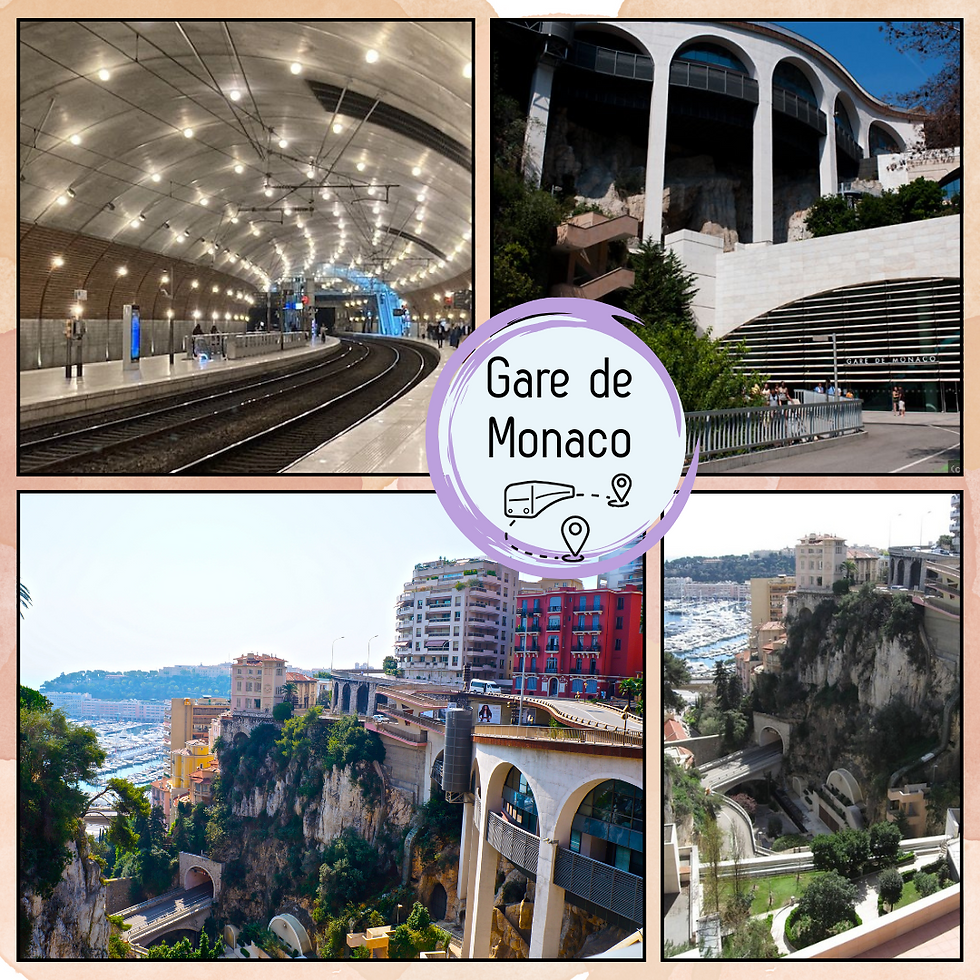
As most people will probably know from images of the famous Monaco Grand Prix, the principality sits perched on the escarpment at the base of the Maritime Alps. Monaco is of course also famous for its casinos, the first of which opened in 1861. This came after Prince Charles III of Monaco granted a charter allowing a joint company to build the casino. The city was soon transformed into a luxury hotspot for the rich and famous. I didn't know this, but the gambling tables are only open to visitors to Monaco. The casino operating company for the whole of Monaco was taken over by the government in 1967.
The population of the principality currently sits at around 40 000, making it the second smallest sovereign state in the world after the Vatican City. The principality is governed by a semi-constitutional monarchy. The House of Grimaldi has ruled since 1297, with Prince Albert II the current head of state.
We started our wanderings by heading down to the port from the train station in the La Condamine quarter. The below photos give a sense of just how hilly it is and how the buildings are all squished together. That's E in the main shot on the left side of the collage as we made our way down loads of steps to the waterfront.

I'd known about the Musee Oceanographique - museum of marine sciences - and wanted to visit it while we were in Monaco. Looking at the middle shot above on the right of the collage gives an idea of where it is located, on The Rock, the land that can be seen jutting out into the harbour in the photo.
We walked along Port Hercule and up to the museum. The harbour is a deep-water port, teeming with fancy yachts, just as I expected it to be. Apparently, the port can accommodate 700 vessels. Port Hercule is a natural bay that was once a trading post used by the Greeks and Romans. The two piers that sit in the harbour today were built in the 1970s to protect the harbour from the harsh easterly winds. Walking along the port made me feel like I was in a James Bond film!

It's only a 2km walk from the station to the Musee Oceanographique but it's rather steep climb. There are buses, but the walk affords beautiful views of the port. Most of the above shots were taken from our walk up to the museum. We stopped along the way when we found a bench and sat and enjoyed our picnic lunch with views.

The Musee Oceanographique was inaugurated in 1910 by Prince Albert I as part of a new Commission dedicated to oceanography. Jacques Cousteau was its director from 1957 to 1988. Before even having the chance to marvel at the museum's collections, the building itself cuts an imposing figure. It is a Baroque Revival-style structure with an 86 metre façade on a building that sits atop a sheer cliff face. The building took 11 years to complete, using 100 000 tonnes of stone brought in from another part of the south of France.
The aquarium in the basement of the museum is the best bit. I've never seen anything like it! There are around 4000 species of fish and over 200 families of invertebrates. Now, I am ideologically opposed to zoos, but I can just about handle an aquarium, especially if there are only little fish swimming around.
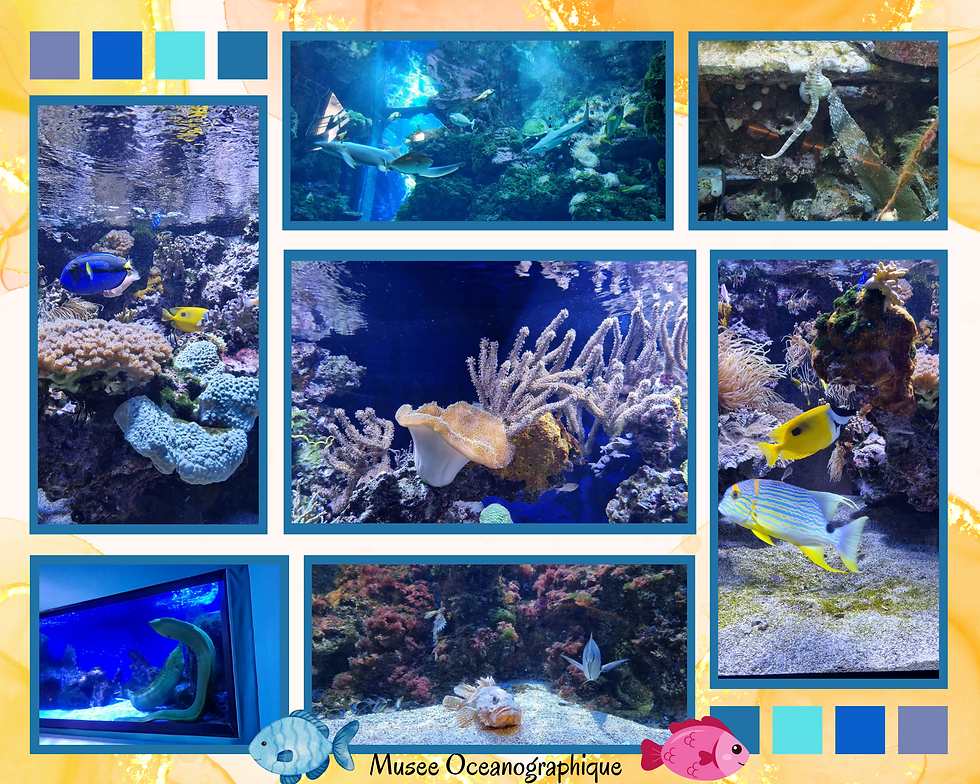
The jellyfish were absolutely stunning. One of the highlights for me. I could have stood for hours watching them. They were completely mesmerising. How cool are my photos! The jellyfish look like floating pincushions of psychedelic dots. Weird but fascinating!

The Sea Turtle Odyssey is another of the museum's highlights. It's an open-air facility accessible from the aquarium, dedicated to preservation of marine turtles. It was so cool to be up close with these magnificent creatures, knowing they were being cared for and rehabilitated while marine biologists learn more about them until they are released back into the wild.

The Musee Oceanographique is absolutely worth a visit. It was the highlight of our day in Monaco. Entry at time of writing cost €22. Oh, and the museum shop has a bunch of beautiful stuff and we had a ball poking around in it. I bought the cute little turtle plush toy and "message in a bottle" mementos in the below collage to remind me of our visit.

The views are also worth the climb up to The Rock. It's actually a rather famous rock, standing 62 metres overlooking the Mediterranean. I understand that the Rock was a coveted piece of land in ancient times and later became the first part of modern-day Monaco that the Grimaldi family conquered over 700 years ago. Today, it forms the oldest of Monaco's four quarters - Monaco-Ville - and the location of the Prince's Palace, home of Monaco's royal family.

Next, we walked back down to Port Hercule and up the other side of the escarpment in principality to the Monte Carlo quarter. I have to admit that it was kind of underwhelming. The buildings are pretty, but gambling and displays of wealth aren't really my thing. We could have explored the quarter further, but we weren't really inspired to do so. I wanted to see the hilly, windy road that often features in films, but that required more walking or finding a bus, and we just didn't have it in us.

We headed back to the train station, stopping along the way for a delicious gelato [the best we had on the French Riviera, I think] and a final glimpse at the beautiful architecture of the principality, away from the fancy yachts and casinos.

Once back in Nice, we took our time to stroll down Avenue Jean Medecin from the central station to our apartment. The "new" part of Nice has a very different vibe to the Old Town. It is the city's main north-south traffic artery and its main shopping street. The avenue runs north from the Place Massena [the square in the below bottom photos] to the central train station. The square and avenue date back to the mid 1800s. There are some lovely old buildings on the street but also lots of fancy shops. I liked the wide, open space in the square, and it forms a nice connection to the Old Town.
Fountaine du Soleil - the Sun Fountain - in the heart of Place Massena is an impressive landmark. There are five bronze sculptures in the basin, representing Earth, Mars, Venus, Mercury and Saturn, and a 7-metre-tall marble Apollo in the centre. The Apollo sculpture was unveiled in 1956 and caused a stir in the city, apparently, as Apollo had four statues of horses on his head. This design was meant to represent the carrying the sun across the sky on a chariot, as the myth goes, but locals thought it looked more the the Renault 4CV, a popular car at the time. Apollo earned the nickname "four horsepower statue". I believe there was also some concern about the size of Apollo's endowment! There's more on the controversy here.

Adjacent to Place Massena is Promenade du Paillon, named after the Paillon River that used to flow underneath. The promenade opened in 2013 after two years of massive works that saw the beautiful park replace an old bus terminal and ugly concrete car park. There are now 12 hectares of green spaces. The "water mirrors" that can be seen in the below shots contain 128 jets that squirt water up to 5 metres in the air. We made a stop there after getting off the train from Monaco and walking down Avenue Jean Medecin. We sat and watched the jets for a bit. There's more detail on the promenade here.

We had found a huge Monoprix on Avenue Jean Medecin. This French supermarket ended up being our go-to place for supplies in Paris. We bought some sushi for dinner and headed back to our apartment for some rest. I'm glad we ventured out to Monaco, and the Musee Oceanographique was an incredible experience, but I wasn't as blown away by Monaco as I thought I'd be. I suppose the principality has an aura of mystique to it - and no doubt it's an unique place - that doesn't quite match up with reality.
Day 4: The surprising gem that is Antibes💓
For our final day on the French Riviera, we decided to take a trip to Antibes. We tossed up between Cannes and Antibes and decided on the latter, as I'd read that Cannes isn't all that much other than the famous annual film festival. As we'd done the previous day, we walked up to Nice Ville and bought our tickets just prior to travelling. We had no trouble obtaining last-minute tickets for the next service, and the train wasn't as busy as our Monaco experience. We paid around €14 each for a return ticket for the 20-minute journey each way, but again, tickets are much cheaper if purchased in advance.
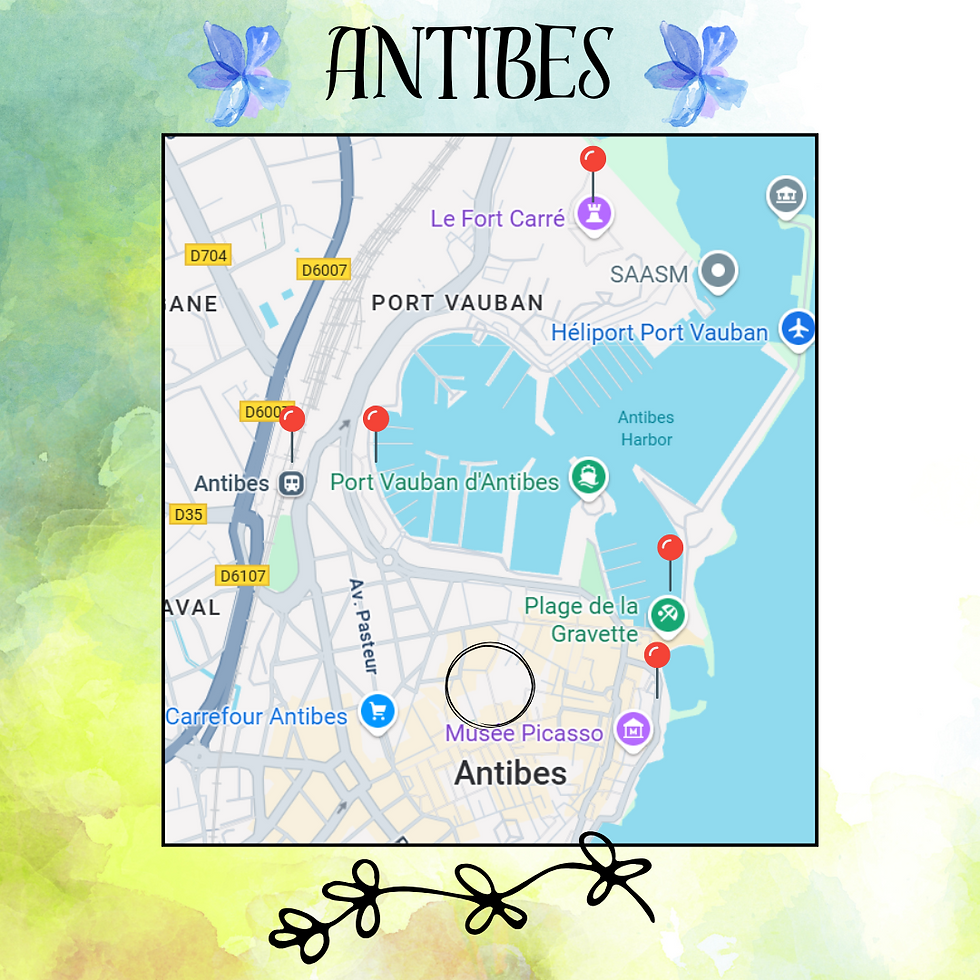
I've marked our journey on the below map. Nice is pretty much in the middle of the key places to visit on the French Riviera. I've marked Eze and Monaco and the Italian border for perspective.

Gare d'Antibes, like the central stations in Nice and Monaco [and the bus drop off at Eze], is a short walk to the centre of town. We headed towards the harbour first and the city ramparts. The walls were built in the 10th century to protect the residents from invaders. They are surprisingly well preserved considering their age and it's possible to climb up in several places for fabulous views of the Mediterranean. So cool to be standing on something with so much history!

As the top two shots of the below collection show, the ancient city walls extend along the coastline. There are loads of beaches in Antibes and its surrounds. This is pretty Plage de la Gravette. There's only a small patch of sand tucked away behind the ramparts at the end of the port, but it's sheltered and close to the centre of town.

We found a lovely bakery on our wanderings and bought delicious sandwiches that we sat and ate as we soaked up the vibe. It was quiet and peaceful and I just loved the stone houses we saw on our wanderings. Antibes seemed like the most liveable of the four places we experienced on the French Riviera.

We continued strolling along Promenade Amiral de Grasse that extends from Plage de la Gravette to and beyond the Picasso Museum, the top of which can be seen in the below left hand photo. Entrance to the museum at the time of writing cost €12. The museum is built on the foundations of the ancient Greek town of Antipolis and was formerly the Chateau Grimaldi. Apparently, it has one of the world's greatest Picasso collections. I am writing this post two and a half years after our trip and I have no notes on why we didn't got into the museum. If my memory serves me right, I think the museum must have been closed. I am sure we would have gone in had it been open!

Not to worry, we headed into the main part of the town in the early afternoon and by then it was buzzing along Rue de la Republique and in Place Nationale. There are beautiful buildings that surround the square, lots of open air restaurants, a rotunda, and a 5-metre high white stone column that was gifted to Antibes by King Louis XVIII. We had a poke around the shops and little alleyways that led into the square. Later, we bought a delicious gelato [below bottom shot] from Gelateria Italiana and sat in the square to people-watch while we ate.

We made our way slowly back to the train station, stopping to chill out at the beautiful harbour. Port Vauban was once a natural harbour and has been in use since before the Roman Empire. The port was fortified in the 17th century by King Louis XIV's military engineer. It is now the largest marina in terms of total tonnage of the boats and yachts moored there in the Mediterranean, with capacity for up to 1500 moorings.
My photos go a little way to show how beautiful Port Vauban is and on a sunny Thursday afternoon, it was remarkably quiet. I can't really explain why, but Port Vauban doesn't have the same over-the-top wealth vibe as Port Hercule in Monaco even though there are clearly a load of extremely expensive yachts moored there.

The fort that can be seen in the distance in the above top shot and the one below is Fort Carre. Entrance at the time of writing cost €5 but it does close to visitors during bad weather. The fort was one of the first fortified strongholds built during the Renaissance in the 16th century by order of King Henri II to fend off border threats from the Duchy of Savoy. The design is of a star with four arrowhead-shaped bastions and the fort stands on a 26-metre-high promontory. In the 19th century when Nice was annexed to France, the fort was rendered obsolete and was officially decommissioned at the start of the 20th century. I understand that soldiers were briefly stationed there during WWI, although the fort had already been listed as a historical monument in 1906. For the film buffs, Fort Carre is the villain's fortress in the 1983 James Bond film, Never say never again. Cool.

We calculated it would be an hour's walk there and back so we decided just to sit and enjoy the view of the historic structure with the city ramparts in the foreground. I absolutely loved Antibes and we had a lovely day out, just wandering around taking it all in. Antibes is easily walkable and a nice way to spend a day on the French Riviera. I've marked the train station, the port, Plage de la Gravette and Place Nationale [circled in black] that we visited, as well as the fort and the Picasso Museum.
This is my Antibes memento, bought from one of the cute little shops that line the streets leading into Place Nationale. It perfectly sums up the unique landscape of Antibes and the views I remember from our wanderings.

Our final French Riviera experience was a sunset stroll along La Prom. Here are some lovely shots from our wanderings. Not as stunning as other sunsets I have experienced - and nothing like the one we were to see the next evening in Riomaggiore at Cinque Terre - but pretty just the same.

Here are some images from our wander back to our apartment, our final glimpses of the beautiful Old Town of Nice.

That was it for our adventures on the French Riviera! After Paris, it was such a change of scenery and vibe. I hadn't been to Nice or any of the French Riviera towns previously, so it was nice to experience somewhere completely new to me. My reflections on what our French Riviera experience meant to me are posted below this shot of my Nice memento, purchased from one of the many souvenir shops in Place Rossetti. Nice, you sure are pretty...


The French Riviera is a beautiful part of France and I feel so lucky to have had the privilege of experiencing it. Once in Nice, the towns along the coast are easy to get to by train and a short walk from each central station into the heart of things. We loved staying in the an apartment in an old building in the Old Town and being able to walk and take the train. The apartment was the perfect sanctuary at the end of days full of wanderings.
I loved our other three French Riviera experiences for different reasons. Each place we visited had its own unique beauty: The Musee Oceanographique in Monaco, the tiny medieval village of Eze and the beautiful views of the Med from the Nietzsche Trail, and finally the glorious harbour, city ramparts, stone buildings, and pretty beaches of Antibes.

I had no real expectations of Nice. I certainly wasn’t prepared for how much I would love the Old Town. The historic, earthen tenement buildings, the narrow streets, and the pretty promenade are simply stunning.
Nice was our third stop after two weeks away from the familiar and I am proud of us for keeping up the pace and embracing each new experience.
We spent most of our time outdoors and were so fortunate to have lovely weather for an October visit. I truly feel at peace in beautiful natural surroundings.

Staying in an apartment in a 200-year-old building in Nice Old Town was lovely: Watching the town wake up each morning, seeing neighbours' washing hanging from their balconies, and buying fresh bread from nearby bakeries. Oh, and the delicious gelato!
The whole vibe of Nice [and Eze and Antibes] after being in Paris: Friendly people, clean air, the Med, and a warm and relaxed atmosphere.
Antibes: I could so easily live there!
Where to next?
Our next stop was Cinque Terre, a place I'd long wanted to visit as it felt like it has a kind of magical quality that intrigued me. We took the train from Nice to Riomaggiore to continue our adventure.


Comments