Paris wanderings: Third time's a charm
Updated: Jan 7

The Second Great Girls' Adventure series
This post is part two of a series of five that document the Second Great Girls' Adventure, a trip my daughter E and I took in October 2022. Our adventure included Amsterdam, Paris [this post], Nice, Cinque Terre and Milan [in that order]. Each place in this incredible list has its own post. I had been to Amsterdam and Paris previously, but was keen to experience both cities again, this time in more depth. Our other three destinations were new to me, so I eagerly awaited those experiences.

A little bit of background📝
Our first Great Girls' Adventure took place in 2015, when E was turning 15 and just about to embark on her final two years of schooling. We were fortunate to experience Türkiye, Greece and Romania on that trip. This time, our Great Girls' Adventure was a belated celebration for our two milestone birthdays [21 and 50] that came and went during the pandemic. Our second Great Girls' Adventure saw us in Europe for three weeks in October 2022, flying into Amsterdam and out of Milan with Qatar Airways. There is a bit more background to our trip in the Amsterdam post.

This second adventure was special as E was an adult this time [almost 22 by the time we embarked on our adventure]. We shared the planning and expenses, travelling as companions and enjoying each other's company and the wonders of the places we visited. This trip was also a bit less stressful for me as I didn't feel solely responsible for everything. E navigated us around like a boss! Looking back now as I write this post in 2025, we had an incredible experience and I will be forever grateful for the opportunity to travel again with my daughter.
This post is all about my third visit to Paris, and finally my chance to do deeper. Paris was our second destination on our Great Girls' Adventure. My post about our first stop - Amsterdam - is here. We loved Amsterdam so we were a bit sad to leave, although E was super excited about Paris and her desire to experience the city is why we added it to our itinerary. I was more measured in my excitement as Paris just hadn't vibed with me on previous visits. I was hoping the reality would live up to E's expectations. I was keen myself to see how I felt about the city with a chance to properly explore it this time.

Travel to Paris from Amsterdam🚆
We checked out of our hotel in Sloterdijk at 9am and caught the train one last time to Amsterdam Centraal. Our Thalys train wasn't due to depart until 11.30am so we had a coffee/chai in the Starbucks at the station and just chilled for a bit. It was easy to find our platform despite the vast size of the station and soon we were whizzing our way to Paris, armed with Pringles and sandwiches for the journey.

Train travel in Europe is incredibly efficient and inexpensive compared to where we live in Australia. The huge distances between places in Australia makes internal travel expensive and time consuming. The trip from Amsterdam to Paris takes around three to three and a half hours and it only cost us $128AUD for both tickets. E was about to turn 22 on this trip, so she qualified for youth tickets, and that admittedly kept the cost low. I booked in advance, another way to save on the cost.
We arrived at the Paris station at Gare du Nord and felt slightly overwhelmed in the busy station and a new country, having gotten used to the ambience of Amsterdam and feeling relatively safe travelling on our own. We decided to walk to our Airbnb apartment at 46 Rue des Poissonniers as Google Maps told us it was only 1.7km and a 20-minute walk. The walk was fine, but it was the slight feeling of discomfort that was the tricky part. There were groups of men standing around on the street staring at us and calling out, and we started to get nervous about where we'd be staying.
The apartment we'd rented had lots of positives and I want to talk about them first. It is in a good spot for its 18th arrondissement location, with a metro station at both ends of the street and several supermarkets close by. Once off the street, the apartment is safe and quiet with everything we needed. We paid $880AUD for five nights, so much cheaper than Amsterdam. The below photos show that the place was compact but suitable for just the two of us. The apartment looked liked it had been fairly recently renovated and was clean and tidy. E slept in the loft bed [top two photos below], and I slept on the sofa bed underneath.

The apartment is described on Airbnb as being in a multicultural and busy area, with this caveat: "If you don't like this kind of neighbourhood, we are afraid you might not enjoy our place." This description is accurate, but what it doesn't really say is that the cultural difference - men in groups on the street all the time, giant slabs of meat hanging in shops, loads of browning, motley vegetables on display - might not be your jam. I've since noticed other reviews from women who have commented on feeling unsafe, and I would tend to agree. That said, I don't think it was an actual safety issue, just the perception of one, because of all the men hanging around. We were fine, but I was always glad to be safely inside the apartment when we returned at the end of the day. We took to using one of the two available metros - Barbes-Rochechouart - as it was down the quieter end of the street. And things felt less daunting once we were off Rue des Poissonniers.
I've been using Airbnb for ten years and never had an issue with the places I've booked. The Paris apartment would rank at the bottom of my list, although it was pretty cheap, so our expectations shouldn't have been high. Overall the apartment was a little dark and damp inside. The bathroom design meant the water from the shower didn't run off properly so it was constantly wet in that room. I did some washing on our second day and it took the rest of our stay to dry. But, hey, we were in Paris!
Our first taste of Paris🎇
After we'd settled into the apartment, we braved Rue des Poissonniers and walked through Montmartre to the Sacre Coeur. The magnificent church was only 850 metres from our apartment! We felt a bit less overwhelmed once away from Rue des Poissonniers and I was hoping that first impressions of Paris didn't dampen E's spirit too much. I mean, Montmartre is a lovely part of Paris, I think. Here are some shots from our walk to Sacre Coeur.

I first saw the Sacre Coeur in 1996, on my first ever international wanderings. It was nice this time to have a proper chance to take in the church and the beautiful views of the city. The proper name for the Catholic church dedicated to the Sacred Heart of Jesus is the Basilica of the Sacred Heart of Montmartre [Basilique du Sacre-Coeur de Montmartre], located at the summit of Montmartre Hill. The neo-Byzantine-Romanesque basilica began construction in 1875 and was completed in 1914 but not formally consecrated until after WW1, in 1919. The basilica was placed on the French national historic monument list in 2020.

Sacre Coeur has free entry and I believe it is possible to climb up to the Dome for views of Paris. We were on an Eiffel Tower mission that afternoon so decided not to take a look inside. Standing at the foot of the basilica and seeing Paris spread out below only intensified E's desire to experience the Eiffel Tower!
Firstly, we walked down the Rue Foyatier, most known for the long staircases leading down [or up, depending on perspective] from the Sacre Coeur. The street was named in 1875, after sculptor, Denis Foyatier [1793-1863] and is now one of the most visited streets in Paris. There are 222 steps although there is also a funicular. That's E in the top shot, making her way down the stairs. So pretty!

We had planned to cross the Arc de Triomphe and Eiffel Tower off our list on that first afternoon so we took the metro from Pigalle, around 800 metres from the bottom of Rue Foyatier [middle map pin], to Charles de Gaulle-Etoile [left side map pin], one of the closest stations to the Arc de Triomphe and only 10 minutes on the train from Pigalle. These pins map out our journey on that first afternoon, a total trip of just over 20 minutes. Cool, hey! [I've added a third pin to the metro map to show Barbes-Rochechouart, the station at the end of Rue des Poissonniers that we used during our stay.]

This was our first metro experience. I'd previously only taken the Paris metro once before, in 2015 when I was in the city for one day for work and that was with the student we interviewed for our project who lived in the city. My impression that day was how complex the system seemed. E took it all in her stride and we became experts at navigation by the end of our stay. I'm so proud of E for her bad-ass navigation and proud of us for mastering the Paris metro.
The above graphic gives something of a perspective on the metro system. Look at that crazy map! It does seem super complex, but a basic understanding of how it all works is all that is needed. There are 14 lines, shown by the numbered list below [plus the two "B" lines for 3 and 7]. That's the metro system. Then there are five RER lines from A-E that form the regional system. The metro and RER lines intersect, but we only used the RER once, to go to Versailles [RER C] as the palace is outside of the metro area.

The ticket that I've included in the above collection is the kind that we used for our stay. At the time [October 2022], books of tickets - a "carnet" - could be purchased from all metro stations. Each journey in Paris is €2.50 no matter the distance, although buying a carnet of 10 tickets as we did reduced the cost. The paper tickets are being phased out as I write this post in 2025 with the introduction of the Navigo Easy card [like the Oyster card for use on London transport] and a new ticketing app
OK, so we were super excited to have used the metro for the first time without incident and even more excited to see the Arc de Triomphe right in front of our eyes as we stepped out of Charles de Gaulle-Etoile station. Here it is in all its glory.

I'd seen the Arc during our 1996 visit, but only from the bus as we whizzed by on our Trafalgar tour. I was so thrilled to see the structure up close this time, even if we didn't go inside. At the time of writing, entry costs €22. I am sure the views are spectacular from the top [noting there are 284 steps up there], but I was happy to see the magnificent structure up close this time. It's rather impressive, standing 50 metres high and 45 metres wide. The monument was built in neoclassical in design, with high-relief sculptures celebrating military victories on the facades of its four pedestals.
The proper name of the monument is the Arc de Triomphe de l'Etoile. It is located at the western end of the Champs-Elysees at the centre of the Place Charles de Gaulle, once called Place de l'Etoile. The structure stands at the juncture of twelve avenues that radiate from it to form a star, an etoile. The monument honours those who died in the French Revolutionary and Napoleonic Wars. There is a Tomb of the Unknown Soldier that lies beneath its vault. The Arc de Triomphe was commissioned in 1806 by Napoleon and completed in 1836, 15 years after Napoleon's death.
The Arc de Triomphe is known for being a rallying point for Bastille Day parades and the end point of the annual Tour de France. During WW2, victory marches were conducted around the Arc: in 1940 when the Germans took France, in 1944 after Paris's liberation, and in 1945 after the end of the war in Europe.

Below is my one shot of the Champs-Elysees, the view of the famous street from the Arc de Triomphe. It's rather a lovely street, but I've walked up and down it before, and E was too keen to get to the Eiffel Tower to be concerned about exploring it further.

We decided to walk to the Eiffel Tower from the Arc de Triomphe, around 2.5km. Our goal was to see sparkly Eiffel! We hadn't eaten since our sandwiches and Pringles on the train from Amsterdam earlier that day, so we decided to stop for dinner.
This was our dinner with a view! We found a restaurant and sat on the pavement while drinking in the view of Eiffel. The below shot shows what E had; I can't even recall now what I ordered, just that the food was pretty ordinary and hugely expensive. It was actually the only time we ate dinner at a restaurant the whole trip.

Here are some shots of the famous Tower as we approached it on our walk. I'm really glad we decided to walk as the view of the Seine is lovely from the side from we approached the Tower. The trees that line the river are so pretty.

Being up close to the Eiffel Tower is a pretty special experience. This was my second opportunity to see it all lit up, but this time I had a proper chance to take it all in. We sat on the grass on the Champ-de-Mars with a bazillion other people and waited for darkness and the lights to come on. Such a cool experience.

We were more than content to see the Tower all lit up at night and didn't bother with tickets to visit the top. I had been up the Tower on my first visit, albeit way back in 1996, anyway. At the time of writing, it is possible to visit the second floor or the summit, at a cost of €27.50 for the former and €36.20 for the latter. Unlike a lot of other museums and monuments, it is possible to buy tickets on the day, but I imagine lines are long in peak seasons. The better option is to purchase a timed ticket online.
Some facts☑️
The Eiffel Tower is 57 metres at the first floor, 116 metres at the second, and 276 metres to the top [the summit]. There are stairs only to the first floor, stairs and a lift to the second, and a lift to the top. You might know the history: a competition was launched in 1886, the 100th anniversary of the French Revolution, for the 1889 Exposition Universelle. Gustave Eiffel, an entrepreneur, together with two engineers and an architect, had their design accepted for the project.
First construction works began in January 1887 and the Tower was completed in March 1889. The official website has a bunch of interesting facts, for example there are 18 038 metallic parts in the Tower, 2 500 000 rivets were used in its construction, 7300 tonnes of iron, and 60 tonnes of paint. Amazing!
Here is Eiffel, in all its sparkly glory. It really is a magnificent sight, all lit up at night. There's a cool light show as well, something I don't remember from my visit, but that was a LONG TIME ago.

This is my second favourite shot of the two of us on our Great Girls' Adventure, after our Amsterdam sunset picture. E, me, and a sparkly tower. Awesome.

Travel tip🌏
If intending to sit in Champ-de-Mars and wait for the light show, come prepared. We saw people with food and picnic blankets. Luckily we had our coats with us to sit on, but I do wish we'd thought things through a bit more. Definitely bring your own food and drinks! Despite our lack of planning, the whole experience was incredible and I am so glad I got to share it with E.
We walked back to the Arc de Triomphe after the light show ended and took the metro from Charles de Gaulle-Etoile back to our apartment. E stopped on the way to buy a crepe - with nutella, no less! - from one of the many stalls found across Paris. I desperately needed the loo, but couldn't find any public toilets. I asked a maître-d'hotel outside a posh restaurant if I could use the toilet. She said I could, but didn't look pleased, and coolly told me the privilege of using the loo would cost €2. I didn't care about that, but I didn't have any cash on me. I passed a bartender downstairs on my way to the loo and he just waved me on. When I came back upstairs, I spoke again to the maître-d'hotel and humbly explained I didn't have any cash. She literally looked down her nose and me and gave me a dismissive wave before saying "you can go". Alrighty, then!

Here's the incredible Arc de Triomphe after dark. I'm also glad we got to see it at night. I love this shot, with the trees framing the monument. We had no trouble finding our way back and felt perfectly safe walking the streets in that part of Paris after dark.

Here's a shot of a beautiful door that I spotted along the way. I love old doors! It had been a long day, and hard to believe we'd woken up in Amsterdam and were now in Paris. The culture shock of the location of our apartment had knocked us about a bit, but we were excited for the next four days of Paris wanderings.

The below map gives a bit of perspective on where we were on Day 1. I've marked the apartment near the Sacre Coeur. I've also marked the Arc de Triomphe and Eiffel Tower. All three iconic landmarks we visited on that first afternoon and evening.

Day 2: Seine wanderings, a garden picnic lunch, and Galeries Lafayette views🪷
Day 2 in Paris started with a walk to an Aldi we found near our apartment for grocery supplies. Aldi! In Paris! The Aldi was a bit ordinary and kind of shabby, actually. That said, we found all we needed for a couple of days of groceries.

After stocking up and packing a picnic lunch, we took metro line 4 from Barbes-Rochechouart to Cite, one of the stations close to Notre Dame. This was only a 15-minute journey, from the 18th arrondissement to the Ile de la Cite in the 4th. The below map shows our journey on line 4, from the top map pin to the bottom one. It also shows our journey in the afternoon when we returned to the apartment from the Opera House [middle map pin to the top map pin]. Taking metro 12 from Saint-Lazare near Galeries Lafayette to Marcadet-Poissonniers, at the dodgy end of our street, is only a 10-minute trip.

Notre Dame was closed at that time after the fire in April 2019 that destroyed the spire and roof and caused extensive damage to the interior. Scaffolding can be seen in the below shots.

This was my second go at experiencing the cathedral but still no opportunity to see inside. Not to worry, it's pretty impressive from the outside! Notre Dame was built in the 12th century, modified in the 18th and restored in the 19th. It was damaged way before the 2019 fire - during the French Revolution - and restored following its resurgence after Victor Hugo published The hunchback of Notre Dame. The cathedral has been classified a UNESCO World Heritage Site since 1991.
The official website has lots of interesting information about the cathedral's architecture and construction. Notre Dame was built in stages, starting with the laying of the first stone in 1163 and finishing with construction of the upper part of the façade and the two towers in 1250. Then there was a second period of construction between 1250 and 1363 that included the north façade and south transept. How cool is that?
Our wanderings then took us along La Seine to the Louvre, about a 20 minute walk. It was a beautiful day and we had a lovely time wandering along the river, strolling down Voie Georges Pompidou after crossing Pont d'Arcole. Ile de la Cite, where Notre Dame sits, is actually a natural island in the centre of Paris. It is known as the epicentre of Paris and is possibly the site of the earliest settlement in the city. Adjacent to Ile de la Cite is the other natural Seine island, Ile Saint-Louis.

I remember how much I loved the Seine bridges the first time I went to Paris. We didn't see any of the bridges with the gold-plated decorations on our wanderings, but we did pass the famous Pont Neuf bridge [middle shot].

Our second day in Paris gave us our first chance to see the Louvre. We planned to visit the museum the next day, but couldn't resist checking out its exterior on a beautiful late morning in the city. The Louvre Pyramid is kind of cool, but equally impressive are the courtyards on which the Louvre sits - the Cour Napoleon and the Cour Carree. The Louvre Palace is the name of the gorgeous buildings that line the courtyards, including parts of the original medieval Louvre.

Adjacent to the Louvre is the famous Jardin des Tuileries. The park has a 500-year-old history, once a royal and imperial playground. The tile factories, or tuileries, that had stood since the Middle Ages gave the garden its name, constructed as part of the new royal residence for Queen Catherine de' Medici in 1564. The garden was later redesigned by Louis XIV in 1664 but in 1871, it was finally opened to the general public. The royal palace was burned to the ground by rioters protesting royal and imperial power during the Paris Commune uprising in 1871. Sadly, the palace was never rebuilt, but the garden has survived.
We had a lovely picnic lunch in the gardens. With our Aldi food... King Louis XIV would turn in his grave if he knew, considering he kept the park for the pleasure of royalty and "respectable people" until it was deemed the common folk could also enjoy it.

Here are some more shots of our post-lunch wanderings around Jardin des Tuileries. It's big - 28 hectares in all - and there are three different parts to it. There's The Grand Carre, with its ponds and garden beds, The Grand Couvert, the wooded part, and the Octogone, an open area surrounding the Grand Bassin. It's all very pretty.

The obelisk in the bottom right photo in the above collage is in Place de la Concorde. This is a large public square at the end of the gardens, the largest square in Paris, occupying 7.6 hectares. The square was built to glorify King Louis XV but during the French Revolution, a number of royalty were executed there, including Louis XVI.
From the Place de la Concorde we walked a further 20 minutes to the Galeries Lafayette, adjacent to the Palais Garnier Opera in the 9th arrondissement. The shopping mall at Paris Haussmann is super posh but the first reason to go there is to check out the art nouveau design of the building and the magnificent dome inside. The second reason is for the views of Paris from The Terrace on the 8th floor. Better still, it's free!

The now international chain of stores dates back to 1893 when the first store was opened, by two cousins from Alsace, selling novelty gifts. The Boulevard Haussmann store opened in 1903. Renovations in 1907 saw the inclusion of the 43 metre high neo-Byzantine dome and then the store was renovated in art deco style in 1932. The original owners were replaced during Nazi occupation of France with non-Jewish owners and over 100 Jewish employees were forced to resign. The store's website says that the stores have been family-owned for five generations but makes no mention of whether the original owners got their company back after WW2.

As can be seen from the above collection, Galeries Lafayette Paris Haussmann is in the perfect spot for spectacular views of the Paris Opera House. We were fortunate to take in the view on a beautifully warm and sunny day. It is also possible to see the Eiffel Tower and the Sacre Coeur from the 8th floor terrace. Just look at these beautiful shots!

I have been to the store twice before but I had no idea about the Terrace. It's an absolute must-do, I think, as the perspective on the building's dome and the panoramic views of Paris are worth a visit, especially since there's no entry fee to reach The Terrace.
We'd had a lovely day wandering around Paris on day 2 in the city. We were happy to head back to our apartment to make dinner from our Aldi supplies and indulge in a bit of Netflix and chill. Here are some more shots of our day's wanderings.

I've put together the below graphic to give perspective on our wanderings. I've ticked off the Sacre Coeur, Arc de Triomphe and Eiffel Tower from our first day's wanderings and circled the places we experienced on Day 2. Remember that our apartment is located just to the right of the Sacre Coeur on this map. It all looks quite spread out, but it's not, really. We walked between all the places I have circled.

Day 3: Two Paris icons: The Pantheon and The Louvre⛪🎨
We spent the morning of our third day in Paris experiencing the stunning Pantheon in the heart of Paris's Latin Quarter in the 5th arrondissement, atop the Montagne Sainte-Geneviève. I had previously visited the Pantheon in Rome [also stunning] but not the monument in Paris. Timed entry isn't a thing at the Pantheon but tickets can be pre-purchased online. We bought ours at the tickets office on the day. We were there on a Friday in October and it wasn't too busy. At the time of writing, tickets cost €16 for entry to the nave and crypt and the Pantheon Panorama.
This time we had to take two metros to get to our destination: from Barbes-Rochechouart [1] on metro line 4 to Odeon [2], then line 10 to Cardinal Lemoine [3], a 550 metre walk from the Pantheon. All up, the journey was still only 20 minutes. The below metro map also shows our journey back to the apartment in the afternoon, from Les Halles [4] on line 4 near Tuileries.

The Pantheon is an absolutely magnificent structure. The architecture mirrors the Roman Pantheon with its neoclassical façade and French Gothic interior.. The Pantheon has a super interesting history. King Louis XV fell quite ill during the War of Austrian Succession in 1744 and it is said that the patron saint of Paris, Saint Genevieve, was instrumental in his recovery. Once recovered, the King embarked on a pilgrimmage to the Saint-Genevieve abbey in the mountains of the same name, where he promised the monks there that he would reconstruct their ancient church in Paris. The King himself laid the first stone of the Pantheon's construction in 1764.

So, the spectacular Pantheon that can be seen today started out as the Saint Genevieve church, designed by Jacques-Germain Soufflot, a young and unknown architect hand-picked by the King. The original design was a Greek cross plan with a triple dome. Sadly, Jacques-Germain died before the monument was completed. His colleague and one of his students took over the project until construction was finished in 1790. The Pantheon was the highest point in Paris until the Eiffel Tower was constructed in 1889. The transformation to a pantheon ["temple for all gods"] took place over 200 years, from the French Revolution to back to a Catholic church under Napoleon's rule, and the final switch during the Third Republic in 1885.

The interior of the Pantheon is vast and beautiful. The interior is decorated with frescoes, mosaics and paintings of Saint Genevieve and key moments in French history. But of course the three domes that fit within each other are the main feature. I stood in awe of them as wandered around. The main dome reaches 83 metres, compared with the tallest dome in the world, St Peter's Basilica in Rome that stands 137 metres.

It's also rather cool to visit the crypt where many famous French people are laid to rest within its walls, including Victor Hugo, Alexandre Dumas, Jean Jacques Rousseau, Voltaire and Emile Zola. Women were not interred in the crypt until 1995, when Marie Curie was given the honour of being the first women interred on merit.
The Pantheon also affords spectacular views of Paris. There are 276 steps to the top, divided into three flights with a spiral staircase for the final section of the climb.

I wish we'd had a bit more time at the Pantheon as our visit seemed rushed and I was content wandering around the massive interior and taking it all in. We'd pre-purchased a timed entry ticket for the Louvre while we were in Amsterdam so we needed to get ourselves to the museum on time for that. We decided to walk - a 3km jaunt - stopping on the way for a delicious ice cream to keep us going.
OK, so we arrived at the Louvre well in time for our timed entry. There was still a bit of a line-up, but it didn't take long to get inside. There are actually three entrances into the museum - the Pyramid, Richelieu, and Carrousel - but the Pyramid is the main entrance.

The Louvre was once a 12th century fortress designed to protect the western edge of Paris. This fortress was demolished in the 16h century and the Louvre rebuilt as a royal residence in Renaissance style, like the adjacent Tuileries gardens. The core of the current collection is still made up of art collected in the 16th century by King Francis I. The museum became a public art museum in 1793. It now houses artworks spanning the 7th millennium BC to the 1850s.
The place is huge, occupying five levels named after prominent French historical figures: Sully [1559-1641], chief minister of King Henri IV, Richelieu [1585-1642], chief minister of King Louis XIII, and Denon [1747-825], the first of the museum's directors. We were there for hours, but I am quite sure we didn't see it all. That said, gigantic museums overwhelm me a bit, and I find I get lost in a sea of paintings and sculptures. It can also be exhausting battling the crowds.

Anyway, our visit got off to a terrible start. We descended from the Pyramid to the main entrance hall and attempted to scan our tickets to get through the barrier. Nope. Didn't work. We had no idea why, so we asked an attendant. Complete embarrassment ensued, as it turned out we had gotten the date wrong. OMG. We'd purchased tickets for the previous day and in our holiday fog, had lost track of the days. I can't believe we stood outside the museum the day before, not realising the date of our tickets. We tried to plead our case at the ticket booth - surely they could tell we hadn't used the tickets - but to no avail. Costly mistake! [At the time of writing, tickets cost €22, so not too bad, but still...] And mortifying for me, as an organised person!
Still, it was pretty cool to visit the world's most famous museum. It was kind of overwhelming, though, as I mentioned above, and I was still reeling from our ticket error as we wandered around.
Of course we made our way to see the Mona Lisa. I feel very privileged to have had the opportunity to see what is arguably the world's most famous painting. That said, our experience was like everyone else's, I'm sure, jostling the crowd to get a glimpse of the quite small painting. The artwork is behind bullet-proof glass and there's a barrier in front of it. The below shot that E took has light reflecting off it from the glass. It's not a quiet, contemplative experience so it does feel more like ticking a bucket list item off than experiencing the painting itself.

Here are some of the other magnificent artworks that I captured on that day. I still think it's worth visiting the Louvre - even if the Mona Lisa experience might be underwhelming - and I'm glad we persevered. Other than the crowds at the Mona Lisa, it wasn't too busy during our October visit.

We found a Starbucks near the Louvre [there's one inside as well] and grabbed a coffee/chai and went back to Tuileries for a late picnic lunch. We wandered around the 1st arrondissement for a bit then took metro line 4 back to Barbes-Rochechouart, about a 10-minute train ride. We discovered the French supermarket, Monoprix, at the near the metro station at the good end of Rue des Poissonniers and shopped there for supplies for the remainder of our stay. I love European supermarkets!
Here are some shots from our wanderings. Paris was growing on me and I did change my impression as our stay wore on. The other two times I had been to the city were rushed experiences, and this time it was nice to be able to wander around. I think we did a good job of seeing some of the city's iconic places and just wandering around soaking up the vibe.

Here's a map of our Day 3 wanderings. I remember feeling in awe that we'd mastered the metro, but it's actually not that complicated! Our journey in the morning took us on line 4 to Odeon then a change to line 10 to Cardinal Lemoine to go the Pantheon. In the afternoon, we found a station near Tuileries [Les Halles] that is on line 4 and took it straight back to our apartment. Still, I felt proud of us for jumping in and taking on the metro!

Day 4: An unashamedly gaudy palace👸🏼
Our fourth day in Paris was spent outside of the metro area at the Palace of Versailles. I had long wanted to visit the Palace so I made sure to book tickets before we left Australia. We paid €28.50 each for a passport ticket that gave us access to the whole estate. I checked the website to write this post and those tickets are now €32 so it's not a cheap thing to do. It is possible to buy tickets just to the Palace or to The Estate of Trianon, but if making a day of it, the passport is the best option. There are extra things that can be purchased as well, like a row boat ride on the Grand Canal. Tickets need to be pre-purchased for a timeslot. Ours was 11am but we still lined up for a bit. All pre-purchased timed entry tickets are valid for half an hour either side of the allotted time.
I've marked the location of Versailles on the below map. It's a mud map attempt to show the location, west of Paris, in the department of Ile-de-France. For perspective, the estate is around 22km from the centre of the city.

We took the metro and the RER [regional line] to get to Versailles, a trip of around an hour each way. We were able to take metro line 4 from our apartment to Saint Michel and switch at that station to RER C to Versailles. The RER was quite busy that morning, and most of the people got off where we did, at Versailles-Château Rive-Gauche station. We followed the crowd, all walking en masse to the estate, around a 10-minute walk.

We wandered around the Palace first as that is where we entered the estate. It was completely as I expected it to be: elaborate and ostentatious. The below shots only go some way to capturing the Palace in all its unashamed gaudiness.

The Palace has its history beginning in the 17th century. It was a hunting lodge at first, then a seat of power, and then from the 19th century, a museum. The place is massive, spanning 800 hectares that includes the Palace, gardens, a park, and the Estate of Trianon. The official website gives the full story of the Palace's history.
There are over 60 000 works of art within the walls of the Palace, spanning the history of France from the Middle Ages to the 19th century. Here are just a few of the glorious paintings we saw during our visit.

There are also lots of interesting treasures on display. The Palace is a combination of a palace in the sense that the rooms are set up with period furniture - as shown in my photos above - and a museum, like the things in the below collection. The dress shown below belonged to Marie Antoinette. The clock-chair is Passemant's astronomical pendulum. Cool.

Perhaps the most famous room in the Palace of Versailles is the Hall of Mirrors, a grand Baroque-style gallery. The Hall is 73 metres long and pays tribute to the political, economic and artistic successes of France. It is said to be a grandiose statement about the absolute power of King Louis XV. France's successes are represented by the painted compositions on the vaulted ceiling and by the 357 mirrors that adorn 17 arches opposite the windows. It was in the Hall of Mirrors that the Treaty of Versailles was signed on 28 June 1919, ending the First World War. The room has been used as a venue for important state functions for hundreds of years.
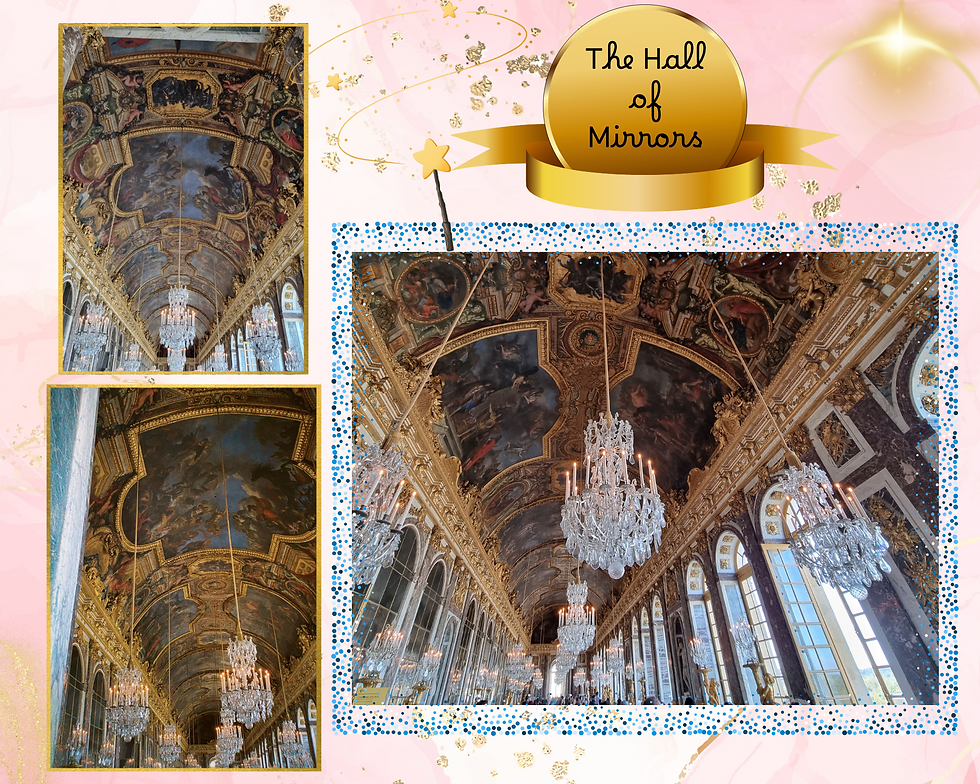
I have to say, I had to stop and pause and realise I was in the Hall of Mirrors. The Palace is such a feast for the senses and gaudiness reigns supreme, so it's a bit hard to tell one sparkly bit from another. I think I was expecting the "mirrors" to be like those distorted mirrors found in sideshows. I'm not sure why I thought that! I think the paintings on the vaulted ceilings are more impressive than the mirrors themselves.
The grounds of the estate are absolutely HUGE and we only saw a portion of the entire thing during our visit. We sat on some steps just outside the Palace to eat our picnic lunch, along with a bunch of other visitors who had the same idea as us. It was rather nice for our eyes to have a break from all the gaudiness inside the Palace and sit and eat with views of the stunning grounds. I'm also glad we took our lunch as there are a few places to eat on the estate, but they were crowded and I imagine quite expensive.

I hope these shots give some idea of the size of the grounds. They are beautiful, with little wooded groves, landscaped gardens, three parterres - ornamental gardens with paths between the beds - with two large rectangular pools, and several impressive fountains.

We wandered around for ages and then found an ice cream shop for a pit stop with a view of the Grand Canal. It was nice to sit in the warm afternoon sun and people-watch for a bit. Here is where row boats can be hired.

This map gives some perspective on the size of the estate. I've circled the Palace at the bottom of the map, the part of the Grand Canal where we sat and ate our ice creams in the middle, and the Estate of Trianon, our last stop before we headed back to Paris.

We were getting tired by now but we pushed on and had a poke around The Grand Trianon for a bit. The chateau was erected in 1687 on commission from King Louis XIV, apparently so that the king could escape the pomp and ceremony of the French court and pursue his affair with Madame de Montespan. And, yes, it is pink! The official website says that its architect described the chateau as "a little palace of pink marble and porphyry". [I had to Google the latter description. Porphyry is a kind of rock. Pink rock.] There's a stunning Peristyle [a gallery of columns running all the way around a courtyard] that can be seen in the below right shot. The royal apartments are located within the main part of the building. The below middle top-row shot is of the Empress's bedroom.

As we had already made our way through the main estate to Trianon, we kept walking down Avenue de Trianon back to the train at Versailles-Château Rive-Gauche station. It was a 3km walk, but gave us the chance to stroll through the pretty town of Versailles.

I finally had my chance to poke around a gift shop after three days in Paris! I bought an eclectic mix of kind of odd mementos: a little tassel and a cute pink box that took my fancy. All the stuff in the shop was terribly Marie Antoinette...

I had a blast on our day out at Versailles. I highly recommend it if visiting Paris, but a whole day is needed, even if not using public transport to get there from the city. We didn't see everything as the estate is vast, but I am satisfied with my experience as I felt quite overwhelmed by all of it. It certainly is an assault on one's senses.
Day 5: A change of gears from gaudy to the macabre☠️
Day 5, our final day in Paris, saw us completely change tack and visit two rather unusual places in the city. We went from the ostentatiousness of Versailles to the macabre for our final day's wanderings, starting with a cemetery. Yep. A cemetery.
I love cemeteries. That may sound odd, but they appeal to me as a history nerd and they always seem to me to be beautiful, peaceful places. I love small, intimate cemeteries, but I have been to several large and quite famous places of rest, including Punchbowl in Hawaii, Arlington National Cemetery in Washington DC, and Highgate Cemetery in London.
We were able to take metro line 2 from Barbes-Rochechouart to the Pere Lachaise station [a 12-minute-journey], although it's about a 10-minute walk from the metro to the cemetery.

Pere-Lachaise is located in the 20th arrondissement on the northeast side of the city. It spans some 44 hectares and is both the largest park and the largest cemetery in Paris. Apparently, there are more than 5000 trees in the grounds and an estimated 300 000 people buried there. [Britannica says that some estimates put the buried at up to 1 million, but no one seems to know for sure.] The remains of French philosopher, Peter Abelard and nun and scholar, Heloise d'Argenteuil, who died in 1142 and 1164 respectively, are said to be the oldest identifiable bones in the cemetery.
I believe Pere-Lachaise is the most visited cemetery in the world and I can see why. It is absolutely beautiful. The grounds are located on a hillside once called Champ Eveque where an affluent merchant lived in the 15th century. King Louis XIV's confessor, Father François de la Chaise d'Aix - known informally as le Pere La Chaise - once lived there and that is how the cemetery got its name. The grounds were established as a municipal cemetery in 1804.

The hilly grounds and tree-lined cobblestone avenues are simply stunning. There are sculptures and tombs and graves along a spectrum of elaborateness and styles, with some abandoned to the elements. It is both a peaceful and calm oasis in the heart of the city. The grounds are crowded with tombs and headstones, with nature taking charge and making the cemetery feel like a sort of post-apocalyptic surreal landscape.
Pere-Lachaise is worth a wander just for the landscape, but of course there are many famous people laid to rest there. One of most famous graves is that of Doors lead singer, Jim Morrison, who died in Paris in 1971, aged 27. The grave has been vandalised over the years by ardent fans and now seems rather inconsequential in a cemetery full of opulence. We managed to find it only by following other people. Despite having a map that we obtained at the entrance, we found it hard to locate specific graves. We found Oscar Wilde's, but gave up looking for Edith Piaf's and other notable people, such as Sarah Bernhardt, Isadora Duncan, Marcel Proust, Frederic Chopin, and Gertrude Stein.

It was something of a spur of the moment thing to visit the cemetery, so I'd suggest being prepared and doing due research if there are certain graves you want to see. There are guided group or private tours but we wandered around on our own and had a lovely time in the pretty surroundings. However, it's not easy to find specific graves, as I mentioned above. I would have to say, though, that the cemetery is one of my favourite places in Paris.
We had decided the night before to visit the Paris Catacombs for something different to do and we managed to secure tickets the night before for an afternoon entry the next day. I think tickets are only available for the next seven days so it is not possible to book any further in advance and tickets are not available on site. I looked up the website to write this post, and there were no tickets available for the next seven days. We must have gotten lucky in what I guess is off-season in October. Tickets cost €12 at time of writing.
Some things to note for visiting☑️
There are 243 steps within les catacombes de Paris, 131 down and 112 up. The burial passageways go down to 20 metres, the equivalent of a 5-story building. The circuit is only 1.2km but being catacombs, it's dark and tight in there, so if claustrophobia is an issue or you have mobility restrictions, I suggest you give the catacombs a miss. There is no step-free access.
We had time after our Pere-Lachaise wanderings before our timed entry into the Catacombs. We needed to get across the Seine to the 14th arrondissement to the Catacombs via Jardin du Luxembourg where we'd decided to have lunch. This involved a slightly complicated half-hour journey from the Gambetta metro adjacent to Pere-Lachaise on line 3 [2 to 3] then line 4 to Odeon [4]. The gardens are a short walk from the Odeon metro. It would have taken us over an hour if we'd walked the whole way.

We found a sandwich shop near the gardens and tried our best with my limited French to order our lunch. The person who served us was completely unimpressed with our lack of French, but this was our first encounter during our time in Paris where the language barrier was problematic. Not to worry, the sandwiches were delicious and we had a lovely picnic and wander around Jardin du Luxembourg.

The gardens were first created in 1612 in the grounds of Luxembourg Palace, new home of Marie de 'Medici, widow of King Henry IV. Today the gardens are own by the French Senate which uses the palace as its meeting place. The pretty gardens cover 23 hectares of tree-lined paths, flowerbeds, grassed areas, and tennis courts. There's also the Medici Fountain [seen in the background of the above bottom right shot] that was built in 1620. It's hard to imagine gardens with such history!
There are also over a hundred statues and monuments scattered around the garden, notably twenty figures of French queens and illustrious women. Cool. The statue in the above bottom left shot is Liberty enlightening the world - the Statue of Liberty - in its first form, sculptured by Frederic Bartholdi in 1870.
The serenity of our gardens experience was a little interrupted when we tried to buy a chocolate ice cream each from one of the cafes. The young woman who served us was quite rude even though I tried my best to put my request into French. She initially made us two hot chocolates and made us pay for them and the ice creams when I finally made myself understood. The ice creams were pretty ordinary, to top it all off. Right-o.
After our rather bruising ice cream encounter, we walked the 1.5km down Avenue Denfert Rochereau to the Catacombs and sat in the sun on a bench in a little park nearby to wait for our entry time. It was completely worth the effort as the catacombs were an incredible and unique experience. Look at my incredible photos!

There's an interesting history to the catacombs. Paris was experiencing a public health crisis in the late 18th century as the city's cemeteries weren't equipped to bury the the dead from the rising population. The solution was to transfer remains to an underground site. City authorities chose a site with easy access - the former Tombe-Issoire quarries - and the first excavations were made between 1785 and 1787 from the largest cemetery at the time at Saints-Innocents. Eventually the site was consecrated as a municipal ossuary and began to be referred to as the catacombs, in reference to the underground burial sites in Rome. The site was opened to the public from 1809.
The Paris catacombs were indeed an incredible and unique experience. It's a surreal, subterranean atmosphere once down in the main passageways. There are bones everywhere! No touching is allowed and it's quite hard to resist the urge to do so! It's such a fascinating and somewhat creepy place and it's a bit hard to believe what you are seeing.
Before the 1809 opening to the public, the ossuary underwent significant decorative organisation. The bones had previously been loosely piled but they were then carefully organised in "walls", with a façade of rows of femurs and tibiae alternating with skulls, and the remaining bones piled against the wall behind. It's this ancient organisation of the bones. The patterns that they make throughout the passages are just as fascinating as the bones themselves.
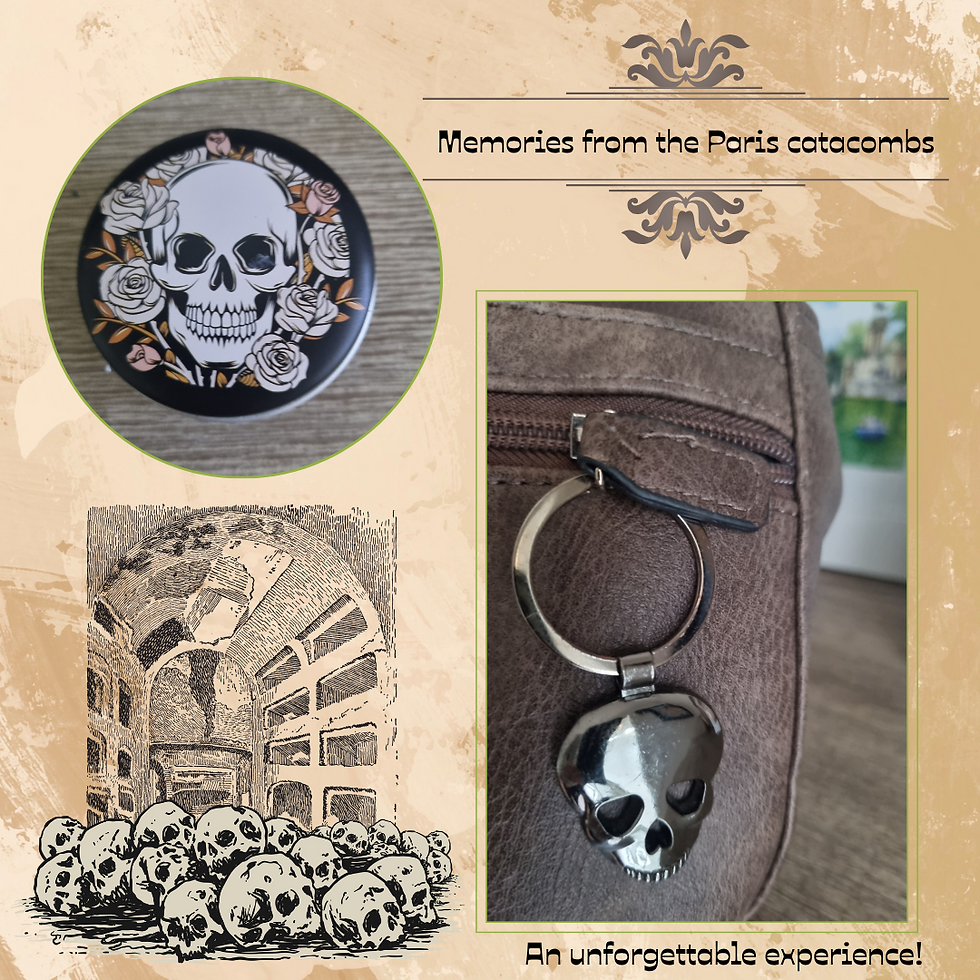
I just had to buy mementos of our visit as it was such an incredible experience. I bought the cool key chain shown in the above photo that is attached to my main handbag so I get to remember the experience on the daily. The little lip balm container in the above photo may seem like an odd thing to buy. I don't actually use the balm, but the container sits on my desk in my home office. I just liked the design on the lid!
We were able to take the metro one last time, directly from the Denfert-Rochereau station near the Catacombs on metro line 4 back to our apartment. Our apartment may have been a little dodgy, but it was quite convenient for taking the metro around Paris.

Here are some shots of our final wanderings, in the Denfert-Rochereau area of the 14th arrondissement. These were our final images of Paris, before we fly to Nice the next day. So pretty!

Below is a map of our final day's wanderings. I've marked on the map all the places we visited during our four and a half day stay in Paris. By no means an exhaustive experience, but far more depth to it than my previous two stays in the city. For a huge city, Paris is surprisingly walkable and certainly doable using the metro. Go for it, I say, as once the metro system is familiar, it's actually not that complicated. Each journey is only €2.50 no matter how far the distance travelled.


Paris is...well...Paris. Yes, it's one of the world's iconic cities and I am sure that even after multiple visits, there'd still be things to see and do. I don't think the city will ever be much-loved by me, but I appreciate its history and its own brand of beauty. I know that E had super high expectations and I am not sure they were met, either, but I'm also sure that she appreciated the experience and the things we did together. All that said, for someone who claims to be lukewarm abou Paris, I sure loved the things we saw and did!
My travel tips would be: Brave the metro. It seems complex but once you get the hang of it, it's the best way to get around. I'd also suggest planning your time in the city, to work out the best use the time you have, and give yourself the opportunity to walk between places. Pre-purchased timed entry tickets where possible will also help with planning. From a budget perspective, my advice is to decide on the things you really want to see as entry to most of the iconic places is around €20-25, or more. Work out which places with an entry cost you're happy just to see from the outside. There are loads of famous structures that afford stunning views of Paris, but I don't think climbing all them is necessary. And remember that The Terrace at Galeries Lafayette Haussmann is free!

Paris is still not my thing, and I am not sure why, but my third visit was a proper exploration of the city and I grew to appreciate it more. The lovely parts are lovely, and I gained a new perspective on the stunning architecture this time.
E and I shared some incredible experiences! The sparkly Eiffel Tower! The Pantheon! The Catacombs! Pere-Lachaise cemetery!
E navigated the city and the metro system like a boss! I am so proud of us for making our way around on our own.

The culture shock of our apartment's location: All those men hanging around and the meat and dodgy fruit and vegetables on display.
The metro: I still can't believe we mastered it!
All the different visual stimuli: Beautiful buildings, the gaudiness of Versailles, the pretty green spaces, all the treasures of the Louvre, the stunning Pantheon dome, the sparkles of the Eiffel Tower at night, nature overrunning the graves and tombs at Pere-Lachaise, and the bones of the Catacombs.
Where to next?
Our next stop was Nice! I was beyond excited to be able to experience the French Riviera for the first time. We decided to fly from Paris, taking an early morning flight from Paris-Orly Airport. Read on for more of our wanderings...


Comments