Milano meanderings
Updated: Jan 7

The Second Great Girls' Adventure series
This post on our Milano meanderings is number 5 and the final one in the series on the Second Great Girls' Adventure that my daughter [referred to as E in my posts] and I experienced in 2022. Our adventure included Amsterdam, Paris, Nice, Cinque Terre and Milan [in that order]. Each place in this incredible list has its own post.

A little bit of background📝
Our first Great Girls' Adventure took place in 2015, when E was turning 15 and just about to embark on her final two years of schooling. We were fortunate to experience Türkiye, Greece and Romania on that trip. This time, our Great Girls' Adventure was a belated celebration for our two milestone birthdays [21 and 50] that came and went during the pandemic. Our second Great Girls' Adventure saw us in Europe for three weeks in October 2022, flying into Amsterdam and out of Milan with Qatar Airways. There is a bit more background to our trip in the Amsterdam post.

This second adventure was special as E was an adult this time [almost 22 by the time we embarked on our adventure]. We shared the planning and expenses, travelling as companions and enjoying each other's company and the wonders of the places we visited. This trip was also a bit less stressful for me as I didn't feel solely responsible for everything. E navigated us around like a boss! Looking back now as I write this post in 2025, we had an incredible experience and I will be forever grateful for the opportunity to travel again with my daughter.
We chose Milan to be part of the Second Great Girls' Adventure as E wanted to experience Italy. I had been to Italy, albeit way back in 1996, experiencing the beauty of Florence, Rome and Venice. I'd had very few expectations of Italy back then but any that I did have were more than exceeded. I loved the architecture, the warmth of the people we encountered, and the incredibly rich history. E wanted to go to Paris and Amsterdam on this trip, both places I had been to previously, so we included Milan as a city in Italy I had not been to before.

Travel to Milan🚆
This was our third train journey of our Second Great Girls' Adventure. We'd previously taken the train from Amsterdam to Paris and then from Nice to Cinque Terre. This time, we first made the short journey from Riomaggiore, one of the five villages at Cinque Terre, to La Spezia, the second largest city in the Liguria region after Genoa. Then we took a train to Milan. Our train for Milan left La Spezia at 5.45pm and we were in Milan by 8.30pm. The below map shows our journey, from northeast Italy to northern Italy, near the border with Switzerland.

Travel tip🌏
As I noted in my Nice post, we made day trips to Monaco and Antibes on the train, purchasing our tickets at the station on the day of travel. Pre-booking is a much cheaper option. The above information shows that it cost us only €36 each to travel 225km from La Spezia to Milan, a three-hour-plus journey. We'd paid €14 to travel from Nice to Monaco with a day-of-purchase ticket, and that's only a 20-minute, 20km journey.
It was well dark when we arrived at Milano Centrale and we'd had a big day of walking in the heat at Cinque Terre. Even so, and buoyed by our mastery of regional and metro systems in Amsterdam, Pars, the French Riviera and Cinque Terre, we decided to brave the Milan tram system to our apartment. The apartment we had rented via Airbnb on Via Giovanni Battista Bertini, is around 4km directly west from the central train station. We spotted a tram stop across the street from the station and managed to figure out that if we took Tram Line 10, we'd be a short walk away from our apartment. The only issue was that we couldn't figure out how to buy a ticket as there didn't seem to be a machine at the stop nor anything on the tram. It was late, so we just got on and hoped for the best, although I was anxious the whole way about being asked for a ticket. Nope. We just got off and made our way to the apartment. Yay!

The Milano trams have been running since 1876, although the original trams were horse-drawn. The trams have been upgraded over the years, but there are still many in operation that are more than 80 years old. The above shot of the interior of one of the trams is exactly how I remember it. There are 18 lines with trams numbered 1-33 and they have longer schedules than the metro and bus systems. Travelling on the trams was such a cool experience.
Our Milano Airbnb apartment is my second favourite accommodation of the Second Great Girls' Adventure after the gorgeous place in Nice. We paid $1170AUD for six nights so it was pretty good value, although the lower price may have been due to its location. It is a 3km walk into the central city from the apartment. That sounds like a bit of walking, but Milan is flat and easy to navigate and our wanderings into the city took us through a beautiful park. [More on the park below.]
Here is the exterior of the apartment, with photos taken on our first day in the city. How cool is the door to our apartment! And the little alleyway! And the door right off the alleyway! [You had me at the door, Milan 💞.]

Below are shots of the interior of the apartment. I absolutely loved the kitchen, especially the wooden table. The lounge area is spacious and bright, with gorgeous windows. The bathroom has been beautifully done, on the ground floor between the kitchen and lounge. Upstairs is a loft space with two sleeping areas with enough separation to feel private.

Day 1: Milano wanderings👣
We discovered a fab Carrefour supermarket at the end of Via Giovanni Battista Bertini and we shopped there for our five-day-six-night stay. After buying supplies to keep us going for a couple of days, we headed into the centre of Milan on our first full day in the city. This 45-minute walk gave us our first experience of the pretty Sempione Park.
The park is in the middle of the city, once a forest and home to exotic animals kept by the House of Sforza who ruled the Duchy of Milan during the Renaissance. The park was also once used for military exercises when the army was based at Sforza castle. The tower that can be seen in the below top and middle photos is the Arco della Pace. More on the castle and the arch below.

The park is beautiful and I imagine it's a busy place in summer. I love green spaces in big cities as they feel like such a haven from all the urban bustle. Sempione Park covers 39 hectares and was constructed between 1888 and 1894, modelled on English park designs.
The Arch of Peace [Arco della Pace] sits at the northern end of the park. The monument reaches 25 metres and was completed in 1838 after 31 years of construction work. The arch commemorates European peace signed in 1815 at the Vienna Congress after the Napoleonic Wars. Atop the triumphal arch is a massive sestiga, a chariot drawn by six horses led by Minerva, the goddess of peace, that faces the centre of Milan. Four victorious knights stand on the other side, one in each corner, representing the rivers of Lombardy: Po, Ticino, Adigo, and Tagliamento. The inscription that can be seen in the below bottom right hand photo pays tribute to the Italian soldiers who died in the two world wars.

The arch is rather beautiful, occupying pride of place in Sempione Park. I found this image while searching for information on the arch. It gives a nice sense of the size of the arch from the people in the foreground. Imagine seeing it in winter like this! Magical.

At the other end of the park is Castello Sforzesco. The 14th century fortress is one of the main Milan landmarks. The original fortification was built in 1368 and was later expanded to become a ducal palace. The castle was all but destroyed during the Golden Ambrosian Republic, a short-lived attempt to gain control of Milan in 1447 by members of the University of Pavia. The Sforza family [ruling Milan from 1450-1555] reconstructed the castle and it has stood since then, surviving an attempt to demolish it by Napoleon in 1800. Additional restorations were carried out in the early 20th century and today it houses several museums. At the time of writing, entrance to all seven museums costs only €10.

We didn't end up visiting the museums but we had a lovely wander through the extensive castle grounds. It's pretty much a thoroughfare that connects the end of Sempione Park with the top part of the city centre and it's fab that the castle grounds can be so easily enjoyed.
Walking through the castle grounds and onto Piazza Castello affords a lovely view of the fountain in the piazza and the Torre del Carmine. The latter is one of the round towers of the castle's façade facing the city. The original fountain was built in the 1930s but later disassembled and placed in storage in the 1960s to make way for the excavation of the modern Milan metro Cairoli line. The 40-metre-diameter marble fountain was later restored and put back in 2000. I believe its nickname is the "wedding cake fountain" as the base looks like a wedding cake.

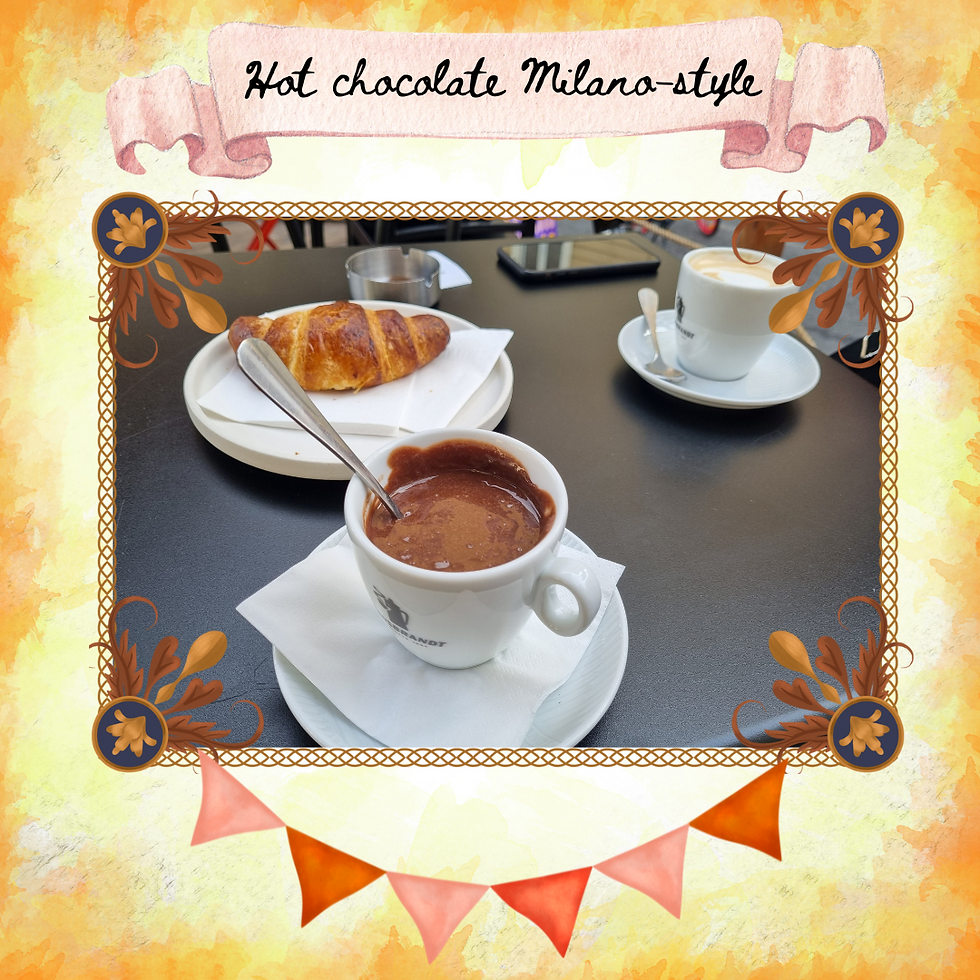
We had timed entry tickets for the Milano Duomo in the afternoon so we took the opportunity in the morning to have a wander around. We headed west of the Duomo towards Basilica di Sant'Ambrogio, stopping along the way for coffee and a hot chocolate at a sidewalk café. My hot chocolate was so thick, I could pretty much stand my spoon up in it! The apple croissant that we shared was delicious, too.
The Basilica of Sant'Ambrogio was founded in the 4th century. The 4th century! I just had to stand at the entrance to the church, touch one of the columns, and reflect for a moment on its history. Ambrose was an official of the Roman Empire who was elected Bishop of Milan in AD 374. Construction of the basilica began in AD 379 over the necropolis outside the city walls where existing monumental tombs lay.

Over the centuries, the basilica has taken its place of significance alongside Milan's other churches. A Benedictine monastery was founded next to the church in AD 784 and its golden altar was commissioned by the Archbishop of Milan in AD 824. The basilica was rebuilt in Romanesque style in 1128 and further expansion took place in the 15th century. The 17th and 18th centuries saw the church's interior decorated in Baroque style. Further restoration was carried out in the 19th century and in 1949 after it suffered serious damage during WW2.

It is for the history and the architecture that I love to visit churches. Basilica Di Sant'Ambrogio is free to go inside and it's worth a visit if churches are your jam. Often I find the exterior to be the more beautiful part and Sant'Ambrogio is no exception, as my photos above show.
Close to the Basilica Di Sant'Ambrogio is the Temple of Victory [Tempo della Vittoria], constructed, with inspiration from 16th century architecture, between 1927 and 1930 as a monument to the Milanese soldiers who died in the First World War. The monument was damaged during Allied bombings in 1943-44. It was rebuilt after the war and expanded in 1973 to include three underground floors containing an ossuary. The white marble shrine is an octagon shape, said to represent the eight former gates of Milan through which soldiers exited the city.

We tried to go inside but were shunted out by a woman who seemed to be cross with us. [No need to understand Italian to get that message!] Looking up the Temple to write this post, I think it's open 9am-12pm and then 1.30-5pm. We got there right on noon so the woman we encountered was probably trying to tell us it was closed. Not to worry, it was a rather impressive sight from the outside and an unplanned stop on our part anyway.

I thought the areas surrounding the basilica and temple were really pretty. Both sites are about 1.5km west of the Duomo. Most of the above shots were taken around there, with a few also taken around where we were staying. Milan is much more beautiful than I imagined it to be. I really fell in love with the architecture and the warm vibe I felt it has for such a big city.
We headed back to Piazza del Duomo and battled the crowds to find a lovely place with sandwiches and fruit for our lunch that we sat in the piazza to eat while admiring the view of the magnificent Duomo. It certainly was busy in the square [as the below shot shows] and this was late October. Imagine the crowds in summer!
The Duomo is every bit as impressive as I expected it to be. And more! It is thought that construction began in 1386, when Gothic was en vogue for cathedrals, in the area of the ancient basilicas of Santa Maria Maggiore and Santa Tecla. Construction spanned some time, beginning with the apse, then the transept and then the naves. The church's façades were built at the end of the 16th century and the tiburium [lantern tower] with the spire on top in 1774. Further façade work was undertaken in the early 19th century and the 20th century saw major restorations take place.

We explored the famous Galleria Vittorio Emanuele II while we waited for our timed entry to the Duomo. The Galleria is Italy's oldest shopping mall, embellished with mosaics and caryatids [sculpted female figures that serve as architectural supports] around its windows and balconies. The ceiling has four-barrel vaults that are crowned with a large dome. There is symmetry to the design, with two large hallways fanning out from a central point. It is rather large, reaching just over 47 metres.
It's all very luxurious inside the Galleria, with a bunch of posh shops befitting their surroundings. It's also super busy, as the gallery connects the Duomo with another of Milan's iconic squares, Piazza Della Scala.

Fun factℹ️
All the premises inside the Galleria are obliged to adopt retro gold lettering on a black background for their business signs to align with the original design.
There are a few ticket types that can be purchased to experience the Duomo. We bought a standard entry, at the time of writing €22, to see inside the cathedral and take the stairs up to The Terraces. Tickets can be purchased for half-hour block entry. This still means lining up, but entrance is guaranteed. There was quite a line when we went in after lunch, both for the pre-purchased tickets and for point-of-entry tickets, so I recommend booking.
The interior of the Duomo di Milano is just as impressive as its exterior. It's all terribly gothic, with large stone decorative pillars and vaults and lots of cool sculptures. There are also beautiful inlaid marble floors, dating back to the 16th century,

The stained glass windows are also impressive. Below are my shots of just some of them. The windows frame the magnificent interior, the star of which is the huge nave that is 44.55 metres high and 20 metres in width between the pillars. There are five aisles in total. This website has a fabulous virtual tour of inside the Duomo that helps flesh out my photos.

The Terraces are easily the best part of touring the Duomo so make sure to purchase a ticket that includes that experience. The magnificent gothic terraces were conceived by the cathedral's architects from the outset. The Terrace walkways are on two levels: the first is around 31 metres above ground and runs along the entire perimeter of the church up to the counter façade. The second level - the Central Terrace - is 45 metres above ground and is reached by two steep stairways. It's the highest point accessible at this point in time. The space on the Central Terrace corresponds to the internal surface of the main nave.

It's hard to put into words the incredible Terraces experience. There are 135 ornate spires [most of them standing 17 metres, dating back to the late 1700s] and a statue depicting the Assumption of the Virgin in Heaven, the Madonnina, made of gold-embossed copper sheets. It feels like you're walking through a forest of stone. It's one of the most unforgettable experiences of my travels to date. The views of Milan are simply amazing! from up there, too.

Fun factsℹ️
There are over 34000 statues, 150 gargoyles, 96 giants and 410 corbels for statues on the Duomo terraces. Corbels are structural pieces of stone, wood, or metal that project from a wall to support a weight above it.
Of course, all this cool stuff is super popular with visitors and there was a massive crowd of people when we went up to the top. It was pretty slow going at times, as the crowd shuffled along. It is a bit frustrating - granted - but I was just happy to be there 😊.

We had a poke around the shop after our visit. These little treasures are my purchases, my only mementos of Milan. I love the historic image of the Duomo in the card I bought and the little carved figurine helps me remember my experience.

Below is a collage of our Milano meanderings, taken mostly on that first day. We had no trouble finding our way around and were happy taking in all the stunning architecture that the city has to offer. There are lots of museums to visit and shopping, of course, but it was enough for us just to wander around.

Day 2: Lake Como🚤
One of the reasons for choosing Milan as a place to stay on our second Great Girls' Adventure is its central location for access to the treasures of northern Italy. I'd previously been to Rome, Florence and Venice, so I wanted to visit new parts of Italy this time. High on my list of must-sees was Lake Como. We picked our second full day in Milan to experience the lake as the weather was fabulous - warm and sunny without being too hot for walking around.
We didn't book anything and it all worked out fine, but perhaps booking would be safer during the peak summer season. We took the train from Domodossola Stazione, about a 15-minute walk from our apartment, but Milano Centrale and Porto Garibaldi stations have links to Como as well. I think I am right in remembering that we bought a one-way ticket to Como as we planned to return from Varenna. The tickets were around €7 each even buying the night before travel. The distance between Milan and Como is 40km and it takes about 40 minutes on the train. Just remember when booking that the destination is Como the city [Como San Giovanni or Como Lago stations] not Lake Como! [Note: Como is the name of the province, the city, and the lake.]
I've marked our Lake Como journey on the below map. We started at Como and visited Bellagio and Varenna on the lake. The ferry distances are also marked.

The first thing we did once we arrived in Como was line up for tickets at the office near the dock for the ferry. It's a good idea to arrive early to be sure of a ticket or better still, pre-purchase online. I reckon we were okay as it was late October, but I'd not like to take my chances in peak season. There are several options for tickets, but I'd recommend the Como-Varenna day pass, currently priced at €25.80. This ticket is essentially a day pass that allows 24-hour travel from time of purchase from Como to Varenna with a stop in Bellagio.
We wandered around the little bit of Como that surrounds the port area while we waited for our departure time, safe in the knowledge that we had our seats booked. I know there is lots to see there, but we only had a short time to explore. The church that can be seen in the below photos is Como Cathedral [Cattedrale di Santa Maria Assunta], a Gothic church that began construction in 1396.

Some interesting points to noteℹ️
Lake Como is of glacial origin and is one of the deepest lakes in Italy and the deepest in Europe. The lake plunges to 425 metres at its deepest points. The depth is what gives the water such a vivid blue colour. The lake is quite large, too, with a total surface area of 146 square kilometres, making it Italy's third largest lake after Lakes Garda and Maggiore. The shape of the lake is a sort-of inverted Latin Y, formed by powerful glaciers and erosion of the ancient river, Adda. Two separate branches of the lake were formed. Bellagio is located in the middle of the branches.
We were booked on the "fast ferry" but it was still a 45-minute journey to Bellagio. Below is a selection of shots that I took as we left Como Village. So pretty!

Our first stop was at Bellagio. The village is located on the promontory that separates the two southern branches of the lake. There are quite a few nice things to do in Bellagio, but we mostly stuck to the town centre - Il Borgo - as it has a charming network of cobblestone streets, steep stairways, and colourful buildings.

There's also Punta Spartivento, the tip of the promontory in the centre of the three branches of the lake. Other places to check out include the Gardens of Villa Melzi, Villa Serbelloni Park, and the fishing village at Pescallo.

We had a toasted focaccia lunch in one of the cafes down a cute little alleyway. This was one time where I wished we'd brought our own food, as the cafes were crowded and the meals were expensive. That said, E was thrilled at her €5 Aperol Spritz after the exorbitant price we'd paid for a glass in Paris!

After exploring Bellagio we took the ferry to Varenna. Bellagio is pretty but I thought Varenna was simply stunning. It's only about 15-20 minutes on the ferry from Bellagio, so I recommend visiting both villages.

Varenna is on the eastern shore of Lake Como. There's a narrow but pretty lakeside path near the ferry terminal - the Passeggiata degli Innamorati - that leads to the stunning Riva Grande bay. Vezio Castle is a medieval fortress perched on promontory above Varenna that dates back 1000 years. There are gardens - Villa Cipressi - and plenty of hikes as well. Again, we spent our time wandering around the beautiful village.

We did visit Villa Monastero, a 12th century monastery and botanical garden that stretches 2km along the lake. There's also an international conference centre on the site and a museum. We didn't go into the museum but had a lovely wander around the gardens. The monastery is my strongest memory of Varenna and that is because of the incredible views. Just look at these photos!

Below is my favourite shot of all the photos I took. It really is worth visiting the monastery for the lake views. At the time of writing, entry into the gardens cost €10 and a further €3 for the museum. It's a 10-minute walk from the pier although a bit of a steep climb.

The history of the monastery is quite fascinating. It was originally a Cistercian nunnery, built in the 12 century. By the mid 16th century, it had been purchased by the Mornico family who owned it for over three centuries! The villa was sold to private buyers eventually but after 1939, it was donated to the state and was opened to visitors.

Villa Monastero is surrounded by a botanical garden that is designed in terraces, growing many rare plant species. The distinct, mild climate of the lake allows numerous botanic species from all over the world to grow. More species are added every year.

We bought some delicious gelato from a little place on the Passeggiata degli Innamorati and sat on some stone steps to watch the world go by. It was quite busy in Varenna, and I imagine it would be super crowded in summer.

We were also fortunate to still be in Varenna as the sun was setting over Lake Como. Not as magical as the Riomaggiore sunset in Cinque Terre, but pretty spectacular just the same.

It was a big day out at Lake Como, but worth it to experience both Bellagio and Varenna. There are lots of things we didn't do, but I absolutely loved our wanderings and I am so pleased we made the journey there and back from Milan. There were loads of people at Bellagio and Varenna, but that was to be expected, given the popularity of Lake Como. That said, it was late October so it would be even more crowded in summer!
We caught the train back to Milan from Varenna at around 5.30pm but it was so busy that we had to stand up for the entire 60-minute journey, squashed in amongst loads of bodies. That was one of the most crowded train experiences I've ever had other than on the tube in London at peak hour. We then took the tram back to our apartment from Milano Centrale and bought dinner supplies from the Carrefour at the end of our street.
I would recommend at least an overnight stay, perhaps in a town close to the lake, to properly explore Bellagio and Varenna. I would have liked more time, but it was a long day with the train trip and the journey across the lake.
Here's the memento of our day at Lake Como, a print I bought from a shop in Bellagio near the ferry on our way to Varenna.

Day 3: A rest day with bonus Milano at night🌃
We were so fortunate with the weather the previous day for our Lake Como experience, as Day 3 was cold, bleak, and showery. We hung out at the apartment all day, taking advantage of being around to make scrambled eggs for lunch.
I have something of an internal battle whenever - and to be fair, it has been rare - I feel like I am "wasting" the opportunity to see as much as possible of the place I am exploring. This mindset partly comes from living at the bottom of the world, I think, and having to spend 25+ hours flying to Europe at significant cost. That said, after being constantly on the go for almost three weeks, we needed a rest. It was also kind of cool just to spend some time in our gorgeous Milan apartment and dream about what it would be like to live there 🤗.

And our day was not for nothing! Late afternoon, the showers cleared and we walked through Sempione Park to the city centre to experience Milan at night. I love European cities after dark! There's something magical about them. Look at how pretty Milan is at night. I also have a thing for historic lamps...

Below are some shots of the Galleria Vittorio light up at night. The symmetry of the building and its arches make for a stunning view at night. The night-time lighting seems to accentuate the building's features. The colour used in the mosaics and paintings is also accentuated as the base colour of the building is neutral.

Below the magnificent Duomo in all its evening glory is on show. The pale exterior colour is beautifully set against the evening sky, such a deep blue after the day's showers. There were still loads of people milling about the piazza but it felt a more peaceful and intimate experience, seeing the cathedral at night. The cathedral is open until 7pm, with the last entrance at 6.10pm. The illuminated façade is a pretty spectacular sight, even if the cathedral isn't accessible, and it creates a glow across the piazza. The Gothic architecture is on full show!

We walked back to our apartment through Sempione Park and past Castello Sforzesco. I didn't feel at all unsafe in the dark, or at any time during our Milano wanderings. Here's the stunning castle lit up at night.

It was also pretty cool to see the Arch of Peace at night. The monument looks even more impressive lit up against the dark sky. It almost felt to me as if the horses were going to fly off the top!

Day 4: Bergamo wanderings🧱
It was still cool on our fourth day in Milan but we were determined to make the most of it, even if we struggled a bit to muster up some enthusiasm. Travel fatigue had well and truly set in by then...
Milan is a super central spot for a base for exploring northern Italy and I had a list of other cities to choose from to expand our wanderings beyond Milan. Verona, Bologna, and Bergamo are all doable day trips from Milan. We did have the Bernina railway on our list [the famous red train from Tirana to St Moritz], but the weather and the distance made us cross that one off. I think if we'd done our trip in reverse and started with Milan, we may have done Bernina, but we just didn't have it in us. Next time!
In the end, we chose Bergamo, partly because the train journey is only an hour, last-minute tickets weren't too expensive, and I loved the idea of visiting an ancient walled city. We walked to Garibaldi station, about 15 minutes from our apartment, to take the train. It's one of the main transport hubs outside of Milano Centrale.
The station in Bergamo is located a short walk from the centre of town and around 2.5km to the funicular that goes up to the Old Town. Here's a reminder of where Bergamo is located in relation to Milan. The city is in the alpine Lombardy region, 40km northeast of Milan.

Bergamo, perhaps lesser known of the cities in northern Italy, has a rich history. It became a Roman municipality in BC 49 and after being damaged during the Fall of the Empire, and it flourished in medieval times at the hands of the powerful Lombard families. The city later became part of the Venetian Republic and its dominions. The old city walls that can be seen today were built as a defensive strategy in the 16th century by the Venetians before they were turfed out at the end of the Napoleonic era. Bergamo earned the title of "City of the Thousand" for its contributions to Italian unification, a title that was bestowed after the local population supported Giuseppe Garibaldi, one of the leaders instrumental in Italy's unification in the Second Italian War of independence in 1859. Bergamo joined the Kingdom of Italy in 1860.
Exploring the historic centre in the Upper Town [the old town, or Citta Alta] is the main reason to visit Bergamo although there's also a gallery [the Carrara Academy] that houses over 1700 Renaissance paintings. We spent most of our time in the Upper Town, but had a lovely wander from the station up to the funicular and back again that gave us the chance to take in the beauty of the Lower Town [Citta Bassa].
Below are some shots of the Lower Town as we wandered through from the station. We saw beautiful civic buildings and private dwellings, just as I expected a city with Bergamo's history to look like. The Lower Town is the "modern expansion" of the original settlement of Bergamo on top of the hill above the plain that now houses this expansion.

We took the historic funicular that the connects the Lower Town with the Upper Town. It cost us only €1.50 for a single journey. The funicular is a traditional two-car system that was built in 1887. Over the years, the funicular has been modernised, with major upgrades in 1917, between 1920 and 1921, in the 1950s and 1960s, and in 1987, a century after its first outing. The system underwent a major overhaul in 2008, completely replacing the automation.
The journey to to Citta Alta only takes a few minutes, but the last 100 metres are quite steep. The line length is different on each side [not sure why] at 240 metres on the right side and 234 metres. The elevation gain is a 52% gradient, travelling from 217 metres to 356 metres. Each carriage has 50 seats.

Citta Alta is perched high and within a system of hills [Parco dei Colli], protected by the Venetian Walls. The architecture of the dwellings and churches in Citta Alta is just beautiful. I took so many photos; the below ones are just a sample. Wandering around the Piazza Vecchia, the heart of the town, is a magical experience. There are several important medieval and Renaissance structures in the piazza, including the Basilica of Santa Maria Maggiore [below top right] that was founded in 1137, and Bergamo Cathedral [below bottom row, third shot] that was constructed in 1340. Well old!

This is my kind of place! Cobblestone pathways and beautiful old stone buildings. I may have been travel fatigued by then, but I was thrilled to be there, in my happy place.

Bergamo's Venetian Walls are now part of the UNESCO World Heritage List [since 2017]. They offer spectacular views of the Lower Town and the Apennines. The walls were built in 1561 and have stood the test of time as an incredible example of Renaissance military architecture. There are almost 6km of walls, still perfectly preserved 400 years later. The walls envelope the perimeter of the Upper Town, built originally to protect Bergamo from enemy attacks. One of the reasons for the walls' integrity is that they were never involved in any sieges. Some parts of the fortifications date back to Roman times and can be seen in Vagine Street and at the Santa Grata convent. These remains were almost completely replaced during the work of the 16th century, creating a new perimeter that did not include earlier elements.
I also read that construction of the Venetian Walls meant that 250 buildings were demolished to make way for the walls, eight religious sites of significant value, including St. Alexander’s Cathedral and the Dominican convent of St. Stephen.
Here's a selection of my shots of the magnificent Bergamo Citta Alta walls. We only saw a small portion of the 6km-plus fortifications as we didn't have the energy to walk the entire thing. That said, we saw enough to experience such an important historic site and have the opportunity to take in the views.

Some interesting points to noteℹ️
The walls include 14 bastions, two platforms, four monumental main gates [St James, St Augustine, St Lawrence, and St Alexander], two powder magazines, about 100 openings for gun ports, and a dense underground system of tunnels and burrows. This design was considered an advanced strategic infrastructure for the time. See below for more on the St James gate that we walked through.
Our final stop on our Citta Alta exploration was at Porta San Giacomo, a white marble gate and stone viaduct overlooking the Lower Town, preserved from a ruined city wall. Porta San Giacomo [St James's Gate] was once the main entrance to to Citta Alta for travellers from Milan. It is the only access to the Walls that is perfectly visible from Viale Vittorio Emanuele, the axis that crosses Lower Bergamo from south to north, both because of its location and its colour.
The gate was built in white marble quarried from the Zandobbio quarries in nearby Val Cavallina. It was designed as a triangular pediment supported by half-columns in classical style. As with the other gates to the city, there is a carved Lion of St. Mark on the façade, the symbol of Venetian rule. Apparently, there was once an old wooden drawbridge at the gate which closed access to the city in case of danger. Sadly, it was torn down in the late 18th century by order of the Venetian governor Alvise Contarini. In its place was built the masonry road that can be seen in the below bottom shot.

Later we took the 15th century stone steps at Salita San Viglio back down to the Lower Town. It's about a 20-minute walk or the funicular can be taken back. The steps are so pretty, though, and kind of cool to be walking along such an historic path.

Even though we were kind of over travelling by then, I loved Bergamo and recommend it as a day trip from Milan. I wish I'd had more energy to explore, but we were both tired and a bit tetchy with each other [the first time in the whole trip, mind you]. We decided to head back to Milan mid-afternoon.

Once back at Porta Garibaldi station in Milan, we walked the 1.5km to Milano Centrale so that I could have a proper look at the station, then we took an old tram back to our apartment for the final time. I love historic European train stations! Stazione di Milano Centrale was opened in 1931, replacing the old station that was built in 1864. The façade is 200 metres wide and its vault is 72 metres high. The architectural style is eclectic, with some Art Deco features and numerous sculptures.

Day 5: An unexpected stunning art gallery👩🏼🎨
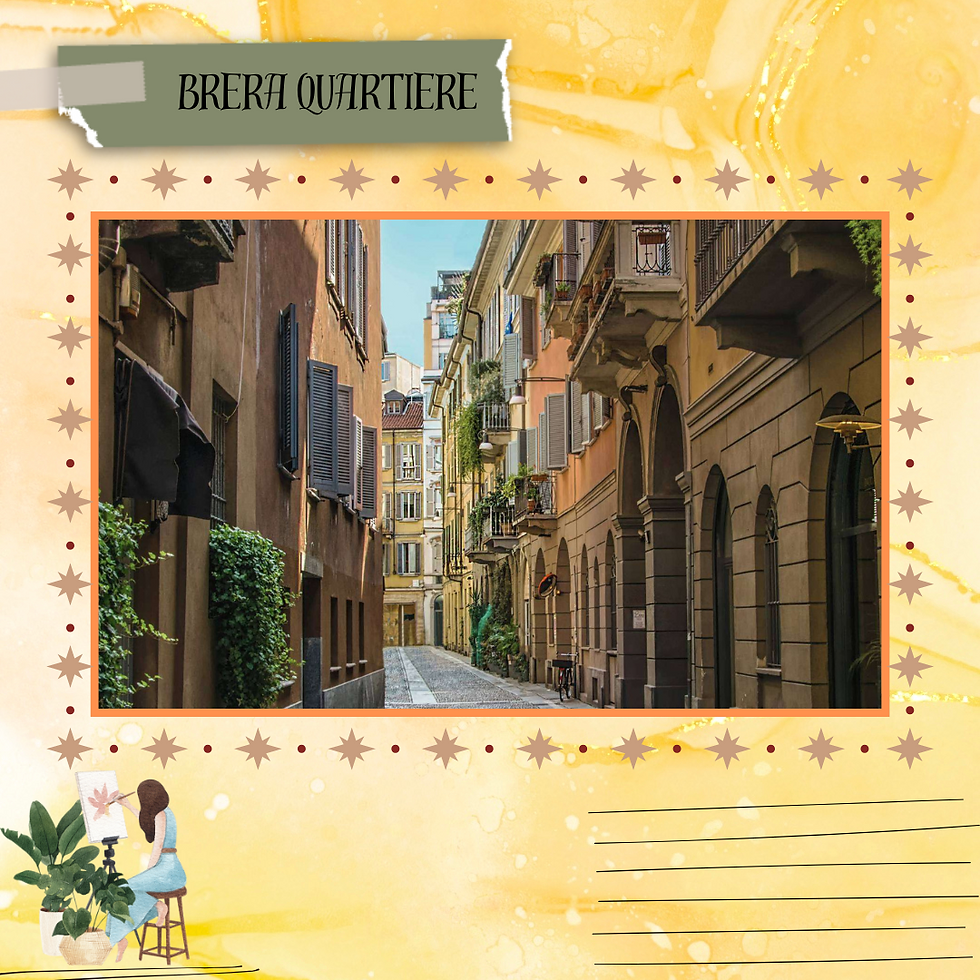
The final day of our Milano meanderings and of our Second Great Girls' adventure dawned, cool and cloudy again. We had one more opportunity to see something of the city, so we walked the 2km distance from our apartment to the Brera district. This part of Milan is considered to be the artists' quarter and the city's boho chic, bohemian neighbourhood. Milan seems to have a bad rap as an Italian city and suffers in comparison to Florence, Rome and Venice, but I thought it was beautiful. Brera is no exception.
We found this super cool art gallery in Brera, the Pinacoteca di Brera. I had never heard of it, but apparently it's one of Milan's most important sites and one of the most famous galleries in Italy. The gallery was founded at the end of the 18th century, in 1776, at the behest of Maria Theresa of Austria. The building itself was once a Jesuit college [from the 14th century] and is now home to the Accademia di Brera, a state-run tertiary academy of the fine arts, as well as the gallery.
![The bronze statue of Napoleon [middle shot] in the courtyard in the guise of Mars the Peacemaker, cast in Rome to a design by Antonio Canova, was erected in 1859.](https://static.wixstatic.com/media/7497d1_e7f36842aabc4e53b40fdb051737e22c~mv2.png/v1/fill/w_980,h_784,al_c,q_90,usm_0.66_1.00_0.01,enc_avif,quality_auto/7497d1_e7f36842aabc4e53b40fdb051737e22c~mv2.png)
Tickets for gallery entry at the time of writing cost €15. The gallery's website recommends pre-purchasing and arriving early, but we pretty much had the place to ourselves, on a Thursday morning in early November. We saw glimpses of art classes being held in the building, and it was kind of cool to walk past some teaching rooms and see students milling around.
I absolutely loved our experience of wandering through the Pinacoteca di Brera gallery. As I mentioned, we pretty much had the place to ourselves so it was such a peaceful, contemplative experience compared with the crowds at The Louvre. As can be seen in the below photos, there is plenty of space in the gallery and without the crowds, we could marvel at the artworks without jostling for a view.
There are some beautiful paintings in the gallery. A couple of masterpieces in the collection that I have featured below, include St Mark preaching in Alexandria by Giovanni Bellini, painted between 1504-1507 [main middle shot, E standing in front of the painting]. There are two paintings by Francesco Hayez: The kiss, painted in 1859 [bottom right] and Melancholy [top left], painted between 1841 and 1842. The bottom left painting is by Girolamo Induno - The sad premonition - painted in 1862. The top right shot is of The Madonna del Suffragio, painted in 1661-62 by Salvator Rosa. Finally, the Rococo painting in the middle left is View of Gazzada near Varese, painted in 1744 by Bernado Bellotto.

Below is my favourite painting. When I looked it up to write this post, I realised I had interpreted it wrong, as the artist, Giuseppe Molteni, has captured a mother mourning her child. I can see it now I know more about the painting, but she looks fed up more than sad to me. I thought she was rolling her eyes, not feeling sad...

I understand that the painting is a masterpiece by Molteni and was originally shown at the Exposition Universelle in Paris in 1855. It is believed to have been influenced by Hayez’s Melancholy [top left above]. Interestingly, Molteni was appointed curator of the Pinacoteca di Brera in 1855 and subsequently became its Director.
After our gallery visit we wandered around Brera for a bit, mostly in search of lunch. We ended up in a small supermarket so we could buy sandwiches and fruit. As one would expect, Italy is full of pasta and pizza - as to be expected - so it's a bit of a search for alternatives. Later, we wandered back to our apartment, stopping for a final gelato.

That was pretty much it for Milan! Here's a map that charts the places we visited during our stay. I've marked Milano Centrale, Porta Garibaldi where we took the train to Bergamo, and our apartment on the northern side of the city. The gallery in Brera, the castle, the ancient church and of course the Duomo are also marked. All of these places we walked to from our apartment, with a few tram journeys from Milano Centrale.

The end of the Second Great Girls' Adventure😊😔
The below photo of E and me was taken in Bergamo on our penultimate day, where I tried not to think too much about the end of our adventure. Yes, we were travel fatigued, but we made so many incredible memories on that trip that I will treasure forever.. Amsterdam, Paris, Nice, Cinque Terre, and Milan...What an adventure!

What happened next?
When we booked our flights and first started our planning, we intended to fly into Amsterdam and out of Milan. What I hadn't counted on was a change of those plans to accommodate the need for me to go to London for work at the end of the trip. My post on all of that is here, my second work stint in London in 2022 as the Global Education Manager for a travel assistance company. The change of plans meant that E flew home the next day from Milan on her own and I flew to London.

We took an Uber to Milan Malpensa in the morning and I saw E off then had a long wait until my flight to Heathrow. I was sad to see E go after the intensity of our shared adventure. It was her first international flight on her own as well.
I was brought abruptly back to reality with a call with my Australian Trainer while I sat in the departures area and listened to her updates on what had been going on in the three weeks while I was away. I arrived in London mid-afternoon and took the Tube to the hotel I'd stayed in earlier in the year during my first work stint. It was cold, wet and dreary in London, this being the first week in November, and I felt quite sad to be on my own. But it was also a weird feeling, to be sad but comforted by being back somewhere so familiar.

My London colleague swung by the hotel on his way home from work to hand over my bag of work clothes that I'd sent over to him before I left Australia for my holiday, to save carrying everything around. My anxiety was ramping up at the thought of what lay ahead of me over the next six weeks!

I have often read things about Milan where the city is described as "industrial" and "boring" and there's nothing to it other than the annual famous fashion show. I disagree. I loved Milan! I am generally partial to Italian architecture and I feel like Milan has an understated beauty. It is easily walkable but also served by an efficient metro system and historic tram network. The loft we stayed in was only second to the beautiful Nice apartment as my favourite. We were 3km from the city centre, but close to a fab supermarket and public transport. One of the best reasons to stay in Milan, though, is for a central spot to explore Northern Italy. Two days of wanderings in the city itself would be sufficient, I think, but there are so many wonderful places a short train journey away to explore as well, from Milan as a base.

Milan was at the end of a packed three-week adventure. Travel fatigue had an impact, and our experience may have been different if we’d started in Milan. Something to learn from!
Navigating the trams and trains and getting ourselves around was another confidence boost.
We could have done more with our time, I guess, but I was happy to wander around Milan's beautiful streets and soak up the architecture and history.
I felt sad that it was all over as E headed back to Australia and I went to London for what turned out to be a very stressful work experience.

The Duomo terraces, the beautiful Lake Como village of Varenna, Bergamo’s 16th century Venetian Walls, and the quiet, contemplative visit to the Pinacoteca di Brera gallery were incredible experiences that I will never forget.
Our beautiful apartment made me feel at home. I tried to imagine what it might be like to live in such a gorgeous city.
Walking through Sempione Park into the city was so pretty and peaceful.
This shot of me at Porto San Giacomo in Bergamo rather nicely encapsulates why I love Europe so much. It is my dream to one day live there and I have started making that dream closer to reality. Here's a post on the start of this plans [to come].

Reflections on the Second Great Girls' Adventure
E and I embarked on our first Great Girls' Adventure in 2015, when she was turning 15. We experienced Türkiye, Greece and Romania on that trip and made a bunch of wonderful memories. This time, we experienced Amsterdam, Paris, Nice, Cinque Terre and Milan, all incredible places in their own way. Both trips meant a lot to me in terms of making memories with my daughter and travelling with a kindred spirit. Travelling makes me grow in confidence as I marvel at my ability to get myself around new places and spaces and add to my knowledge of history, of geography, and of how to navigate the unfamiliar. Being able to wander the world is a privilege and not one I will ever take for granted. And as someone who is hyper-sensitive to their surroundings, being in new places feeds my soul and stimulates my senses, something again I am privileged to be able to do.


Comments