Berlin: Our first steps onto (mainland) Europe
Updated: 2 days ago

A little bit of background
This post is part of the series on our first ever world wanderings. This was 1996, three years after W and I got married (sans honeymoon that we couldn't afford) and after a year of saving. This trip was to be an adventure of a lifetime! We'd planned a whirlwind 19-day bus tour of a good chunk of Western Europe and a two-week self-drive road trip around England, Scotland and Wales. The smaller chunks of the trip included an LA stopover, a London taster and a long weekend in Berlin, the subject of this post.

The opening post in the series on our first ever world wanderings documents our three-day LA stopover. The second post is on our London taster. These posts give good background on how we got to Berlin where we took our first steps into Europe. Those first steps built on during our Trafalgar tour, documented is this post. The final post in the series is on our self-drive around England, Scotland, and Wales.
The post - and all the posts in the series - has been written in retrospect, almost 30 years after the trip. In an brand move for me and for the 1990s, I wrote a journal and typed it all up when I got home, complete with the printed detritus of our adventure, faithfully stuck into the journal. I've written this post using that journal and from my memories. As with the whole series, and all my travel wanderings posts, I'm recording my experience of travelling and what that experience meant to me. The posts in this series have particular meaning 30+ years later, as they explore not only our wanderings but what travel was like at the time.
Our 1996 trip was our first ever experience outside of Australia and New Zealand. We did this trip in the days before there was easy access to information on the Internet and before the days of Google maps. I recall how wide-eyed we were, as we experienced so many firsts on the trip of things we'd only read about in books or seen on TV and in film. There was no blogging back then! I also look back now and marvel at how much travel has changed and how much easier it is now to both plan and execute. And of course there is a caveat on the photos I have included, taken on an 'analog' camera. They reflect the quality of the photos in the mid 1990s and their survival almost thirty years later.
Berlin will always be a special experience for me. It was our first time in mainland Europe and our visit in 1996, not long after the Berlin Wall came down, was at a pivotal time in Germany's and the city's modern history. Berlin had only been designated as the capital of Germany for six years and the seat of parliament would not be transferred from Bonn for another four. I'd missed the opportunity to see East Berlin during the Cold War years, but I was keen to experience the new Berlin and its unique history.

Arrival in Berlin
We were one week into our six-week first ever world wanderings when we arrived in Berlin. In that first week, we'd experienced a heady stopover in Los Angeles and a whirlwind exploration of London, staying with a friend. The next stage of our itinerary saw us on a three-day Berlin sojourn before the start of our European tour. Why Berlin? Our flight package with Qantas and British Airways included return tickets from London to a selected European capital city. We chose Berlin as I learnt German in high school and had been fascinated with the country - and indeed Europe - ever since I can remember. Berlin wasn't on our European tour itinerary, so we took the chance to experience the city at a time when it was being transformed into the capital of the reunified Germany.
Leaving London late in the afternoon, we were in Berlin 90 minutes later. How odd it seemed to us, living in the big, brown land of Australia to be in another whole country after such a short flight and on a tiny 757 aircraft! It was a somewhat bumpy journey, I recall. I was enthralled by the lush, green landscape below us as it looked like carpet. We flew into Tempelhof, an airport that is no longer operational. Tempelhof was closed to aviation traffic in 2008 and has been redeveloped as a events and trade fairs venue since then.

I was equal parts excited and anxious arriving in a country where we didn't speak the language, other than my vague high school German. While Los Angeles and London were BIG experiences for us - both unfamiliar and new - we didn't have to navigate a different language. I felt quite daunted by the prospect of being in Berlin now that it was a reality.

Berlin is the capital and largest city in Germany and its own state. It has the highest population within its city limits in the European Union and is built on the banks of the Spree.
It has been the capital four times, returning to its current state in 1990 after the fall of the Berlin Wall. Berlin was divided by the Wall from 1961 to 1989 when Bonn was the capital of West Germany.
Berlin dates back to 9000 BCE, but its name is rooted in Slavic language from 7th century settlement by Slavic tribes.
We tentatively made our way to Arrivals and experienced a smooth entry into the country as we had no luggage to collect, having left our big suitcases in London. These were also the pre-September 11 days and airport security was not as tight as it is today. I remember standing outside the Arrivals area and feeling anxious about how to get to our hotel, even though we knew it was only a short bus journey. A lovely English woman helped us as she must have overheard us talking to each other about what to do.
We stayed for three nights in Kanthotel, on Kantstrasse, in the Charlottenburg part of the city to the west of the newly-unified heart of Berlin at Alexanderplatz. We had no trouble finding the hotel in the end, our first confidence boost of the trip! I had to do a bit of Google detective work as I write this post almost 30 years later to discover that the hotel is now a Best Western. It's located on a main road, close to the Berlin integrated train system (the U-bahn subway and S-bahn above ground city transit), and around a 25-minute journey into Alexanderplatz. Sadly, I don't have a photo of the exterior of the hotel from our stay, but the one below shows what it looks like now.

I can't recall the cost now, but I do remember thinking at the time that it was expensive compared to Australia for a similar standard. I noted in my journal that the hotel was 5-star, but looking below at the only shot I have, it doesn't seem that way! That said, the surviving picture and the little bit of information I kept from the hotel brochure is super 1990s. Gawd. I'm not bothered anyway about accommodation as it's only somewhere to sleep and our room was small but clean and in a good location. That's all we cared about. We'd had a light meal on the plane so didn't bother with dinner. I think we were just relieved to have made it to Berlin!

Day 1 in Berlin
We were up early on the first morning as we planned to travel to Oranienburg, in what used to be East Berlin, to visit Sachsenhausen Memorial and Museum. It may sound odd, but visiting a former concentration camp was a bucket list item for me. I am a history nerd (and I have a degree in the discipline), with a particular interest in social and political history. I spent a dark period in my teenage years devouring books on the Holocaust and thinking constantly about the extent of human cruelty.
To fortify ourselves for the journey to the museum, we enjoyed the hotel's buffet breakfast. At the risk of sounding like bumpkins, this was a new experience for us. There were all kinds of breads, meats, cheese, fruit, yoghurts, cereals and hot food as well, so unlike Australian hotels at the time. We expected to be sharing the breakfast room with loads of other tourists but it was relatively empty despite being peak season (early July). Perhaps we were just up too early?
Remembering that this was 1996, we had a set of printed instructions on how to get to Sachsenhausen that our travel agent had photocopied from her own copy of Let's go Germany. We set off, full of trepidation about getting to our destination. We took the correct train, although we couldn't work out the ticketing system, my high school German failing me. The ticket below is the only one we bought for our entire three-day stay. Honesty is my jam and I felt guilty about using the one ticket, but we couldn't figure out what to do. There didn't seem to be any ticket machines for boarding and disembarking and no tapping on and tapping off like we do today. We weren't asked to show our tickets at any stage during our stay.

Anyhoo, we travelled about an hour north of the city, on an old rickety train, past grey, graffitied buildings, loads of construction, and remnants of boarded-up stations from the Cold War era. I'm not sure what I was expecting, but it was so odd to get off the train, walk about 20 minutes through a little town, turn down a suburban street and then find a concentration camp at the end of it. I somehow imagined the camp would be isolated and away from residential dwellings.

It's been a long time since we made the journey to Sachsenhausen, but I will never forget the experience. It was just as chilling and disturbing as I'd imagined it would be, made even more so by the cold, gloomy weather. We were also the only people there for most of our visit. It's an odd experience, I think, visiting memorials to the dead. It feels important to remember, but there's also an uneasy intimacy of standing in a place of so much suffering without fully understanding it. There's a discomfort for me, a conflict between remembrance and morbid curiosity to see for myself the horrific impact of the Nazi regime.
Sachsenhausen concentration camp was built in Oranienburg in 1936 as a training and model camp for SS guards and staff. It later served as an administration centre for all Nazi camps.
Over 200 000 people were imprisoned in the camp between 1936 and 1945, including political opponents, Jews, and Soviet prisoners of war.
The camp was used by the Soviets from 1945 until 1950 ato hold political dissidents and low-level Nazi functionaries.
Sachsenhausen was first opened as a national memorial in East Germany in 1961 and was then extensively redesigned and restructured after German unification. The camp is huge, with barbed wire fences, guard towers, labs where human experiments were carried out, and crematoria. There are several memorials to those murdered in the camp and of course the Arbeit macht frei (work will make you free) gate. Everything seemed well preserved, partly I imagine as Sachsenhausen is less well known than other camps and is located in what was East Germany. Again, this added to the disturbing nature of the experience. The camp visit left an indelible mark on us.

Rusted old barbed wire was lying all around the main part of the camp. I know it wasn't the right thing to do, but we picked up a small piece. This was our younger selves making a decision to do something out of character but something that made the experience feel even more visceral to me. The reality of what we had seen at the camp was so strong. That little piece of barbed wire still reminds of the experience and the of the depths of inhumanity. Writing this post in 2024 feels even more poignant, given the genocide being committed against Palestinian people in Gaza. How have we not learnt from history? It makes me so sad to think that the oppressed have now become the oppressors.

Our hearts felt heavy that day, again made even more so by the gloomy weather. At least there were loads of people milling around when we headed back into Berlin and strolled up the K'damm (Kurfurstendamm), the main shopping street. The avenue runs into Tauentzienstrasse where the sculpture in the below photo was erected in 1987. The sculpture - Berlin - represents a broken chain that symbolises the severed connections between West and East Berlin during the construction of the Berlin Wall.

On the same street is the KaDeWe, the second largest department store in Europe after Harrods. The name is abbreviated from Kaufhaus des Westens, meaning 'Department Store of the West' and is located in the historic heart of West Berlin's shopping district. . The store's luxury vibe served as a prominent symbol of Western capitalism and consumerism during the Cold War. KaDeWe was expanded not long before we visited, to cater for increased business after reunification. We had a wander around, but didn't buy anything other than a store bag, as shown in the below photo. KaDeWe is a posh store - a German Harrods - and our budget didn't extend to buying from a store like that!

KaDaWe was founded by Adolf Jandorf, a Jewish businessman who built up a chain of basic needs department stores before opening KaDeWe in 1907 to cater for the elite.
The store was transferred to Aryan owners during the Second World War as part of the Nazi policy to seize Jewish property. In 1944, a German bomber was shot down and crashed into the store, killing the plane's seven crew and destroying much of the store.
KaDaWe has been 100% owned by a Thai company since 2015.
On both days in the city we had kebabs for lunch, found everywhere in Berlin. Turkish cuisine came from the people of the gastarbiter (guest worker) program. This program admitted foreign workers to West Germany after World War Two to help rebuild the country's infrastructure, and many were from Turkiye. I remember the kebabs being so delicious - full of warmth and flavour and served with sauerkraut in a damper-type roll. Yum! Sadly, I have no photos. This was the pre-social media age of analog cameras with a shot limits per roll. We didn't even think to take pictures of our food back then!
Our day was as eclectic as the city we were in. From a concentration camp memorial, to a luxury goods store, to Bahnhof Zoo, or the Berlin Zoologischer Garten, a huge train station and the most important traffic junction in the former West Berlin. It's a mecca of shops and eateries now, but is probably more famous as a former drug and hustler scene. I remember thinking how beautifully diverse our surroundings were and so many rather offbeat people and fashions. Loved the vibe!

Our last stop for the day was the Kaiser Wilhelm Memorial Church (Gedachtniskirche), a Protestant church affiliated with the Evangelical Church of Berlin. The church, originally built in the 1890s, was bombed extensively during the Second World War. It's an imposing site - an old church sitting in the middle of a modern city, the bomb damage still visible. Amazingly, there are stairs in the old church that lead to nowhere as the spire was blown off. The ground floor is now a peace memorial, nicknamed by Berliners as der hohle Zahn, meaning "the hollow tooth". There's a new part, built between 1959 and 1963, but it's the damaged old part that is the constant reminder of the destructive bombings of the Second World War.

The day had been a hugely emotional experience. It is hard to escape the past and the horrors of war in Berlin. Our bodies and minds needed a rest by late afternoon. Even though our hotel was in quite a central location, we struggled to find something open to buy dinner that evening. We ended up at a Burger King, the equivalent of Hungry Jack's in Australia. I was still nervous about speaking German but we managed to order a meal deal each. The food tasted the same as if ordered from any generic burger chain. Not very German, I know, but needs must and all that!
Day 2 in Berlin
We'd picked up a brochure in the hotel for English-speaking guided city walks. We liked the idea of making the most of the limited time we had in the city so we turned up at Bahnhof Zoo where the tour started. Somehow our introverted selves managed to find the guide who charged us 10DM each, telling us we looked like students so we could have student tickets. Ha! This is what you did back then - read through brochures in hotels and just chanced it, based on the information in printed material. It doesn't sound like much, but winging it like that was pretty adventurous back then!

The tour was amazingly comprehensive and our guide, Susanne, very knowledgeable. Susanne was Swiss but had lived all over the place. She was warm and interesting and easy to listen to. The tour took us around so many iconic places. Walking gave us such a lovely feel for the city. I wish I'd kept the information about the tour as I remember that we walked A LOT, following Susanne onto the train a couple of times. It's actually the only walking tour I've ever done and it was absolutely worth it, especially back in those days when you couldn't Google stuff and read about what you are wandering past. The tour was really just a taster as we only spent a few minutes looking at a bunch of key places from the outside. It was still a great way to experience the city in a short timeframe and Susanne's commentary helped us understand the significance of the sites we strolled past.
One of the most striking things we saw was the Berlin Cathedral, right across the road of the plain, drab Communist party building. The building was to be torn down eventually. This rather bad quality photo was taken from a 2006 article about the building's demolition. Its ugliness against the Cathedral is quite stark.

Here we've captured the cathedral's reflection in the old building. Not a bad shot considering our now-ancient camera! Also, it's kind of cool that we saw the Communist Party building before it was torn down.

Below is the cathedral in all its magnificence. We didn't have time to go inside but it was enough to see it from the outside. The terrible photos taken on our now long-outdated camera do not do it justice at all!

Berlin Cathedral is a German Protestant church and dynastic tomb of the House of Hohenzollern.
The Collegiate Church and its community in Berlin date back to 1451. The current church was remodelled from an earlier 1747 structure, built between 1894 and 1905 by the order of Emperor William II, in Renaissance and Baroque Revival styles.
The church was damaged during WW2 but reconstruction did not start until 1975. Restoration has continued since then.
Along with the cathedral and the old Communist party building, we walked down Unter den Linden, the boulevard in the Mitte district named after the linden trees that line the street. We also walked along the River Spree, around the lustgarten on Museum Island, once used for Nazi rallies. We saw the Nazi book burning memorial at Bebelplatz, a memorial made even sadder for its location across the road from Humboldt University. The Empty Library is below ground, featuring a bunch of empty bookshelves to memorialise all the books by Jewish authors that the Nazis destroyed in 1933.

Below are two key Berlin landmarks: The Brandenburg Gate and the Reichstag. We had the chance to see these magnificent structures and the incredible construction all around Potsdamerplatz as the city moved forward after the fall of the Berlin Wall. At the time of our visit, Berlin was the largest construction site in the world. Berlin was designated as the capital again in 1990 but the seat of parliament did not transfer from Bonn until the year 2000. The Reichstag was under major construction to prepare for the transfer. What a time to be in Berlin!

The Brandenburg Gate is an 18th century neoclassical monument and one of the best-known German landmarks.
It was erected on the site of a former city gate that begins the connection between Berlin and Brandenburg, the state that surrounds Berlin.
The bronze sculpture on the top is of a chariot drawn by four horses.
The Gate was a marker of the division between East and West Berlin and now stands as a symbol of unity and peace.
The Reichstag building is hugely symbolic, not only for its 18th neo-Renaissance design, but for the 1933 fire that entrenched the Nazi regime.
Its symbolism made it an important target for the Russian Red Army during the Battle of Berlin in 1945.
The building's location in West Berlin meant it could not be used as a parliament building by either of the two German states but now stands as a symbol of reunification.
Here are some more key places that I managed to capture on film during our city walk. Going clockwise from the top left: The 69-metre-high Victory Column can be seen in the distance, the famous Berlin landmark commemorating the Franco-Prussian War in the 1870s, with Victoria, the Goddess of Victory atop the monument. The Altes Museum is one of the main museums in the city, built between 1825 and 1830 in neoclassical style. The Deutscher Dom is another of the magnificent Berlin cathedrals. It dates back to the beginning of the 18th century. Sadly, the church was almost completely destroyed in the bombing of Berlin during World War Two and only rebuilt between 1983 and the year we visited the city. The last photo shows the place that is now a documentation centre and museum (the Topography of Terror) on the site of the former SS headquarters.

The tour, although four hours long, was a bit of a whirlwind and I'd love to return to the city again one day to explore all the place we glimpsed (and more!) in more depth. We only had two days in Berlin but at least we got to wander around and take in some of the history and incredible changes happening in the mid 1990s. I will be forever grateful for that opportunity. (Post update: We planned to return to Berlin in April 2026, thirty years after our first visit, but those plans were scuppered by the Trump-led attacks on Iran. Our flights with Qatar Airways were cancelled.)
The tour ended at Checkpoint Charlie and at a section of the Berlin Wall. It was a real 'pinch me' moment for me as I couldn't quite believe I was standing in front of something so historically significant. We left the tour and explored the Checkpoint Charlie museum, fascinating for its displays of escape attempts told through photo essays and newspaper clippings. I love narrative museums like that.
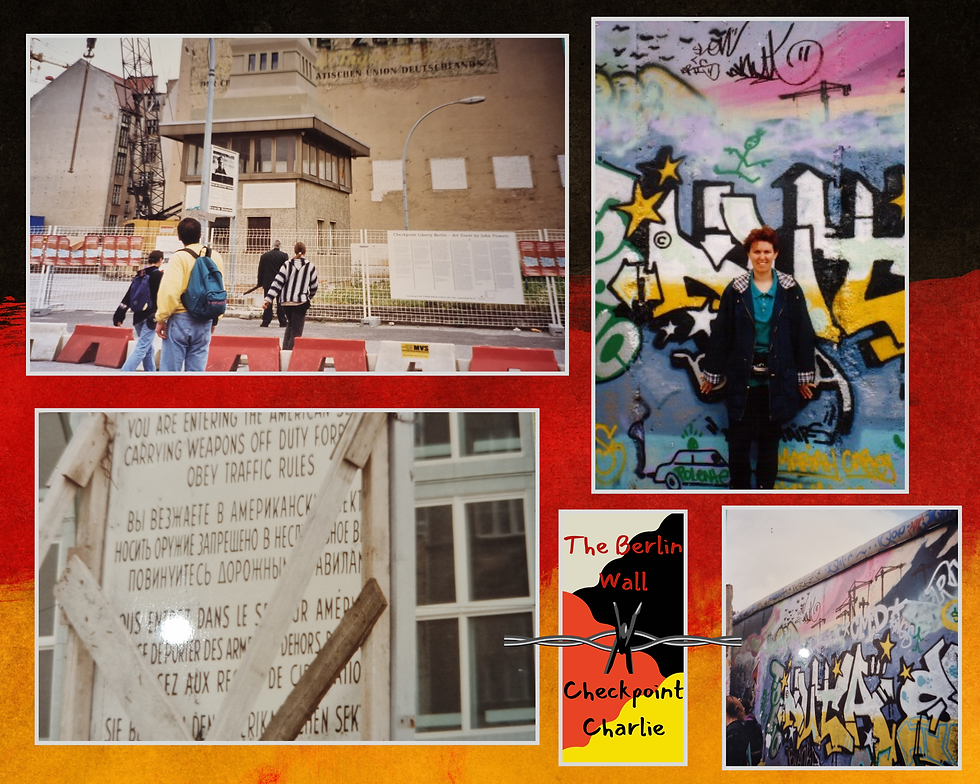
Checkpoint Charlie (or Checkpoint C) was the Western Bloc's name for the best-known Berlin Wall crossing point.
After reunification, the American guard house became a tourist attraction, now located in the Allied Museum in Dahlem, Berlin.
Haus am Checkpoint Charlie began as a small exhibit and moved to the current location in 1963. The collection has grown over time to represent freedom and unity and to capture the stories of those who lived behind the Wall and tried to escape to the West.
The mementos of the Berlin Wall in the below collection were given to me by my sister who had visited Berlin a few years earlier. Completely tacky, I know, but the pieces of the Wall that came in a plastic case are so on brand for the 1990s! I've kept the pieces of the Wall, but of course have no way of knowing if they are genuine. Hardly likely, but still something to keep and treasure. The postcard in the below collection features a now famous shot by German photographer, Peter Leibing, of East German guard, Conrad Schumann, jumping over wire to freedom on the third day of the construction of the Wall.
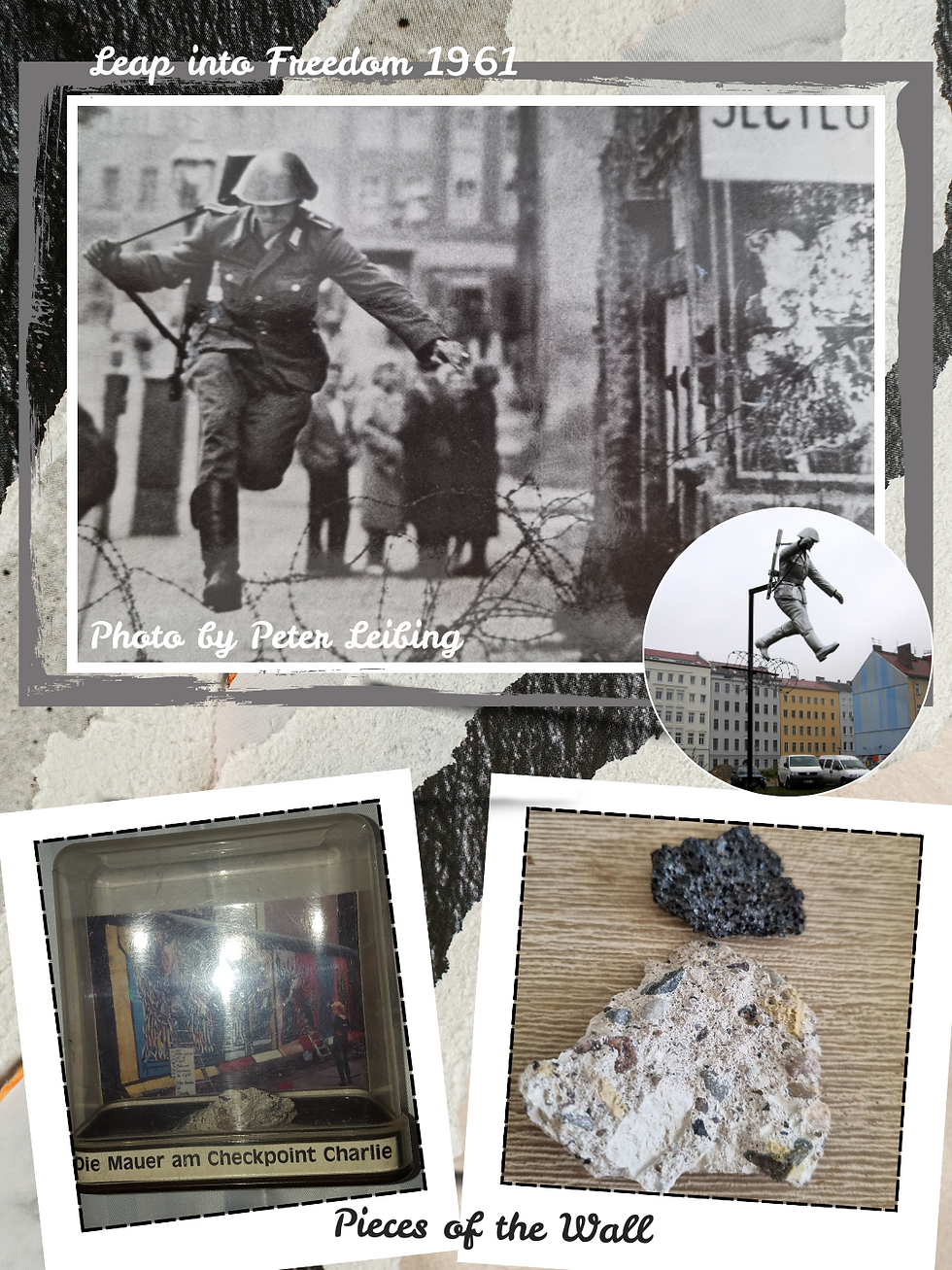
Conrad Schumann was born in 1942 and died by suicide in 1998 at his home in Bavaria, aged 56. Sadly, Schumann suffered from depression for many years and struggled with his mental health after being rejected by his family when he returned to East Berlin after the fall of the Wall.
The Mauerspringer sculpture that commemorates Schumann's leap to freedom was created by Florian and Michael Brauer and Edward Anders and unveiled in 2009.
The walking tour only took a couple hours, plus the time allowed to visit the Checkpoint Charlie Museum, but we'd seen so much in that short period. Fortified by another kebab, we walked to Schloss Charlottenburg in the afternoon. The sun had come out and it was a lovely Sunday afternoon.

The baroque palace is magnificent, but we were content just to wander around the gardens, taking in the afternoon sun with all the local families having picnics. My face in the below collection says it all - we were pretty exhausted from two days of walking around Berlin!

Schloss Charlottenburg is amongst the largest palaces in the world. It was built at the end of the 17th century and expanded in the next one under the guidance of Frederick the Great, King of Prussia from 1740-1786.
The famous Amber Room was designed for Charlottenburg, but eventually installed in Berlin City Palace. It was gifted to Peter the Great in 1716. The room disappeared during WW2. Considered one of the Eight Wonders of the World, it was reconstructed in the Catherine Palace near St Petersburg.
I remember the end of the day for the most delicious chocolate ice cream I'd tasted to date. I tried to ask the server for two ice creams, but again, my high school German failed me and one ice cream with two scoops was made for me! Not to worry, I knew the words for "another, please", so we could both enjoy a double shot of the scrumptious ice cream.
After two hectic days in Berlin, we crashed and slept for several hours back at the hotel before waking up at 9pm briefly and then going back to sleep. Our whirlwind week of wanderings in three different countries had caught up with us!
Returning to London
Our final day in Berlin was really only a morning as we had a flight back to London in the afternoon. The last thing I remember about Berlin was the dreary weather on our third morning in the city. Having a late breakfast and a quiet morning allowed us to continue to recharge, especially since we were starting to get a little anxious about the next part of our adventure. A week of one's normal routine doesn't feel anything like a week of travel on the other side of the world. We'd packed a lot in already and our heads were spinning!
We took the bus back to Tempelhof to return to London to embark on our 19-day bus tour of Europe. Arriving early at the airport meant a longish wait for the lunchtime flight, but we passed the time with people-watching. The airport was kind of depressing, though, especially on a bleak day.
There was another Tube strike in London when we arrived back, but we felt less daunted this time using the system. We found the Tower Thistle without any dramas and collected the luggage that we had stored there three days earlier. The hotel is just the Tower Hotel now, but I'm sure you'll know it. The front of the hotel, where the cafes are located, is often featured in TV shows and films. To us, the hotel was very flash!
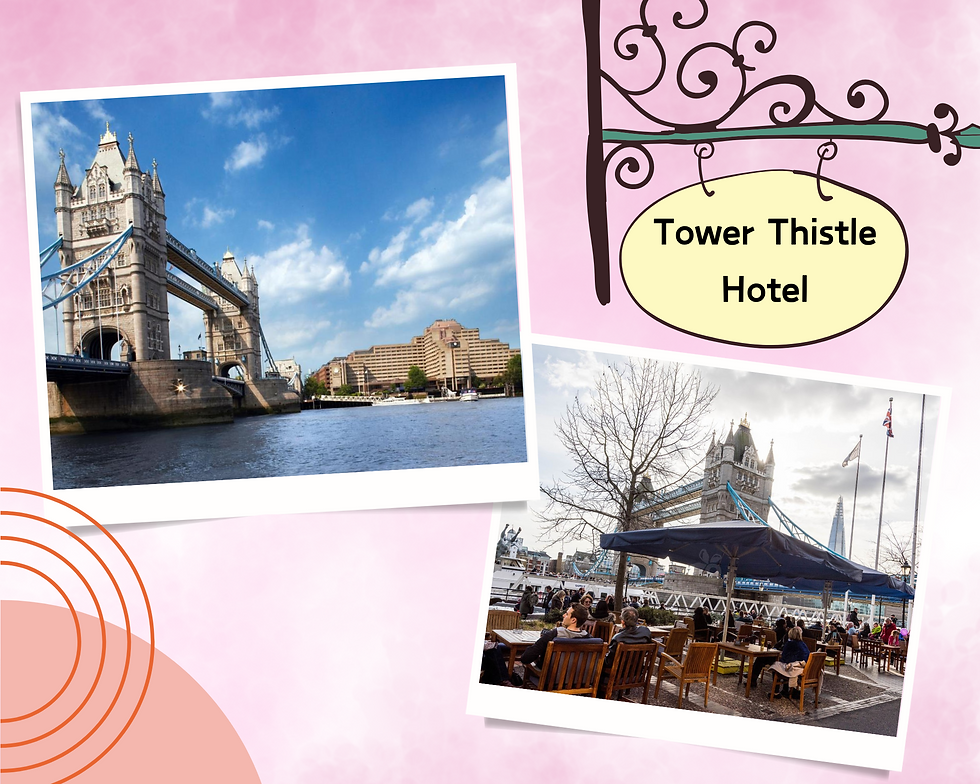
We could have gone out and explored London a bit more but we honestly didn't have the energy. Our Trafalgar bus tour began and ended at the Tower Thistle - hence our booking - and it officially began at the horrendously early time of 5.30am the next morning. Glad of the chance to rest and prepare, we only ventured out to find a nearby Safeway for some dinner. This was exciting enough for us, being able to buy a prepared dinner at a supermarket. It seems odd to say this now, but at the time in Australia, you couldn't do that.
The room gods were shining on us for our front end stay at the Tower Thistle as the Tower Bridge could be seen from our room. We were fortunate to see the bridge lift up that evening to let a ship pass through. How cool is that? That said, for some sad and inexplicable reason I don't have a photo, just the very bad one below of the view of the bridge from our room.


I was absolutely thrilled to have had the opportunity to visit Berlin and to finally set foot in Europe. I have been a Europhile since I was a child, fascinated by the history, the architecture, and the landscapes of all the countries of Europe and the idea of Europe as a concept. How so many different cultures and languages fit together on one land mass holds endless fascination for me. I had learnt German at high school and had always been interested in Germany and its turbulent history.

Berlin was our first experience of mainland Europe, so it will always hold a special place in my wandering heart.
We felt proud of ourselves for navigating the city, no mean feat back then without the benefit of Google maps!
I felt privileged and in awe of the politically and historically significant places we experienced, even if just as a taster.
Berlin cemented my love of Europe. This love has not dimmed in the years since our very first experience.

Berlin is a funky and eclectic place. It felt like we'd stepped into another dimension!
I have only appreciated with the passage of time the significance of our visit so soon after the fall of the Berlin Wall. There was so much construction! That watershed period in recent history came to life for us.
The sombre and heartbreaking experience of Sachsenhausen made me see the realities of the Holocaust for the first time.
Checkpoint Charlie and The Wall were pinch-me moments.
Turkish kebabs. Delicious!
I would love to return to Berlin one day and explore the city further as there's so much more I would like to experience. We saw a lot of things, but not in as much depth as I would have liked. Our first ever world wanderings were very much a taster and quite a whirlwind, experiencing lots of things in a short time. With the privilege of time, better earning capacity, and experience, I have learnt that depth is what I am after.
As I noted above, we did intend to return to Berlin in 2026 and had a 10-day plan to properly experience the city. That plan was put to an end by Trump and his ridiculous and devastating attacks on Iran. We were booked to fly with Qatar and our trip had to be cancelled. I hope we can return one day soon.
What next? Our adventures on a tour bus for three weeks with 40+ other people, hurtling around Europe...


Comments