Hola, Spain: Bookending our Portugal wanderings
- Jul 9
- 17 min read
Updated: Jul 21

A little bit of background 📝
Our first experience of Spain was a feat of happenstance. The focus of our wanderings that year was Portugal, and Spain ended up being the bookends of that trip. We flew in and out of Madrid, hired a car, and drove into Portugal from there. The below map charts our journey in May of 2024, beginning and ending in Madrid. You can read all about our Portugal adventure in between the Spanish bookends.

Why fly in and out of Madrid? I had joined the Qatar Airways air miles club! I'd travelled multiple times with the airline during 2022-2023 when I was working as the Global Education Manager for an international travel assistance company. I have nothing but positive things to say about Qatar Airways and my travel experiences with them. I even managed to fly with Qatar twice business class for work. So cool! I had points to use, so we booked with Qatar, stopping at the swanky airport in Doha on the way. There is a downside of travelling to Portugal with Qatar, though. The airline doesn't fly directly to Lisbon or Porto from Brisbane. We'd have needed a significant layover in Madrid to get to Lisbon. Instead, we decided to end our flight in Madrid and drive into Portugal, thus allowing us to see a little of Spain.


Our journey to Portugal: But first, hola, Spain! 🫒
We arrived in Madrid mid-afternoon from Brisbane, the day after we'd left home. Our experience of the airport was super positive. The arrivals process was navigated easily and quickly. Collecting our hire was also a fairly smooth process. We were on the road in no time, still reeling from the long journey from Australia. I always feel a bit weird when I am first deposited in a new country after a long time in the air. I'm not a natural flier at all, despite loads of international journeys. I find it hard to be cooped up in a plane for hours and then thrust back into the real world, albeit an unfamiliar one.
Soon we were heading on the highway for a one-hour journey to Talavera de la Reina, southwest of Madrid. I chose Talavera to break our journey to Portugal by checking Google Maps for the shortest possible journey to a place we could easily find and book for a night's accommodation. I wasn't sure how much travelling we'd be comfortable with after coming all the way from Australia. Everything still felt a bit surreal at this point, and not just from the travel fatigue. We were in Spain! And driving on the left (wrong?) side of the road! And feeling both nervous and excited about our adventure!
I've created the below map to chart our journey from Madrid into Portugal, taken over our first two days. You can see Talavera de la Reina at number 2 on the map, our journey from Madrid on Day 1. The third map marker is Badajoz, our second and last stop in Spain, on Day 2. Then we entered Portugal at Evora to reach our final destination at Setubal. Just a reminder that you can read about our Portugal adventure here.


Talavera de la Reina is in the province of Toledo in central Spain, in the district of Castile-la Mancha.
The city dates back to the eighth century, first conquered by Muslim forces in AD 713 and then Christian forces in 1083.
The de la Reina (of the queen) was added in 1328, after 17-year-old King Alfonso XI of Castile married his cousin, 15-year-old Maria of Portugal. He gave her the city as a wedding gift!
Talavera is known as the The City of Pottery, from the internationally-known tin-glazed earthenware made in the area.
We arrived in Talavera de la Reina in the early evening. It was super easy to find from the signs off the highway. What was less easy to find was the apartment we had booked for the night. We found the right street and a general sense of the apartment's location. However, the streets are narrow and mostly one way and we couldn't find anywhere to stop. The apartment's owner contacted us on WhatsApp and let us know that someone was waiting for us outside the apartment to show us where to park. Another couple of loops of the area were needed before we located our host. A slight lost in translation moment ensued: The lovely woman randomly jumped in the backseat of our car! There was a fair bit of waving and pointing as we tried to communicate with our non-existent Spanish and her basic English. Loads of smiling and nodding got us there in the end.
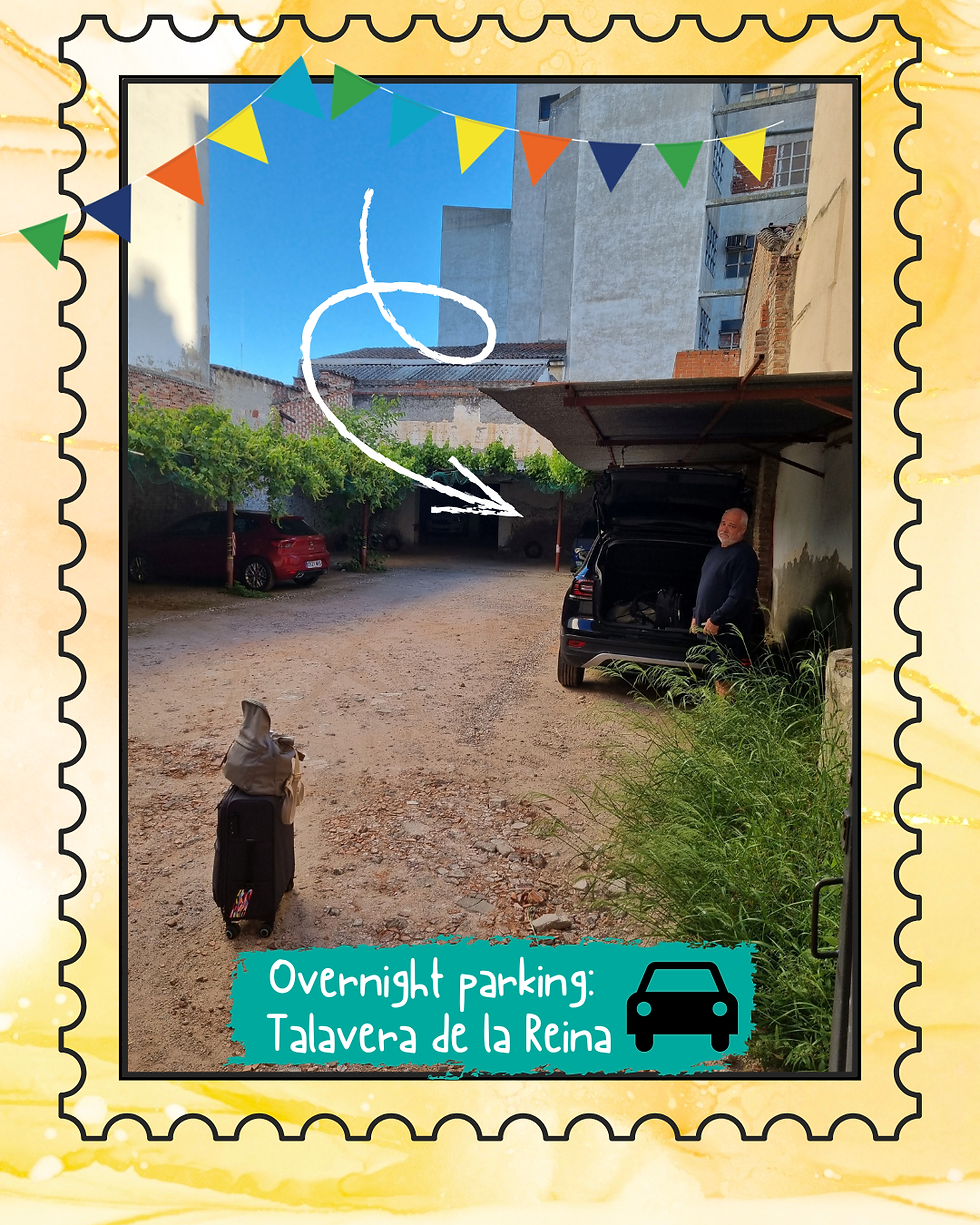
We were grateful for the free, secure car park - so Spanish! - especially since the apartment had only cost $120AUD for the night. For an inexpensive place, it is spacious and clean - more loft than apartment - and perfect for one night.

What we didn't know was that the day of our arrival - May 15 - is the annual Fiesta de San Isidro, the feast day of the patron saint of Madrid. We missed all the celebrations, but found the old town where we were staying rather quiet, with nothing much open. It was lovely and peaceful for our walk in the gorgeous early evening sun, but we could only find a tiny shop open. A small purchase of some ham and cheese had to see us through dinner and our breakfast. Travel fatigue was enough to stop us from finding an alternative food supply!
We only caught glimpses of the beautiful city that evening, but we loved what we saw. I think we were mostly just relieved to be in Spain and finished with our long journey from Australia. We'd never hired a car in Europe before, although we had driven on the right side of the road in the United States several times previously. It was a relief to have our first driving leg out of the way. The spring weather was glorious, too. I had my first sight of old doors and ancient city walls. I was well and truly in my happy place.

We wandered along the Tagus River for a bit in the beautiful early evening sun. The city straddles the Tagus. The river is the longest on the Iberian Peninsula. It flows over 1000 kilometres from mideast Spain to Lisbon, emptying into the Atlantic. It is such a pretty feature of the city.

We walked past the magnificent Catholic church, the Iglesia de Santa Maria la Mayor. This church was my first glimpse of the distinct creams and browns of Iberia, so different to the churches I had seen before in the UK and other parts of Europe. The stunning deep blue sky really shows the church in all its glory.

Historians believe that Iglesia de Santa Maria la Mayor dates back to 1194, built on the site where there was previously a mosque.
The cloisters were added in 1469 and several chapels in the 15th and 16th centuries.
The facade is Gothic-Mudejar in design. Mudejar is a form of ornamentation used in the Iberian Christian kingdoms between the 13th and 16 centuries.
I was glad that we had a pretty decent night's sleep despite very little nourishment. We were up early the next day on a chilly spring morning as we had a long drive ahead of us. Our morning drive took us through the flat, brown Spanish landscape to Badajoz, a city on the border with Portugal.
Badajoz is the capital of the province of Badajoz, sitting on the left bank of the River Guadiana.
The river stretches across Spain flowing east-west then heads south through Portugal into the Gulf of Cadiz at the western end of the Strait of Gibraltar.
Badajoz was founded in 875 CE although archeological finds in the area date back to the Bronze Age.
Badajoz lies in the A5 route that connects Central Spain with Portugal. It is an important link between the two countries for trade and cultural relations.
Fortuitously, as we drove into the city we could see the fortress. I had only planned on Badajoz as a lunch stop to break our journey, so it was so cool that we spotted the fortress. We doubled back to the Lidl we'd passed on the way in as we were desperately hungry by then! Badajoz gave us our first experience of poking around local supermarkets, something we love to do. Loaded up with supplies from the Lidl, we headed back to the fortress and had a picnic in the magnificent ancient site.
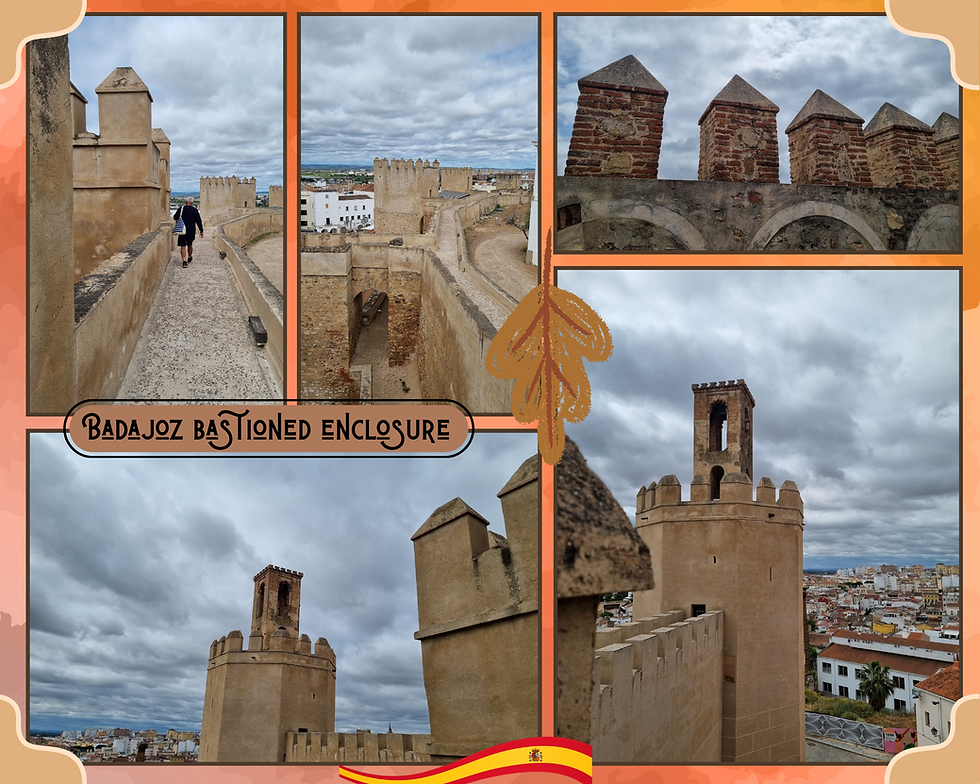
The Alcazaba of Badajoz is a Moorish citadel.
Historians believe the fortress was built by the Almohads ( North African Berber Muslim empire) in the 12th century, but could have existed from the time of the city's founding in the 9th century.
The fortress was built to control the passage from Portugal to Central Iberia.
There was a fierce battle in 1821, led by the future Duke of Wellington, to seize the fortress from the French.
It was declared a national monument in 1931.
The fortress is, understandably, located on a hill, providing views of the surrounding city. The alcazaba was declared a national monument of Spain in 1931. It's free to walk the whole line of walls. There are several towers and gates still standing, built in the Mudejar style. The tower in the bottom right shot above is Espantaperros Tower, built in 1160 and reaching 30 metres.
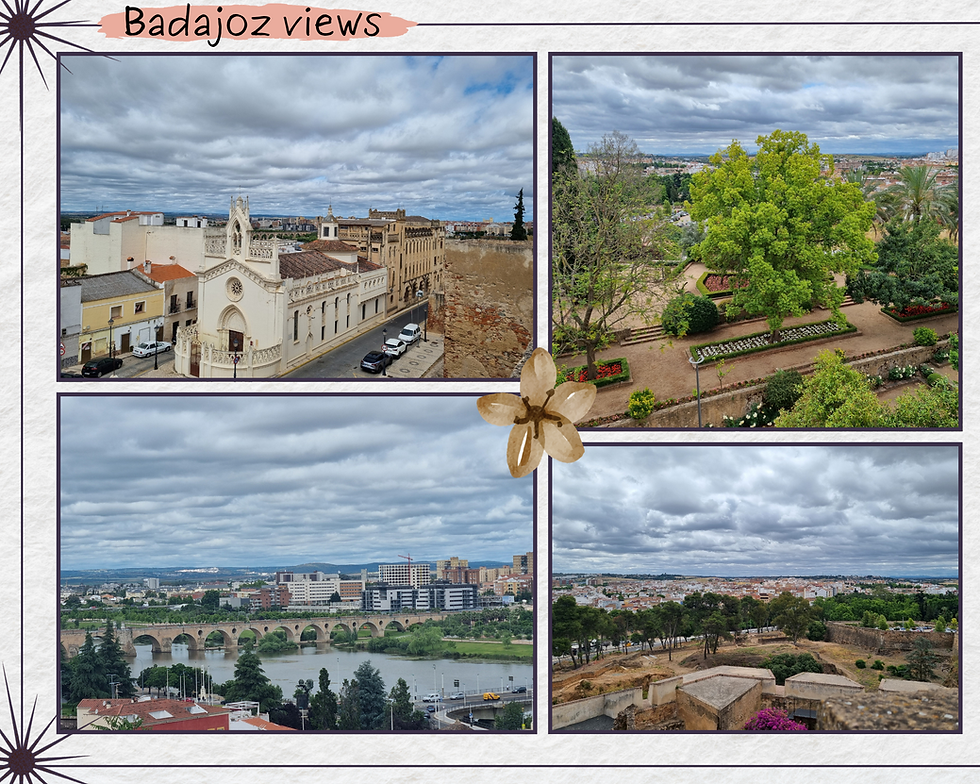
So, that was it for our Spanish experience at the front end of our Portugal wanderings. We headed over the border after lunch into Portugal for our first glimpses of the country. You can read about our Portugal experience here.
Hola Spain de nuevo 👋🏼
The end of our adventure saw us sadly and reluctantly saying farewell to Portugal. We needed to head back to Madrid for the back end of our Portugal wanderings to fly back to Australia. The front bookend of our journey saw us drive south from Madrid and west into Portugal. By the end of our Portugal expedition we were in Northern Portugal (map marker 1) staying in the Peneda-Geres National Park. Ending our trip there gave us the chance to drive east into Spain and come from the north into Madrid. This was a 550 kilometre journey! Our plan was to break that journey with an overnight stay in Zamora (map marker 2). This plan meant we would drive around 300 kilometres from Geres first, then 270 kilometres to Madrid.

We had an idea to stop along the way at Braganca near the Spanish border. However, somehow Google Maps took us on a meandering journey through the Peneda-Geres National Park and into an isolated part of Spain. Not to worry, we had the chance to breathe in our last glimpses of the stunning landscape.

The landscape changed from the lush valleys and bushland of Peneda-Geres to the much drier and flatter plains of central Spain, where the dominant colour is brown. We seemed to drive for ages in the middle of nowhere. Portugal is different as there are villages dotted everywhere.
When our internal clocks chimed for lunch, we couldn't find any roadside places to stop - certainly no parks near the highway - so we ended up stopping at a massive service station to break our journey. Hilariously we ate our picnic lunch sitting in the car in the gravel car park. Arriving in Zamora in the early afternoon felt like coming upon an oasis. We were reunited with the Douro River again! The Douro is the largest river by discharge of the Iberian Peninsula, flowing 900 kilometres from central Spain to the Atlantic Ocean at Porto.

Zamora lies 650 metres above sea level, 50 km upstream of the Portuguese border on the Douro River. It is a city and a province in the Castile and Leon region.
The city was founded in the Bronze Age then occupied in the Iron Age by pre-Roman Celtic peoples of Spain who called it Ocalam.
"Rome wasn't built in a day" in Spanish is No se ganó Zamora en un hora (Zamora wasn't built in an hour), referring to 15th century battles between Queen Isabella and Juana la Beltraneja, a claimant to the throne.
We wanted to check into the apartment we'd booked for the night before having a wander around. Unfortunately, there was an issue with our roaming data and I needed to get online to obtain the code for the apartment building. Slight panic for a moment, but then we found a shopping mall and sat in the McDonald's to pinch their Wifi until we fixed our tech issue.
The apartment doesn't look much from the outside, but it is really nice inside, all modern and clean, and perfect for our overnight stay. The building is on a pretty tree-lined street - Avenida de Requejo Primero - that is a lovely walk into the centre of the old town.
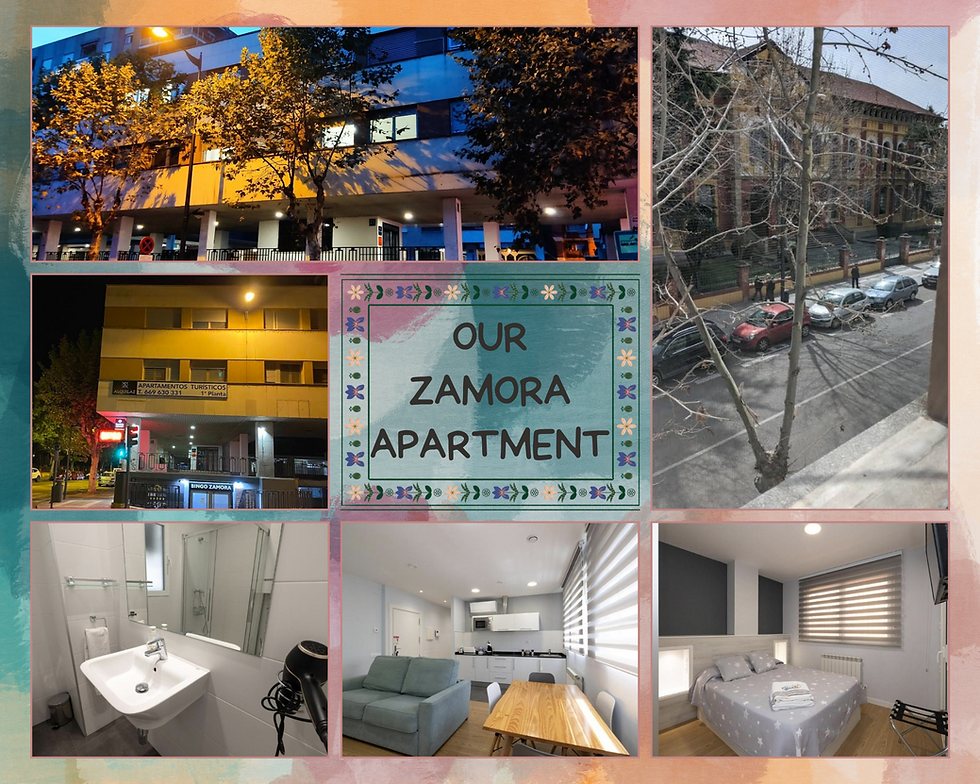
I loved our afternoon wander around Zamora. The old town is full of beautiful old stone buildings, cobbled streets, and pretty green spaces. Stone buildings are totally my jam so Zamora was an architectural feast for me. I also noticed the clean streets and well-kept buildings, such a difference from Portugal's shabby vibe. The warm and brilliantly sunny day also helped make us feel so happy to be in Zamora. The sky was such a deep, cloudless blue that day. We must have hit the Spanish siesta period of the day as we hardly saw another soul!

One of Zamora's most notable architectural features is its Romanesque design. This architectural design is characterised by robust construction, thick stone walls, small windows, and semi-circular arches. Apparently, Zamora's 24 Romanesque churches are the most of that style in the one city in all of Europe. They were all built in the 12th and 13 centuries. One such example is Zamora Cathedral.
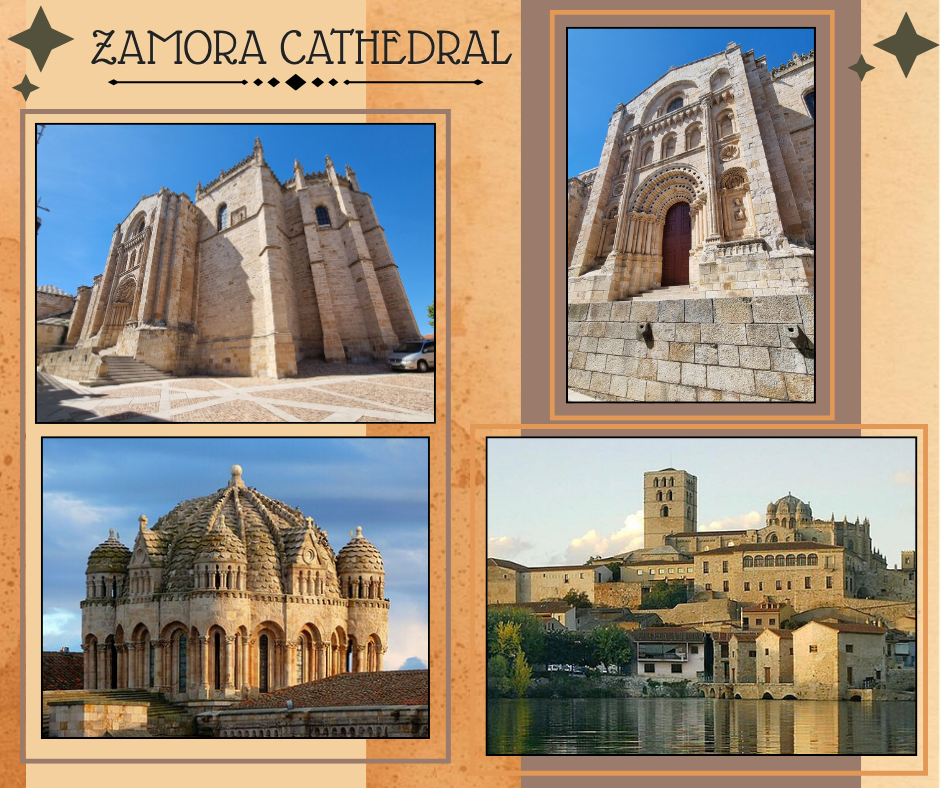
The cathedral was built between 1151 and 1174, the oldest cathedral in Castile and Leon in northwestern Spain.
It has one of the best-known examples of a gallonade dome. Not heard of that? Me, either. Apparently gallonade domes are fluted, pumpkin-like or scalloped designs, resembling segments of a sphere. The dome is one of the key symbols of Zamora and can be seen from anywhere in the city.
The bell tower reaches a height of 45 metres. It was built in the 13th century, in keeping with the Romanesque style.
We sat in the annex to Zamora Castle - appropriately named The Castle Park - while we waited for the castle to open. The park has a pretty garden and views of the Douro. The castle is free to enter. At the time of writing, opening hours are Tuesday to Sunday from 10.30am-2pm and again from 5pm-9pm. The perimeter of the castle is well preserved as are its most important walls, the parade ground, and the keep tower. The castle is reached by a bridge that sits where the original drawbridge was built

There is lots to explore at the castle, but nothing remains of its interior. I understand that the castle was closed for a bit and reopened in 2009 after an upgrade to its defensive structures and the surrounding gardens. There's just a little shed at the entrance as made our way into the castle, staffed by a single person. There are no facilities or gift shop. I like that the castle is accessible but not overly touristy. We had a lovely time poking around as there were hardly any people around when we entered at opening time.
The castle is a medieval fortress, between between the 10th and 12th centuries.
It was never a castle as such, but a structure to protect the city.
The castle is protected by a deep moat as part of its defence system.
The structure underwent a major transformation in the 18th century to become an artillery fort to adapt to new methods of warfare.
Another notable structure in Zamora is Bishop's Gate, known in Spanish as Puerta del Obispo. The gate is part of of the first walled enclosure of the city. I didn't realise its significance until I was putting this post together or I would have taken a better picture!

Bishop's gate was built during the 11th century, originally serving as the southern-side entrance to the city.
In architectural terms, it is a lowered semi-circle arch with a plain impost (the top section of a pillar that supports an arch). It is topped by a small gable roof.
The gate serves as a reminder of Zamora's strategic importance during the Middle Ages.
The arch connects a square that provides a viewpoint to the Douro River and another square that houses the Bishop's Palace, adjacent to the cathedral.
Did I mention that I just love old doors! It's their age, their intriguing designs, and the thought of what once lay behind them that interests me. I love these old wooden doors that I spotted in Zamora, portals into the city's stunning ancient stone buildings.

Day 15 saw us take the second leg of our journey from Portugal to Spain, back to where we started over two weeks ago, to Madrid. We covered the 270 km journey easily and arriving in the city mid-morning. We'd headed straight out of Madrid when we first arrived so this was our opportunity to do a bit of exploring. W drove into the most populous city of Spain in another bad-ass manoeuvre and managed to find us a park in the centre in an underground parking area. As we started to wander the city, we found the crowds and the busyness after the relative quiet of Portugal and Zamora.

Madrid, the capital of Spain, is the second largest city in the European Union after Berlin and has the second largest metropolitan area after Paris.
The city lies on the River Manzanares in the centre of the Iberian Peninsula and sits around 660 metres above sea level.
History tells us that the site has been occupied since prehistoric times, but the first recorded historical documents date from the Muslim age in the second half of the 9th century.
One of the most notable features of the city is El Retiro Park - buen retiro in Spanish, meaning good retreat - one of the largest parks in Madrid. It was such a beautiful day and we loved wandering through the park. It's so nice to see big, beautiful green spaces in major urban areas to balance out all the concrete and buildings. The park is a real gem and a peaceful escape in the busy city. I tried to imagine what it would be like to live in Madrid and be able to regularly stroll through the park. It's spacious and there are lots of paved walkways and its size means it doesn't feel crowded.

El Retiro encompasses 1.4 km² of gardens, monuments, an artificial lake with a fountain, galleries and event venues. There are cafes and restaurants and children's playgrounds.
El Retiro is the same size as Hyde Park.
The park belonged to the Spanish monarchy until 1868 when it became a public park after the Glorious Revolution deposed Queen Isabella II.
It has been a UNESCO World Heritage Site since 2021.
We didn't have a lot of time in Madrid, although I know there are loads of museums and churches and other historic buildings to visit. We happened upon the Church of Saint Jerome the Royal in our wanderings so chose it as the only building we explored inside. The Catholic church sits in the heart of Madrid and is commonly known as the Hieronymites. Inside the church there are sculptures, painting, neo-Gothic lamps and beautiful stained-glass windows. Admission to the church is free.

The Church of St Jerome the Royal dates back to the early 16th century. Major restorations occurred between 1848-1883 after damage sustained during the Napoleonic Wars.
The church is built in Elizabethan Gothic style on the remains of an ancient Hieronymite monastery next to the Prado Museum, now the main Spanish national art gallery.
The church has a long association with Spanish royalty and the location of several important investiture ceremonies.
Most of our day was spent wandering around taking in the vibe. The day was hot and beautifully sunny, with a brilliant blue sky to make the magnificent white buildings stand out even more. There were loads of people around! We found a Starbucks for a bit of a respite and had toasted sandwiches and a cold drink for lunch. I don't like to give my money to Starbucks, but it was an easy option and only the second time in the whole trip when we didn't have our usual picnic lunch.
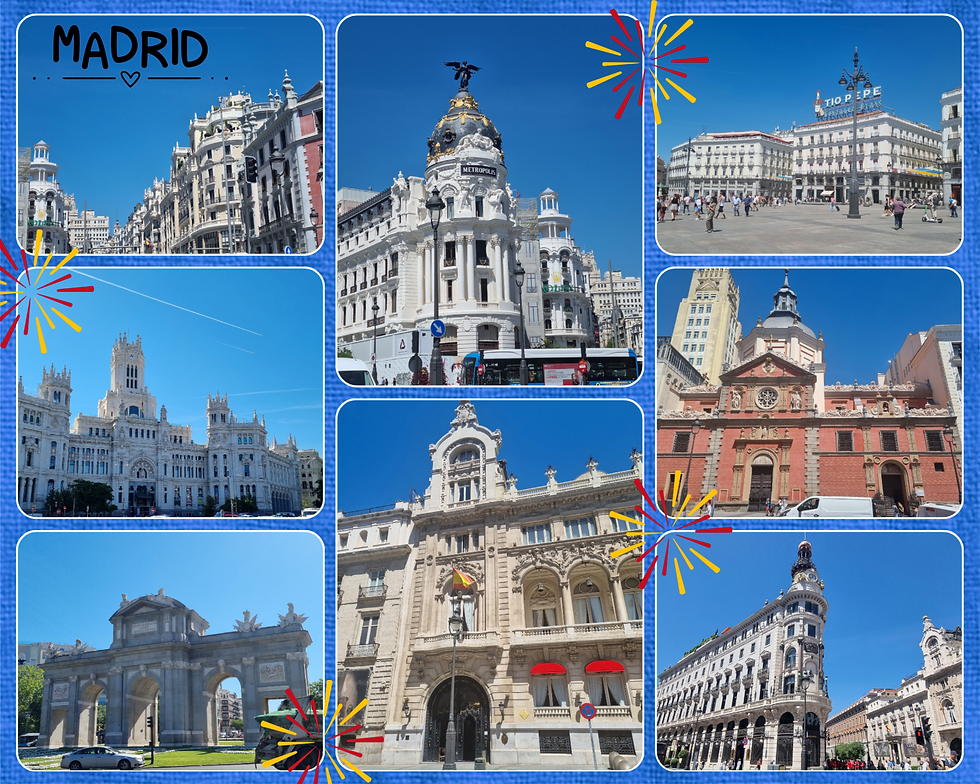
Later in the afternoon we fetched our car and returned it to the airport. Our flight back to Australia was due to leave the next morning. It felt easier to return the car (and avoid paying for another day's rental) rather than try to organise it before our departure. I booked us into an apartment for the night that was close to the airport and a metro station. The below map gives a bit of an idea where we stayed, around 9.5km from the airport.
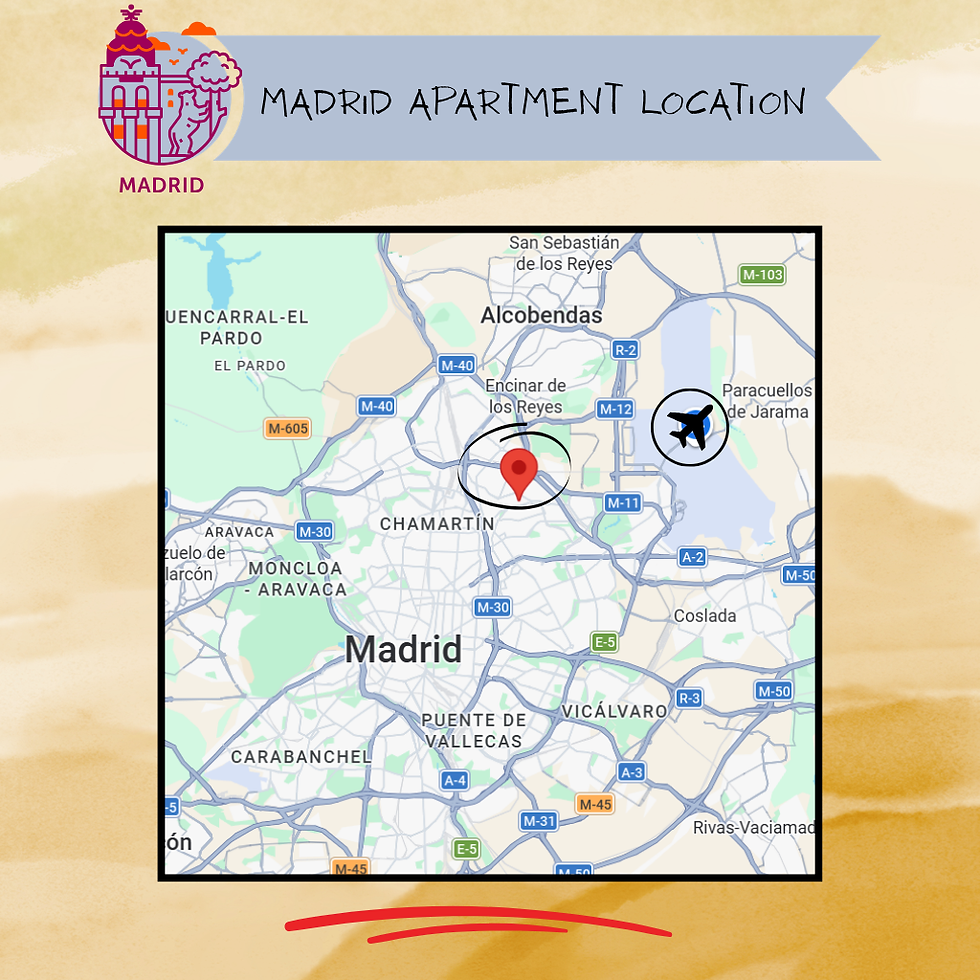
It was super easy to purchase a travel card for the metro after we'd dropped off the car and make our way to the apartment at 4 Calle Torregrosa. The building is a short walk from the metro, in an area full of apartment buildings. A code was sent to us via Booking dot com, but we couldn't make it work to let us into the apartment. Fortunately I had a WhatsApp contact for the apartment manager and she unlocked the door remotely for us.
It was a relief to be able to relax for a bit, repack for our journey home, and take a stroll through the neighbourhood to find a small market for dinner supplies. The apartment cost us $192AUD for the night but it was worth it to be close to the airport for a hassle-free departure.

I have to admit that finding mementos of our travels through Portugal and Spain was not an easy task. This is a good thing, I think, that we didn't see a load of tacky souvenir shops and stalls. My house is decorated with postcards and prints from my world wanderings and I was looking for something to remind me of Madrid's beauty. I managed to find the below set of gorgeous postcards.

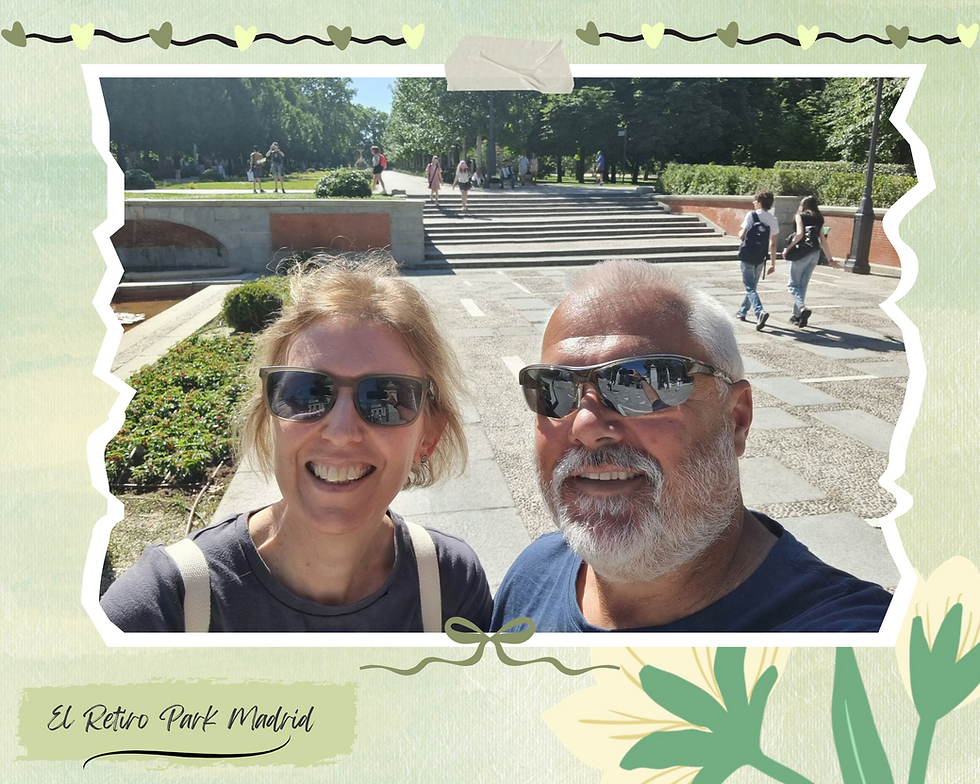
Here we are in El Retiro Park. I'd certainly go back to Madrid to explore the city further. It's such a vibrant city, where history and modern life blend seamlessly, rightly earning its place as both the geographic and emotional heart of Spain.
That was it for our Portugal adventure with a bookend experience of Spain. The next day we made the long journey back to Australia. Our Qatar Airways flight left at 9am for a seven-hour journey to Doha and a short stopover, then the gruelling 14-hour flight to Brisbane. At least we were treated to this beautiful sunset as we made our way to the metro station to travel to the airport.


Spain was such a lovely bonus for us as our focus was on exploring Portugal for the first time. We stuck with Qatar Airways and appreciated the priority boarding, lounge access and legroom seats that my air miles gave us. We could easily have sat in Madrid airport for hours and hours and flown into Lisbon, but I am so glad we decided to hire a car and drive to Portugal. Sure, this plan created an added another layer of travel and planning, and it reduced our time in Portugal. What we saw of Spain we loved and it helped us better understand and appreciate Portugal as well.

Our first time in Spain! Our appetite was well and truly whet. I'd love to return to see more.
Our decision to drive into Portugal from Madrid and back again: Such a lovely opportunity to see something of Spain and the eastern side of Portugal.
Madrid is the second largest city and metropolitan area in the EU. It was such a confidence boost to drive in and around Madrid. Navigating the airport was no mean feat, either!

The Spanish landscape: Flatter, browner, less vegetation and none of the whitewashed villages that are dotted everywhere in Portugal.
The contrasting beauty of Zamora and Madrid: Stone Romanesque style versus white buildings and the oasis of pretty El Retiro park.
Our quiet wanderings through Zamora during siesta: It almost felt like we had the historic old town to ourselves!
Chic versus shabby chic: Portugal is more casual with a lot of rundown and abandoned buildings.
We were to return to Portugal the following year and again flew with Qatar Airways into Madrid, hiring a car and taking two different routes in and out of Portugal. There is a post to come on those adventures. You can also read about our first Portugal expedition.


Comments