Easter break London wanderings
Updated: Jan 6

A little bit of background📝
Back in London! This post explores my sixth opportunity to wander the iconic city. My four previous visits to London in the two-thousands had been part of conference and work projects. I’d be fortunate to use available downtime to immerse myself in all London has to offer during those trips. This London trip was a family experience, to celebrate our 25th wedding anniversary in April of 2018. Our daughter, referred to as E in my posts, who was 17 at the time, came with W, my husband, and me. We took the trip around Easter to coincide with our actual anniversary on April 10. London was kind of the taster of the trip, though. The main event was the 10 days we spent in Northern Ireland and the Republic of Ireland.

Why did we choose [both] Irelands for our anniversary trip? Our first ever world wanderings in 1996 came three years after we got married, when we’d saved up enough money for a proper holiday. Part of that 6-week trip was a 2-week self-drive around England, Scotland and Wales. We didn’t have the time nor the funds to include Ireland so here we were, 25 years later, making up for that and completing the Great Britain and Ireland circle. The trip was also W's first time in London since our whirlwind 2-day taster in 1996.

Travelling to London✈️
We’d come to London via Sydney and Abu Dhabi, using Virgin frequent flyer points from W’s work travels to fly free to and from Sydney. We then took an international flight to Heathrow with Etihad.
Our Etihad experience was a good one; well, as good as it gets sitting in economy seats for 22 + hours! Unfortunately, E had been ill on the flight from Sydney to Abu Dhabi, so we’d used our short stopover at the airport to find a chemist to ease her nausea. I remember feeling terrible that W and I slept through her being sick on the flight. The flight attendant gave her a muffin but I'm not sure about that as a means of easing travel sickness. I wish in hindsight I had reserved extra legroom seats. The space makes all the difference, lessening the feelings of claustrophobia with no one sitting directly in front.

Needless to say, we were relieved to land in London! We'd booked an Airbnb flat in Fulham for our stay. The place felt like ‘proper London’: small but cosy and warm, and an easy walk to the Tube. We've had a pretty good run with Airbnb places, and the Fulham flat gave us a taste of authentic London life. Much better than a hotel!

This, my sixth visit to London, was less about new explorations and more about W rediscovering places he’d seen over twenty years ago and E experiencing London for the first time. We did A LOT of walking and taking in the iconic places and spaces of the city. I’d seen most of them many times before, but it was nice to tag along for E’s discovery of what I think is one of the most interesting cities in the world. Also, I realise I didn't buy a single thing the whole time we were in London. Huh!
Sadly, the weather wasn’t kind to us. This was spring, but it was freezing cold and dreary for most of our stay. It drizzled with rain on two of the four days, and we only saw the sun in the afternoon of our final day. The weather affected my planning, and I know that we didn’t do some of the things that I’d hoped we’d do.
We basically walked around for four days and the only places we paid to go into were The Monument and The London Eye. That is kind of our vibe, though. I love going to so-called places of interest, but I also just like wandering around, taking in the atmosphere. I love green spaces and all kinds of landscapes, and I'm just as happy to marvel at buildings from the outside as from within. [See my Chicago post, where we spent most of our week in that city just wandering around in the snow.]
Looking back, I realise there were also some personal things going on for both E and me at the time, and they probably impacted on our trip. That said, I was still thrilled to have had another opportunity to experience a city that I have grown to love. I truly feel at home in London, even though there’s so much I’ve still to explore.
I’ve waded through over 600 photos to prepare this post. I can’t believe we took that many photos over four days! Content warning: There are A TONNE of photo collages in this post, but I hope they go some way to capturing the London vibe and our experiences of wandering around this historic city.

Day 1: Central London💂🏼
We started our wanderings in Westminster and St James’s. These are the parts of London that I think of as being central and the hub of the city. I know them so well after multiple visits. I love the cluster of historic buildings and squares and the green spaces. Westminster Abbey, the Houses of Parliament, and Whitehall in particular, are magnificent buildings. There are always loads of people around so even though it can be crowded, there's a nice buzz to the place.
Fun fact ℹ️
Charing Cross is considered to be the centre of London and the point for measuring the distance to and from London. This is not for the geographic location, although the junction is central, but for the site of the statue of King Charles I that was originally where the main Eleanor cross stood, in memory of King Edward I's wife, Eleanor of Castile, who died in 1290.
Here we are wandering around Palace of Westminster, commonly known as the Houses of Parliament. The site dates back to 1016 but sadly a fire destroyed the original buildings in 1834 and they were reconstructed between 1840 and 1876.

The Houses of Parliament take their common name from the House of Commons and the House of Lords, the two legislative chambers that are housed [haha] in the building. The original construction mentioned above was for a royal palace and primary residence of the current king. A fire in 1513 destroyed the royal apartments and the later, a bigger fire in 1834 destroyed most of the palace. The current buildings have been constructed in Gothic Revival style. The Houses of Parliament are probably one of the most recognisable buildings in London.
The whole site is quite big and so it takes a good bit of time to wander around and see all the parts of the structure. There are also lovely views of the buildings from the other side of the river. In 2014 I did the Houses of Parliament tour so check out my post for more information. I highly recommend the tour. Being able to poke around a good bit of the interior space is super interesting.

Another instantly recognisable building is Westminster Abbey, founded in 959 BC and consecrated in 1065. The abbey is a gothic cathedral that has been the location for coronations of monarchs since 1100. Well old!
At the time of writing this post, entry costs £30 but there are London attraction passes that give free admission. We didn't go inside as W and I had done that before, and I think the abbey is just as well appreciated from the outside. The multitude of facades are stunning. There's also always a line up to get in so make sure to book tickets in advance.

We continued our wanderings and spent some time in Whitehall. although a distinct part of London, Whitehall is technically a road and area in the City of Westminster, creating a thoroughfare that runs south from Trafalgar Square towards Parliament Square [the bit between the Houses of Parliament and Westminster Abbey]. There's a bunch of government buildings and the Palace of Whitehall and the Horse Guards building that you can see in the below photos. Also as can be seen in the photos, Whitehall sits on the opposite bank of the Thames to the London Eye, so there's a nice perspective on the observation wheel from Horse Guards Avenue.
You can also see the Cenotaph in the below collage, a war memorial unveiled in 1920 as the UK's national remembrance for those killed in WW1. The memorial was rededicated in 1946 to include WW2 casualties and later casualties from all Commonwealth countries in subsequent conflicts.

No visit to Central London would be complete without a wander around Trafalgar Square. The square dates back to the early 19th century but commemorates the Battle of Trafalgar where British naval forces won victory over France and Spain in the Napoleonic Wars in 1805. The site itself has been a city landmark since the 1200s as it it close to Charing Cross, London 's notional centre and location marker.
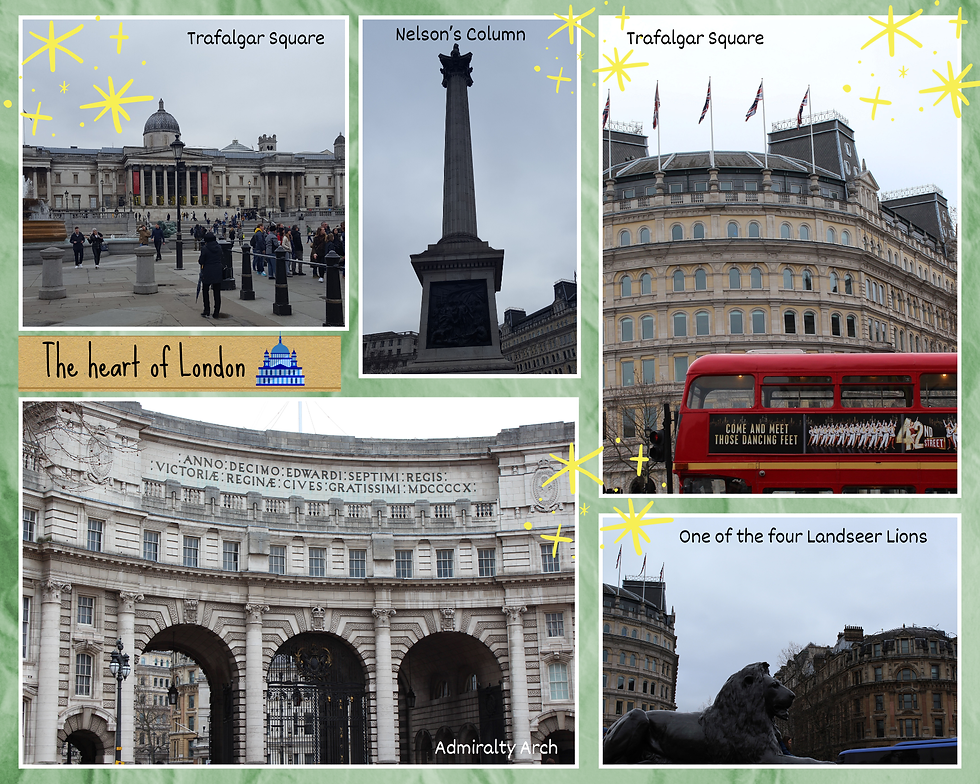
Admiralty Arch can also be seen in the above collage. The arch is another iconic structure in London, commissioned by King Edward VII in memory of his mother, Queen Victoria. The Latin inscription along the top can be translated to: In the tenth year of King Edward II, to Queen Victoria, from most grateful citizens, 1910.
St James’s Park is my favourite London green space. It's one of the group of eight Royal Parks in London. We did a bit of a loop around, taking in Birdcage Walk and swinging by Buckingham Palace, returning later to the latter on another day. [See photos later in this post.] The park stretches 23 hectares, bound by Buckingham Palace to the west, the Mall to the north, Horse Guards to the east, and the Birdcage Walk to the south. The whole area is so familiar to me as I've wandered around it each time I've been in London. It's just so pretty, and lovely to see beautiful green spaces in the heart of big cities.

These wanderings occupied our morning. Later we met up with my friend, AD, who lives in Kent. I’d last seen her during my 2015 work project visit. AD came with us for our afternoon wanderings, starting with lunch at our favourite spot, the café in the crypt of St-Martin-in-the-Fields. We then wandered from Trafalgar Square to Kensington Gardens and Hyde Park and back to Marble Arch, via Knightsbridge, first swinging by Covent Garden.

We'd poked around Piccadilly earlier in the day. This is another pretty part of London. I don't mean Piccadilly Circus, but the gorgeous buildings in the posh Piccadilly-Mayfair area. This the part of the city where the Ritz lives⭐.

It was a pretty bleak day, but just look at our beautiful photos of Kensington Gardens! The Gardens form another of the eight Royal Parks in London, covering 107 hectares, to the west of Hyde Park. The gardens are Grade 1 listed and go back as far as 1536 when they were used as a royal hunting ground.

Central London is so pretty where the green spaces merge. There's a kind of continuous green space that connects Kensington Gardens, Hyde Park, Green Park, and St James's Park.

Two of the key structures in Kensington Gardens are (i) Royal Albert Hall, built in 1871, and (ii) Queen Victoria’s memorial to her husband, Albert, opened in 1872, 11 years after Albert’s death.
Royal Albert Hall, a magnificent Grade 1 listed building, is the round building in the below collage. It has an 1850-square-metre glazed iron roof designed by the structural engineers and architects who built the roofs of St Pancras and Charing Cross stations. During the two world wars the roof was used as a navigation point for pilots. A mosaic frieze, The Triumph of Arts and Letters, encircles the building. There are 16 sections on the building that showcase human accomplishments throughout history. Seven leading Victorian artists were commissioned to design the sections. Read here to find out more about each section of the frieze.
Royal Albert Hall is a rather stunning building, framed by pretty trees. I've never been inside, but I've stood in front of the building twice now. Learning about its architectural detail only adds to my love of it.

The other shots in the above collage are of the Albert Memorial. The memorial is styled as Gothic Revival, with an ornate pavilion standing 54 metres tall. The statue of Albert ceremonially seated underneath was added in 1876. The memorial has been Grade 1 listed since 1970. The central part is surrounded by the sculptural Frieze of Parnassus which shows 169 composers, architects, poets, painters, and sculptors. The corners of the main part of the memorial showcase allegorical sculptures of agriculture, commerce, engineering and manufacturing. There are sculptures representing Asia, Europe, Africa and the Americas.
I've seen the memorial multiple times during London visits. I understand that Queen Victoria felt a profound love for, and loss of her husband. The memorial stands as testimony to that love. It's just...so...gaudy.
Not far from the Memorial is Knightsbridge, properly famous for being the location of Harrods. It's actually a pretty part of London, with lots of gorgeous, and super expensive!, houses.

We finished up our day's wanderings at Marble Arch, on the edge of Hyde Park, another of the eight Royal Parks. The white marble arch was built in 1827. It was first located at the state entrance to the Court of Honour at Buckingham Palace but was moved to its current site in 1851 to make way for the expansion of Buckingham Palace.

Day 2: London bridges walk🌉
I’d done some research on London walks, and we thought it would be kind of cool to do a bridge walk, making our way up the Thames from Tower Bridge to Vauxhall Bridge, crossing some of the bridges along the way and exploring the walking paths that frame the north and south banks of the river.
We started our river walk at The Monument on the north bank. I’d climbed up the 300-odd stairs of The Monument during my last visit to London, but suggested to W and E that we do it both as a jumping off point for our river walk. The Monument is a must-do, I think, when in London, for its history and for the views. It’s super easy to get to on the Tube as it's a short walk from Monument station. At the time of writing, 2024 tickets cost only £6, purchased on the day at the site. We got there right on opening time at 9.30am and there was no queue.
The Monument is a...monument...to the Great Fire of London in 1666. The Monument sits at the junction of Fish Street Hill and Monument Street and was built between 1671 and 1677. It reaches just over 61 metres. That's E and me at the Monument's base, to give you an idea of the scale of the structure.

Something to note is that the stairs - all 311 of them! - are very narrow and windy. There's not much space inside for the climb. I hope the below photos show what it's like inside. There's barely enough room to fit two people if someone is coming the other way. It's also a good idea NOT to have a big bag with you. Way cool, though!

The views are spectacular from the viewing platform as can be seen in our photos, even on a bleak day. It's possible to walk around the whole top bit to take in the London panorama although there's not much space on the platform.

Below are some shots of us the top. It's safe, as you can see, as there's a cage around the viewing area. It was freezing at the top when we were there, but I would still highly recommend braving the climb and the weather. It's a cheap way to get amazing views! It's also amazing to think that the Monument was built just a few metres from where the Great Fire started in Pudding Lane on 2 September 1666.

Make sure to check out the Monument structure itself as it has multiple inscriptions and sculptures on the panels of the pedestal. For example, the sculpture on the west panel represents the King bestowing his protection onto the city after the fire.
After Monument, we headed downriver before making our way back up the Thames towards Vauxhall. This detour was planned so we could experience Tower Bridge. Our detour took us slightly away from the river along Lower Thames Street. I love exploring the nooks and crannies of a city. You never know what you might stumble across!

Heading to the riverbank took us along a lovely walkway known as Sugar Quay. There are fabulous uninterrupted views of the entire span of Tower Bridge all along Sugar Quay. There’s also a pretty section with pale blue fences set against the trees that line the river.

Here are some more fabulous photos of Tower Bridge from Sugar Quay. I love the main shot, capturing a red London bus as it travelled across the main section of the bridge.

Taking the north to south option to cross the Tower Bridge provides an opportunity to stroll past the Tower of London that sits just west of the bridge. We’d already been inside during our first visit to London and our focus for the day was river wandering so we didn’t go into the Tower. There’s a lot to see and experience at the Tower – including the crown jewels - so I’d recommend allowing the better part of a day when planning a visit. Tower of London tickets cost around £35 at the time of writing so it’s best to make the most of the time and money!

This was my third opportunity to cross Tower Bridge, and my third visit did not dim my enthusiasm for the magnificent and iconic structure. I love a good bridge! Tower Bridge is a spectacular turreted behemoth, built between 1886 and 1894 in neo-gothic style to blend in with the Tower of London, as requested by Queen Victoria. It’s now a Grade I listed structure. In architectural terms, Tower Bridge is a bascule suspension bridge, meaning it has a drawbridge and uses a counterweight that balances the span when it lifts upwards to provide safe passage for boats along the river.

The bridge is around 300m long and the two towers reach 65 metres in height. Tower Bridge spans the boroughs between Tower Hamlets and Southwark. Here we are crossing the bridge. I hope my photos help to show the size of the towers!

Crossing over the bridge put us on the south bank of the Thames for the first time that day. Here are some shots of the south bank on the western side of Tower Bridge. The Tower of London can be seen in the top left-hand shot.

We made another small downriver detour at the Shad Thames area on the eastern side of Tower Bridge before continuing to walk upriver to London Bridge. Shad Thames is filled with converted Victorian warehouses and cobbled streets, so it's well worth a poke around. There’s a wide pedestrian path between Tower and London bridges, part of the 4km Queen’s Walk of pedestrian space that stretches between Tower Bridge and Lambeth Bridge. There are so many little interesting lanes and buildings in the spaces adjacent to the Thames river paths!

London Bridge is not particularly memorable structurally although the modern bridge occupies the space where the oldest river crossing once stood. The current bridge is a box girder structure made of concrete and steel and devoid of any decoration or distinguishing features. The main beam girders form the shape of a hollow box. The bridge is 270 metres long and 32 metres wide.

The modern bridge was built between 1971 and 1973 but there is a rich history to its design life. Three bridges have spanned the Thames before it: several wooden bridges [1176 BC-AD 50], a medieval stone arch bridge [1176-1832] and a Victorian stone arch bridge [1832-1968]. Until 1729, London Bridge was the only Thames road crossing downstream of Kingston-upon-Thames.
Making the walk up to London Bridge and crossing over it affords fabulous views of Tower Bridge, even on a grey day, with the HMS Belfast and City Hall in the foreground [the latter is the round silvery building behind E's shoulder]. This is E and me on London Bridge, looking back towards Tower Bridge. For perspective, there is only 1km between Tower Bridge and London Bridge.

While there is the chance to see The Shard from Queen’s Walk, London Bridge is a great opportunity to properly see the 72-storey, 300-metre-high pyramid-shaped building, completed in 2012. The Shard is one of the iconic modern structures that pepper the London skyline. It is possible to go up to the top for views and dine and stay there.
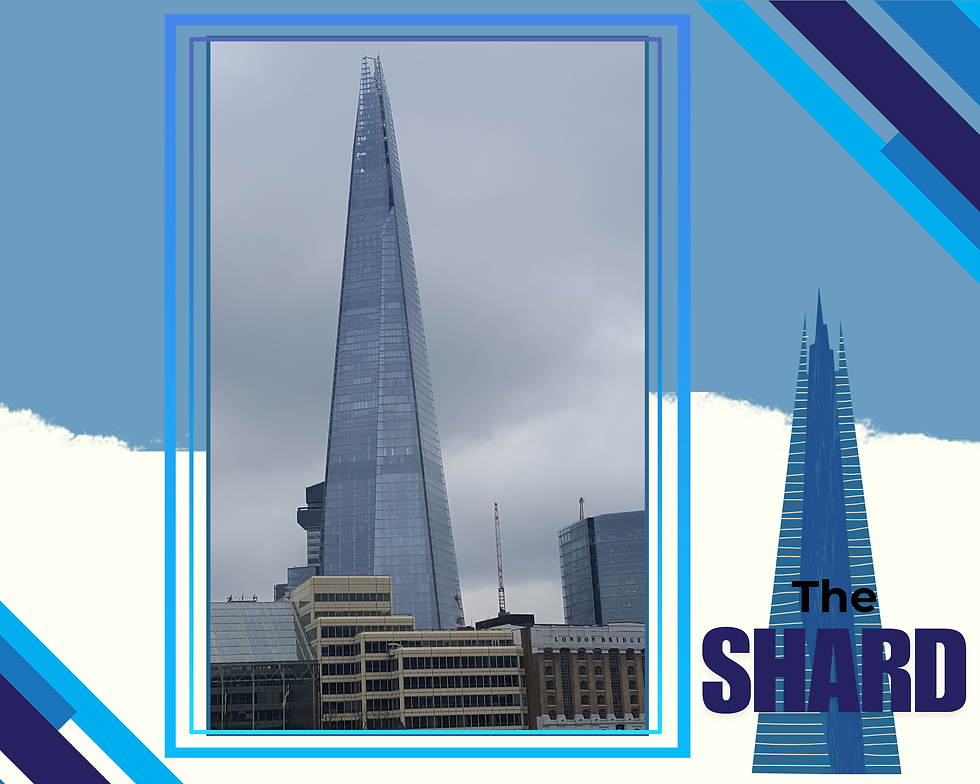
Here we are crossing London Bridge from the south to the north bank. This approach provides a view of another iconic London building - 20 Fenchurch Street - affectionately known as the Walkie Talkie. You can see the unusual building in the top right-hand shot below. The Walkie Talkie skyscraper at 20 Fenchurch Street was completed in 2014, standing 160 metres high over 38 storeys.

We continued to head upriver after crossing over London Bridge, moving a little away from the river to Upper Thames Street then back to the river, passing Southwark Bridge. Fyefoot Lane [top right hand shot below] is part of the City of London Pedway Scheme, an elevated pedway network that is designed to address traffic issues by separating pedestrians from street level traffic.

Southwark Bridge, a Grade II listed structure, is an arch bridge with the dubious honour of having the least amount of traffic of all the Thames bridges in London. The 244-metre-long and 17-metre-wide bridge was opened in 1921. It has three cast iron spans supported by granite piers. Despite its lack of traffic, it is rather famous! Southwark Bridge is the iron bridge, its colloquial name, referenced in Dickens’ Little Dorritt. The bridge can be seen in films such as Harry Potter and the Order of the Phoenix, the 1964 version of Mary Poppins, in the final scene of Lock, stock and two smoking barrels, and in the season 3 finale of Luther.
Below are my shots of the bridge, taken while we walked across Millennium Bridge, the next one up the river. Again, for perspective, there’s only about 1km between London and Southwark bridges and only 600m between Southwark and Millennium bridges.
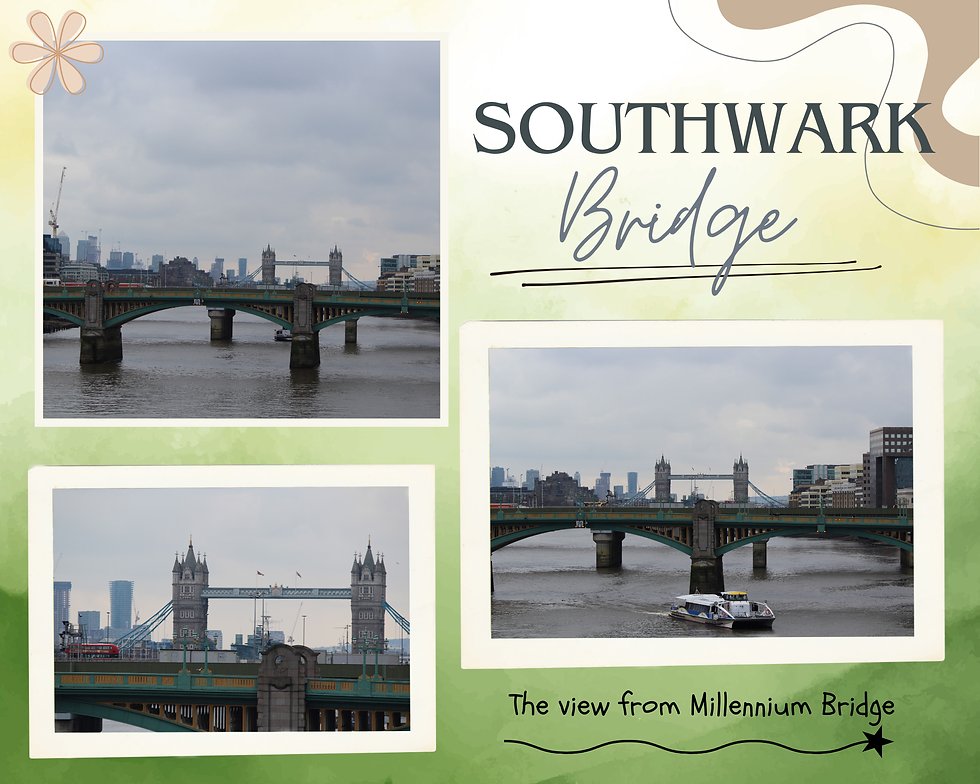
We stayed on the north bank and didn’t cross Southwark Bridge, but we did walk over Millennium Bridge, one of the modern Thames bridges. The bridge is bookended by the Tate Modern and the Globe Theatre on the south bank and St Paul’s Cathedral on the north bank.
Here we are taking a slight detour for these cool shots of St Paul’s before we crossed Millennium Bridge. The cathedral looks a long way from the river on a map, but it’s only a few hundred metres. The top left hand shot below shows the end of Millennium Bridge that feeds into Peter’s Hill that leads up to the cathedral. I just love the perspective of St Paul's from the end of Millennium Bridge. The buildings that link the cathedral to the bridge form a kind of tunnel.

Millennium Bridge is a steel suspension pedestrian bridge known colloquially as the wobbly bridge. When it opened in 2000, the bridge swayed once people started walking over it. The bridge was then closed on that opening day and reopened 18 months later after modifications were made to stop the swaying. The bridge has two river piers and three main sections and eight suspension cables. It is flanked by Southwark Bridge and the railway bridge at Blackfriars. Again, there's a fab perspective of St Paul's from the bridge. You can also see The Shard in the background.

A couple was having their wedding photos taken when we were crossing over. Just look at these pretty shots of the bride and groom with the cathedral in the background. What an incredible backdrop for wedding photos!

Here are some shots we took from the bridge of both banks, with glimpses of Tower Bridge downriver and Southwark Bridge. The Walkie Talkie and The Shard stand out as the modern buildings on either side of the river. The white building with the thatched roof is Shakespeare's Globe Theatre and the Tate Modern Museum is featured in the bottom left-hand photo.

We crossed over Millennium Bridge to the south bank of the Thames and continued our journey upriver. The south bank is a super buzzing and popular part of London’s river spaces, with the Queen’s Walk extending for several kilometres to provide easy pedestrian access to the riverfront.

I’m not sure why now, but we stayed on the south bank until we reached our final destination at Vauxhall, passing five bridges along the way: Blackfriars, Waterloo Bridge, Hungerford and Golden Jubilee Bridges, Westminster Bridge, and Lambeth Bridge. Perhaps we were saving up our Westminster and Golden Jubilee Bridge crossings until later. [See further down in this post.]
Here we are in the section of the south bank between Blackfriars Bridge and Waterloo Bridge. What has struck me when putting this post together of how hard it is to understand the distances between the bridges. The perspectives from the photos make the bridges look super far apart, but that's not the case at all!

Waterloo Bridge feeds into Waterloo Station. It's a road and foot traffic bridge that commemorates the Battle of Waterloo in 1815. It's another box girder bridge, built in 1817 but later demolished, in 1934, due to serious movement noticed in the 1920s. The current bridge was opened in 1942, connecting the South Bank to the Strand. It is colloquially known as 'the ladies bridge', named after the women who worked on its construction during WW2.
Blackfriars Bridge is also a road and foot traffic bridge, originally opened in the 1766 for pedestrians only, completed and opened to all traffic in 1769. The current bridge was opened in 1869 by Queen Victoria after the original bridge was replaced by sturdier materials. Honestly, until we did the river walk and I had to put my photos together to make this post, I had no idea there were so many bridges over the Thames and with such interesting histories.
Our lunch pit stop was at one of the eateries in the Southbank Centre on the downriver side of the London Eye. There are a bunch of restaurants and cafes in this part of the Southbank and there's a nice buzzy vibe to the place.

We continued on after lunch towards the London Eye, passing the Hungerford and Golden Jubilee Bridges. These bridges sit between Waterloo and Westminster bridge and join Charing Cross with the Southbank. The Hungerford Bridge is a steel truss railway bridge that was built in 1864. It is now flanked by two modern cable-stayed pedestrian bridges that are named after the Queen's Golden Jubilee, opened in 2002. It's hard to tell the bridges apart, as the Golden Jubilee bridges sit so close to Hungerford. The bridges are often visible in shots of the London Eye as they look so close to the wheel. They are that close, as just 220 metres sits between them.

We paused at Westminster Bridge to take in a new perspective of Big Ben and the Houses of Parliament. Here are some shots either side of Westminster Bridge. We walked over the bridge on our final day in London so you can read about the bridge later in this post.

Big Ben was undergoing a facelift at the time of our visit, so we didn't get the full perspective of the glorious, iconic structure. Still, it was an interesting time to be there. The works began in 2017 and took two years to complete. The tower had its four clock dials reglazed, its ironwork repainted and the intricately carved stonework cleaned and repaired. It is estimated that the restoration work cost £61 million! Read here to learn some fun facts about Big Ben and its history.

Here are some interesting upriver perspectives of The London Eye. The two left hand shots were taken after we walked past the Eye, from the southern edge of Westminster Bridge. The main shot was taken later that day, once we’d crossed back over to the north bank.

We must have been running out of steam by the afternoon as I have far fewer photos of the final leg of our bridge journey. One last push in the Lambeth part of the south bank saw us almost at our destination at Vauxhall.

As mad-keen spy nuts it made sense for us to finish our river walk at Vauxhall Bridge. The bridge may be less famous than the building that sits next to it - the MI6 Secret Intelligence Service, Section 6 headquarters. The actual address is 85 Albert Embankment, Vauxhall. The building has been the MI6 HQ since 1994.

We came up to the MI6 building from Lambeth then crossed over to the north bank of the Thames where the above shots were taken. Vauxhall Bridge is a Grade II listed steel and granite deck arch bridge opened in 1906. It's 247 metres long and 24 metres wide.
Once we were back on the north bank, we headed back to Westminster. We first wandered along Millbank and the Riverside Walk Gardens. The sculptures in the below photos include Love, Aluminium by Lorenzo Quinn, installed in 2017 [bottom right hand photo]. It shows two hands joining in a never-ending circle, to represent love, respect, appreciation, honesty, transparency, trust and faith. The other sculpture [middle row, left hand side] is the Locking Piece sculpture by Henry Moore, cast in 1967. It is made of bronze and shows two interlocking forms holding a third element between them.

We continued to make our way back to Westminster, walking along the pretty Victoria Tower Gardens South, giving us a nice view of Lambeth Bridge. That bridge is a road and foot traffic bridge, notable for its red paint scheme, the same colour as the leather benches in the House of Lords, located at the southern end of the Houses of Parliament nearest the bridge. The current bridge was built in 1932, replacing one built in 1862 at the site of a horse ferry between Westminster and Lambeth.

We were pretty had it by then, but our final push for the day saw us come in from the upriver end to Westminster. How pretty it is, with the beautiful buildings and trees.

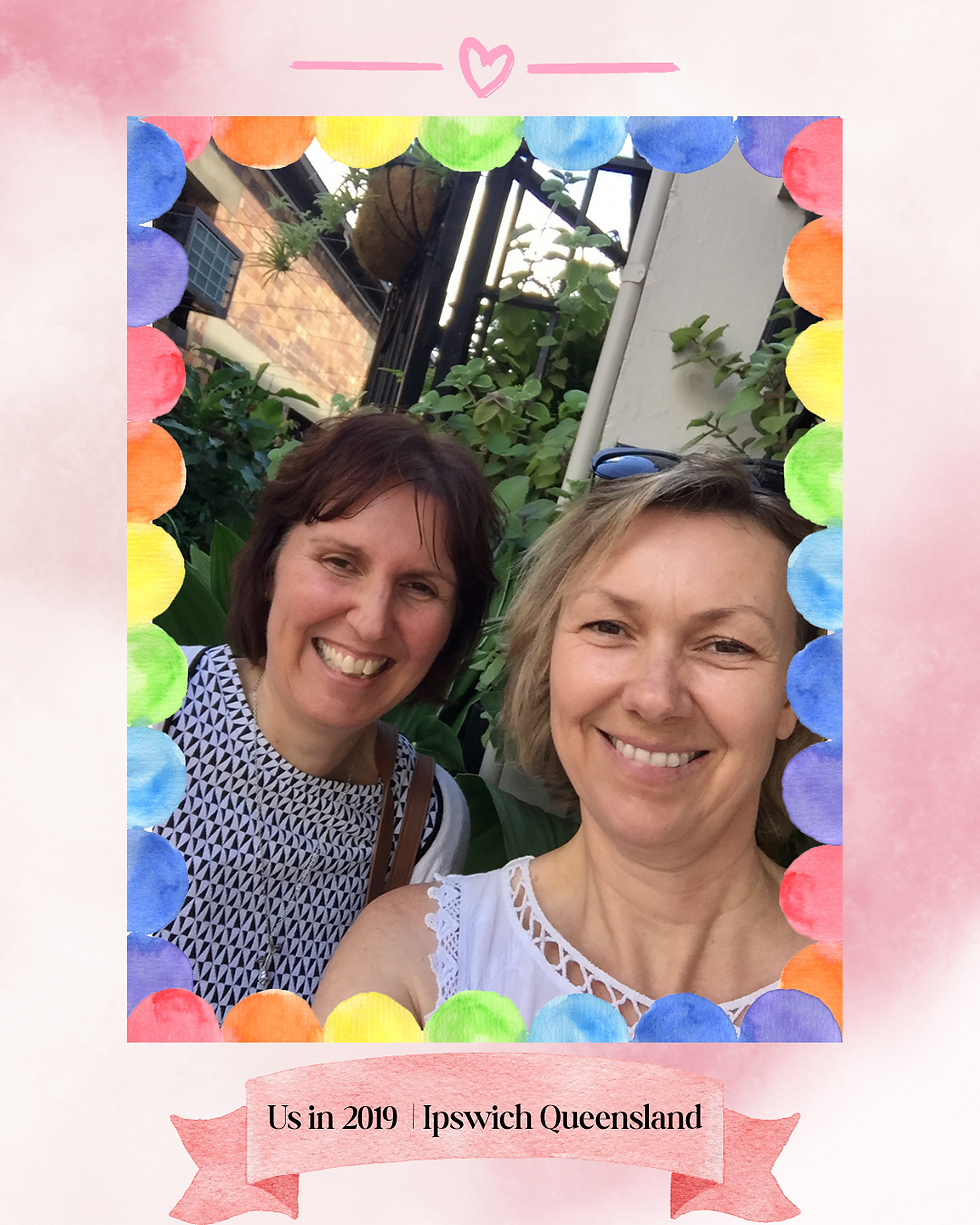
We finished off our day with coffee at the Pret a Manger near Piccadilly Circus, with my Aussie friend, AC, and her husband and son. They lived in London for many years although AC and I first met in 1990 at university in Australia. I don't have any photos of us on that day and I'm sorry I didn't capture our catch up. Below is a shot of us catching up in Australia the following year. I did see AC in London several times during my 2022 [twice] and 2023 work trips.
It was a huge day of walking, but one of the best days I've spent in London across all the visits I've made to the city. The weather was rubbish but we had such a lovely time crossing bridges and taking in different perspectives of all the bridge structures between Tower Bridge and Vauxhall. We loved wandering the beautiful pathways that line both sides of the Thames. I certainly gained a new perspective on a city I love and poking around the riverbanks is a great way to spend the day.

Day 3 wanderings: A train station, canals and a famous pedestrian crossing💓🎵
The weather wasn't much better on Day 3 - still cold, bleak and showery. We headed to Kings Cross-St Pancras first up. The two stations sit across the road from each other. King's Cross was built by the Great Northern Railway in 1852 while St Pancras was built by the Midland Railway Company in 1868. St Pancras International is where you go to take the Eurostar, but both stations are used for regional lines and there is a single Tube station at Kings Cross St Pancras. The area between the two stations is a lovely square and it's worth a wander around both terminals. King's Cross is home to a super cool Harry Potter shop and Platform 9 3/4.

As the above photo shows, the weather was indeed rubbish. We decided to chance it and take a stroll along St Pancras Lock. The lock is on Regent's Canal in the borough of Camden, first built in 1817. It passes under the railway lines at St Pancras station. I love the idea of living in a houseboat and we had a nice wander along the towpath even in the dreary weather.

We stumbled across Gasholder Park during our wanderings. The green space opened in 2015, with housing built into the restored guide frame of a Grade II listed Victorian gasholder. The gasholder was originally constructed in 1850. How cool is that?

We then walked the 5km to St John's Wood for a bucket list experience for me: walking across the famous Abbey Road pedestrian crossing. I know it's super touristy, but I'd been wanting to do it for ages. It wasn't too busy at the crossing - I guess because of the weather - so I had my chance to nerd it out and cross. It's actually a rather inauspicious place and an ordinary zebra crossing. It's the symbolism that matters and its place in British music history. Bucket list experience ticked off!

We took the tube to Notting Hill after all that walking. Again the weather was a bit of a downer, but you can't beat the gorgeous architecture of Notting Hill and the pastel-coloured buildings. Read here for more on previous Notting Hill wanderings including my quest to find the blue door and the bookshop from the Hugh Grant film.

If my memory serves me correctly we went back to King's Cross for a late lunch. We really needed some warm sustenance! We also needed a late afternoon rest after all the walking.

Day 4 wanderings: Finally some sun!🌞
It looked like our fourth and final day might be better weather-wise. The weather in London is quite unpredictable. I was back there for Easter 2023 and the weather was generally a lot better that time.
We'd managed to stroll around Fulham where we were staying over the course of the three days for some shots of pretty buildings and trees in between the showers. I love the light in the main shot.

The first part of our final day was spent having a poke around posh Belgravia. This part of London is known for its elegant Georgian architecture, expensively grand homes, and pretty green spaces. It's close to Hyde Park and Buckingham Palace and consistently appears on list of the top posh neighbourhoods. I love wandering around neighbourhoods during my travels, just soaking up the vibe. Sadly the weather meant our photos don't quite capture the beauty of Belgravia.

It's a short walk from Belgravia to Wellington Arch. The Grade I listed triumphal arch forms the centrepiece of Hyde Park Corner, where the park meets Green Park. The arch was constructed in 1830 with the original sculpture atop the arch being a horse statue of the 1st Duke of Wellington. This was replaced in 1912 with the bronze Goddess of Victory Nike riding an ancient four-horse chariot. Both the Wellington Arch and the Marble Arch were commissioned by King George IV to commemorate Britain's victories in the Napoleonic Wars. The Australian War Memorial, to remember those who died in both world wars, is located alongside the Wellington Arch.

We wandered back past Buckingham Palace after that. The below shots were taken on both our first and last days in London. The most impressive parts of the palace, I think, are the golden gates.

Our afternoon was taken up with a ride on The London Eye and some clothes and shoes shopping in Piccadilly Circus, at my favourite shop in the UK, Sports Direct😊. We crossed over the Golden Jubilee Bridge from Whitehall to get to the Eye. This route provides a nice perspective on the Eye.

We'd pre-purchased our tickets for The London Eye and that was a good move as it's a popular tourist attraction - the most popular in the UK, I believe - and both times I've been on it, there has been a long queue. Here we are on our go-around. See my post on my 2011 London wanderings for my first experience on The Eye.

The London Eye, or Millennium Wheel, is a cantilevered observation wheel on the South Bank of the Thames. It's the tallest structure of its kind in Europe, at 135 metres, with a diameter of 120 metres. It opened in 1999, with its 32 sealed passenger capsules that can hold up to 25 people each. The rotation is quite slow - around 26 cm per second - and it takes around half an hour to do a full rotation. Even on a cloudy day the views are pretty spectacular although it's also easy to spend the whole ride marvelling at the design of the Eye itself!

Westminster Bridge is a road and foot traffic bridge that links Westminster on the north and Lambeth on the south of the Thames. The green colouring is to match the leather seats in the House of Commons. The bridge was built in 1862 although there was an earlier bridge at the crossing built in 1750. The current bridge is Grade 11 listed and was completely refurbished in 2005-2007 when the iron fascias were replaced and the whole bridge repainted. The best thing about the bridge, I think, is the incredible view of Big Ben as you cross over it.

That was it for our four-day Easter stay in London! The next day we took the train out to Stansted to fly with Ryanair to Dublin to begin our 10-day adventure with a hire car in Northern Ireland and Ireland.
Check out my posts on my previous London wanderings in 1996, 2011, 2013, 2014 and 2015. There are also posts on my 2022 [here and here] and 2023 blocks of time spent in London for work.


The British weather is unpredictable. I've been to London twice now at Easter and once in early May and each trip served up different weather. The dreary, showery weather did influence our experience, largely because we were determined to explore outside spaces. Walk as much as you can is my top tip. The Tube is cool and can take you pretty much anywhere you want to go across London, but the best way to experience the city is to walk. Sometimes it can be quicker to walk between places than brave the crowds and the long treks to the platforms on the Tube.

This was my sixth visit to London and I loved poking around in familiar places and exploring some new spaces as well. Iconic buildings and beautiful green spaces are my jam. It had been five years since I'd travelled with family - after multiple solo trips for work projects and academic conferences - and being along for the ride while E discovered, and W rediscovered, London was a joy. The weather was rubbish, but nothing can dampen my love for London. Breathing in the history of London is enough for me, just from wandering around.

The cold! It was so cold in London for spring, and the bleak and showry weather really did impact on what we were able to do.
The bridge walk along the Thames was one of the best days out I have had on all my wanderings. I loved all the cool things we saw and the unique perspectives on the bridges and the iconic buildings that line the Thames.
Staying in a house in Fulham: It felt like we lived in London, even if only for a few days.


Comments