More of our whirlwind 19-day European bus tour
Updated: Sep 19

A little bit of background📝
This is part 2 of my posts on our mad dash around Europe on a Trafalgar bus tour with 47 other people.

Our three-week bus tour of Europe was a big chunk of our six-week first big adventure in 1996. Our adventure started with an LA stopover, a whistlestop London experience, and a long weekend in Berlin. Then after the bus tour we hired a car and did a two-week road trip around England, Scotland and Wales.
Once again, I have to place a caveat on the photos that I've included in the post. They were taken on a 1990s camera, and scanned from the printed photos that are now almost 30 years old. The quality isn't great, to say the least. The 1990s fashions are also not great!
Our whirlwind European tour💨
We didn't have much money in those days. We couldn't afford a honeymoon when we were married in 1993 so our adventure three years later was a big deal to us. I had no idea that I'd have travel in my future, so tried to pack as much as possible into our six-week trip. We did a Trafalgar tour for our first experience of Europe, taking us on a three-week chaotic adventure through France, Switzerland, Italy, Hungary, Austria, the Czech Republic, Germany, Luxembourg, and Belgium. The tour started and ended in London, crossing the Channel on the ferry from Dover to Calais and back again on a charter bus.

Why did we decide to do a tour, the two of us self-confessed introverts? Our reasoning was that it was the best way to gain a taste of Europe for our first foray onto the continent. It seemed a lot easier to place our wanderings in the hands of a tour company in those days, back before we were researching and booking things online ourselves. The world seemed less accessible then, something to wonder about and explore armed with only what we'd read in books or seen in films and on tv to guide us. That sense of wonder was kind of cool, though. It made everything we saw and experienced so incredible! That may sound old fashioned now, but I guess it was part of the adventure, knowing so much less about where we were heading.

The pros and cons of our decision to do a tour will become apparent as you read through the post. Right, let's go!
Leg 7: Klagenfurt to Budapest 🚌
We left Klagenfurt early on Day 11 to head to Hungary. We would return to Austria later in the tour, but for now, it was just a stopover of sorts on our way to Budapest. We stopped in the morning in Graz before making our way to the border. The journey from Klagenfurt to Graz is around 90 minutes and 135km.

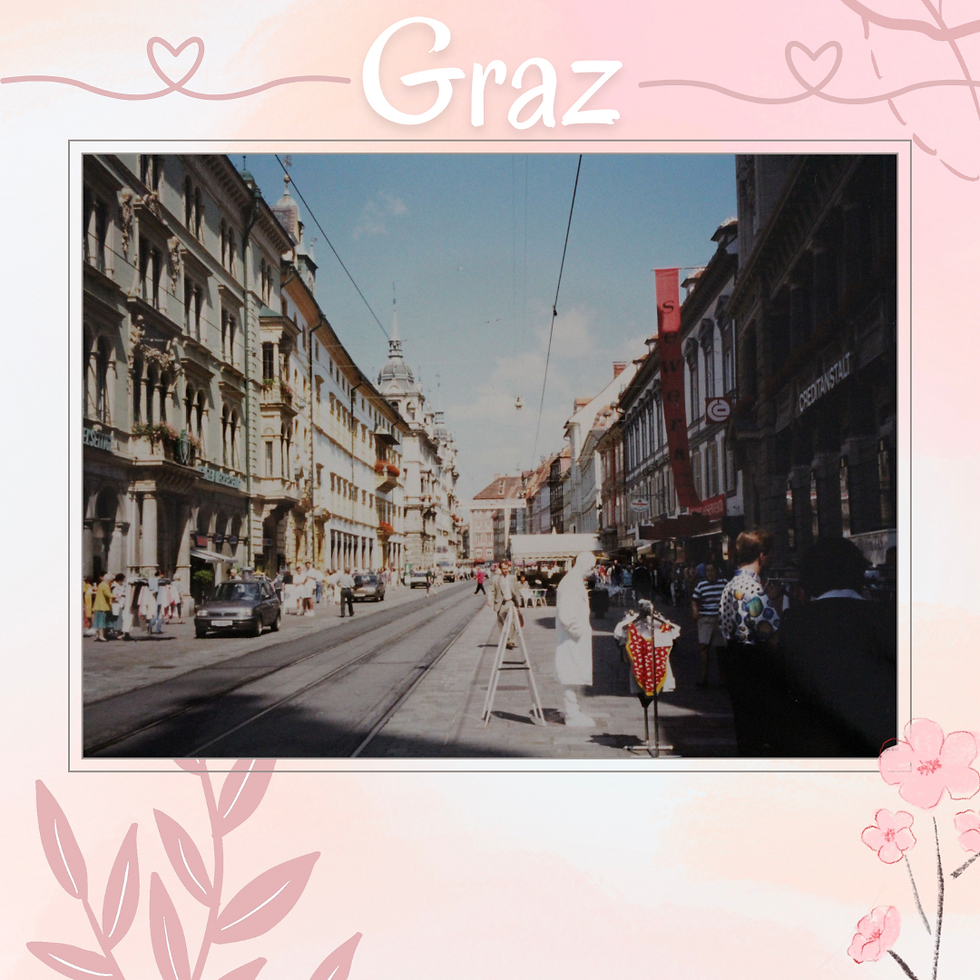
The below photo is the only one I have of Graz. I do remember that we spent most of our time searching for a loo and for films for our camera. Our search did give us the chance to absorb the vibe of the lovely, tidy town with its tram line in the centre. I recall buying the most delicious fresh bread and apricots for lunch as we wandered around.
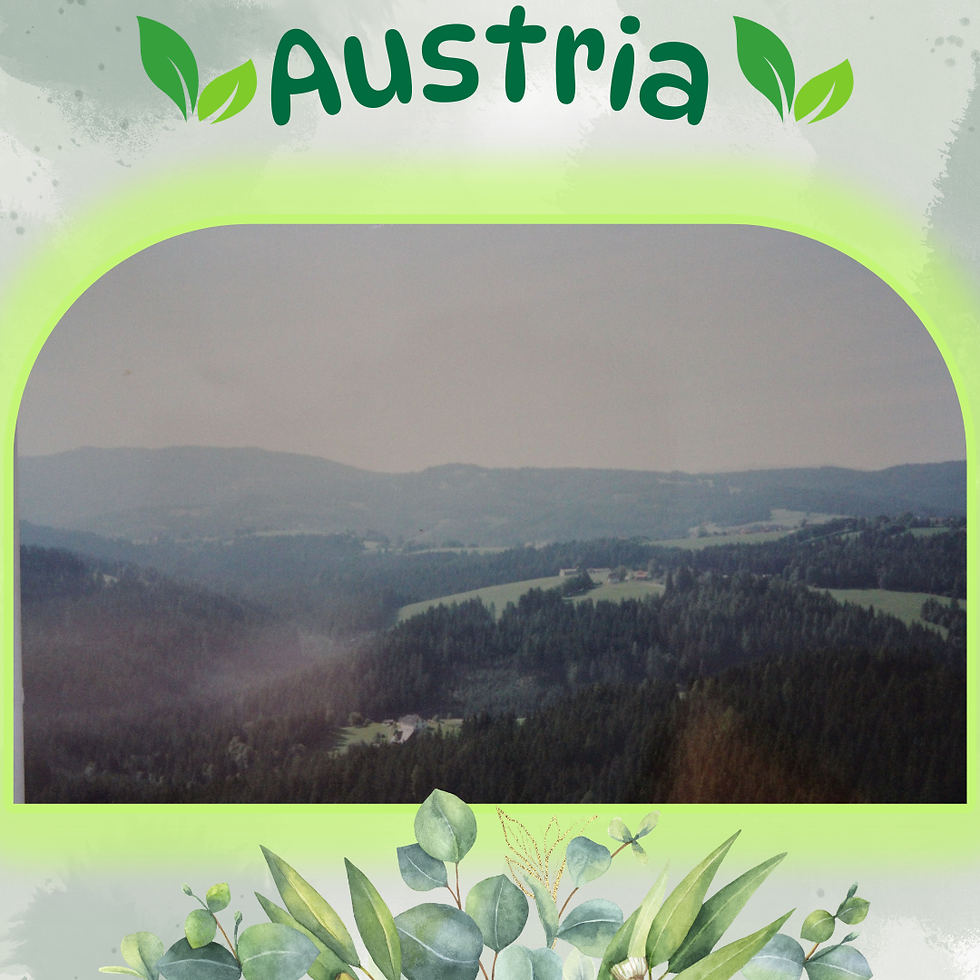
We drove past more mountain scenery and through little towns and endless tunnels on the way to the border after leaving Graz. The mountains in Austria were rocky and not as lush as the Swiss Alps but pretty just the same.
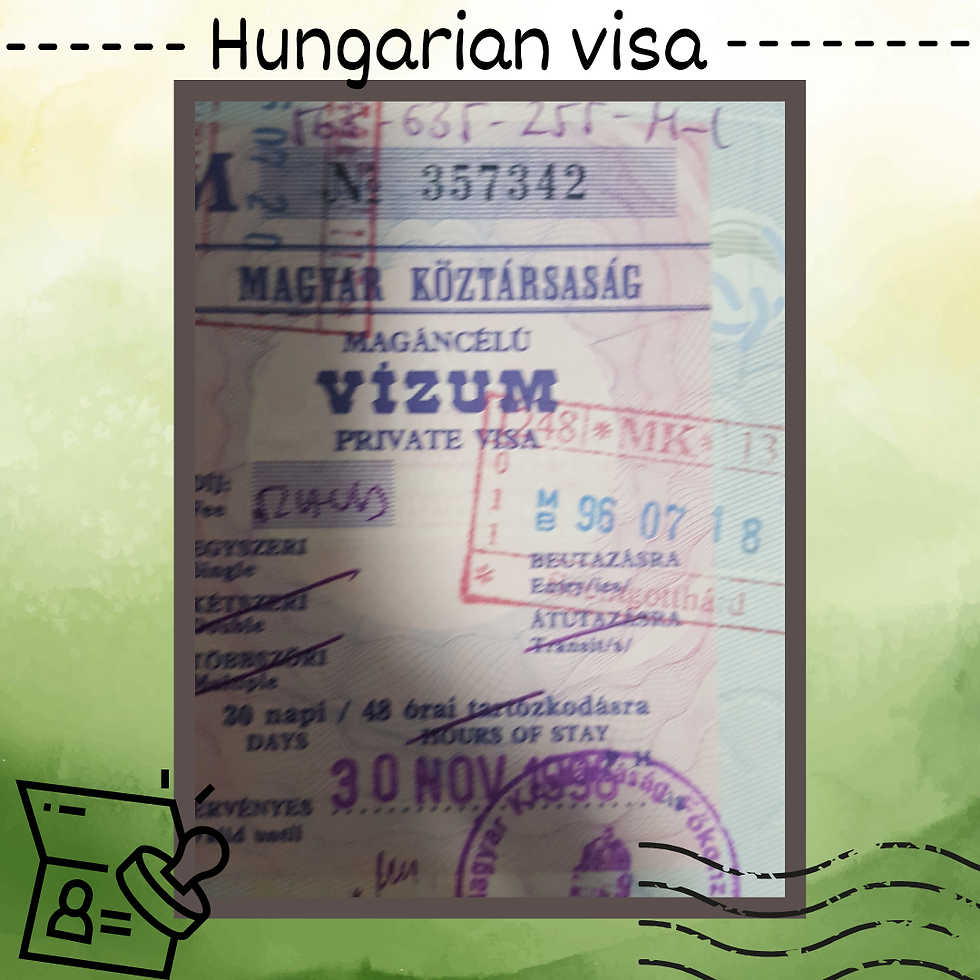
We had a slightly scary border stop on our way into Hungary as the guards came on board the bus to check and stamp our passports. Australians and New Zealanders had to have visas to enter Hungary back then. These were the days when when you had to send your passport to an embassy and have the paper visa affixed [see below]. The guards took the passports, and we had to wait over an hour for them to return. When they did, they smiled at us the said "kangaroos". We smiled nervously back as they had giant guns on their hips and frightened the life out of us!
Graeme had told us all to stay on the bus at the border but people were hot and cranky by the time we were eventually waved through. The guards were not happy about the smashed window and initially demanded we had it repaired before they let us into the country. While we waited, the tour bus behind us gave the guards a bottle of wine and was let in without fuss.
My heart was beating fast after that encounter as nothing like that had ever happened to us before. We finally got through the border check and then Luc stopped the bus a few metres down the road so we could change currency. In 1996, money could not be changed in former Eastern bloc countries outside of those countries as the currency was worth so little. We went into the little shop at the border - really more of a bar - and bought a Pepsi for the equivalent of 50 cents. It was so cheap in Hungary in those days.
The drama continued only a little way down the road. An unmarked police car pulled us over for allegedly speeding. I recall that Graeme paid the guards the [equivalent of] $20 'fine'. Graeme showed us the paperwork he received. It was like a pub raffle ticket! Graeme and Luc feigned ignorance so we could move on without too much drama, advising the Hungarian couple on our tour who lived in Melbourne to sit quietly when they offered to translate. Those from our group who were sitting in the back of the bus told us later that the had spotted the police following us for some time, pointing and laughing at the bus. I guess foreigners then were something of a novelty and an easy target, and we certainly stood out with our brightly-coloured bus and spider web pattern on the broken front window. Graeme said the guards would probably take their families out to dinner on the money he gave them as $20 would have gone a long way in Hungary in those days.

It was a long journey to Budapest, around 4 hours all up from Graz [400km]. The journey was a great opportunity, however, to roam around the Hungarian countryside and experience the simple, undeveloped rural parts of the country. We stopped at Lake Balaton, the largest lake in central Europe, before arriving in Budapest late in the afternoon.

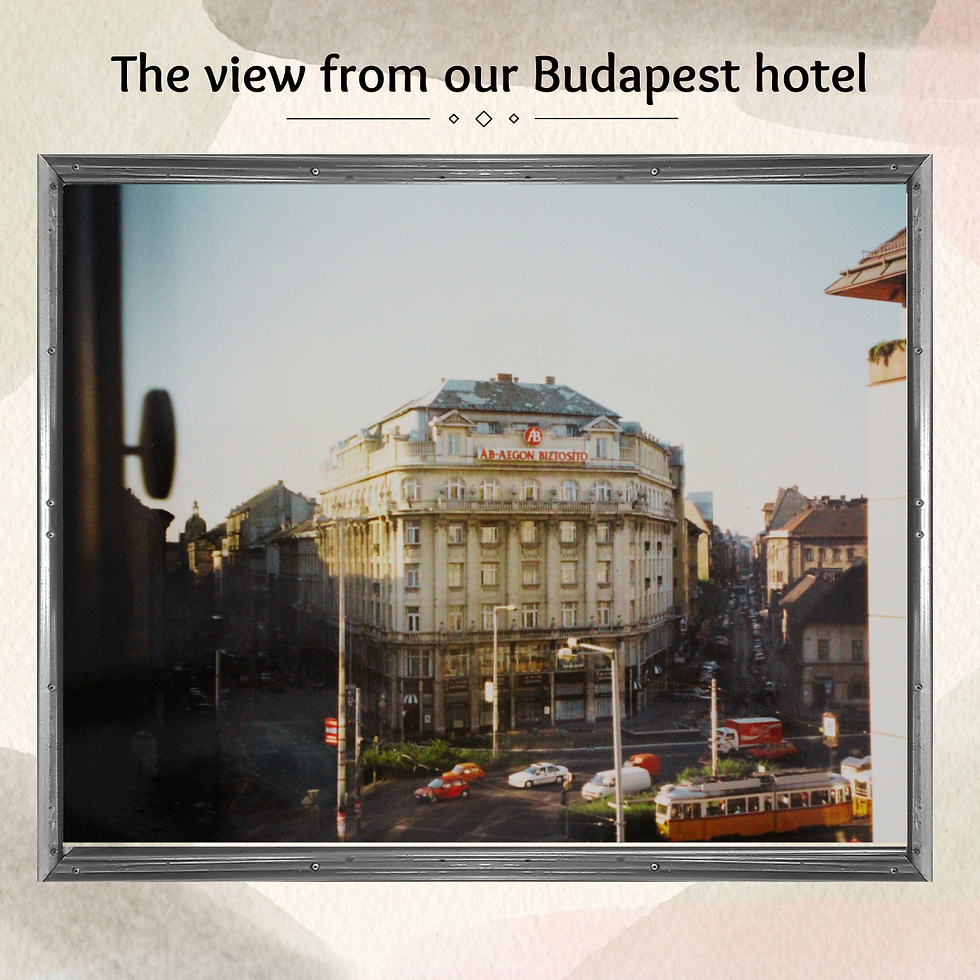
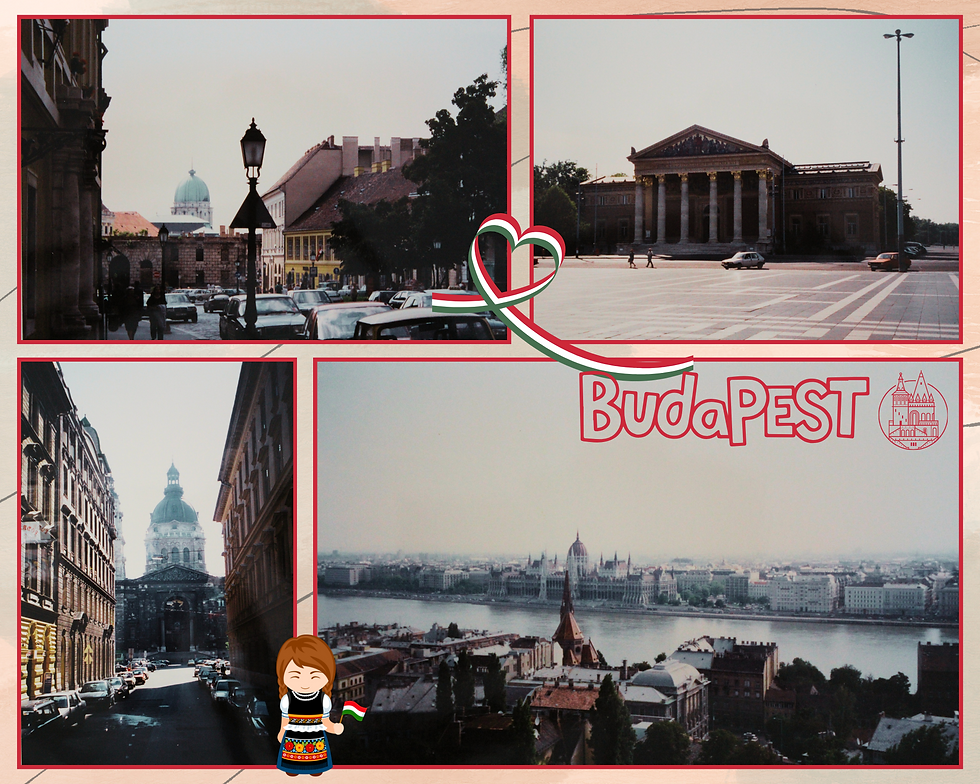
We had a wonderful view of the sparkling Danube River as we drove into the city. I was keen to see what Budapest was like, in our second experience after Berlin of a former communist city. I am not sure what I expected - something less developed perhaps - but Budapest looked more like other European cities we'd been to than I thought it would, complete with American fast food places everywhere. Our hotel was rather flash, too, with its huge lobby and views of the city [and the women dancing in the window of the nightclub across the street...]. Our lovely hotel dinner included goulash.
We had a call from a friend at home that evening who had been trying to reach us in Italy for my husband's birthday. I wrote in my journal at the time that our mobile must not have worked in Italy, but I don't recall much about how mobile phones worked in those days. I am surprised we even had one! It was not a smart phone, of course. Her voice sounded far away and it was strange to hear something familiar in an unfamiliar place. She said we sounded tired. That's because we were! Whirlwind tours like the one we were on are not for the faint of heart! [We also received faxes from family and from my work colleagues. Faxes! How quaint that sounds now.]
Day 12 saw yet another massive buffet breakfast before we were whisked away for a city tour. Our guide was Erika. She was a lovely woman, easy to listen to with a great sense of humour. I fell in love with Budapest instantly and would love to visit again to experience the city further. There is something unique about it - the river, the stunning architecture, the relaxed vibe, and the unique Buda and Pest sides to the city.
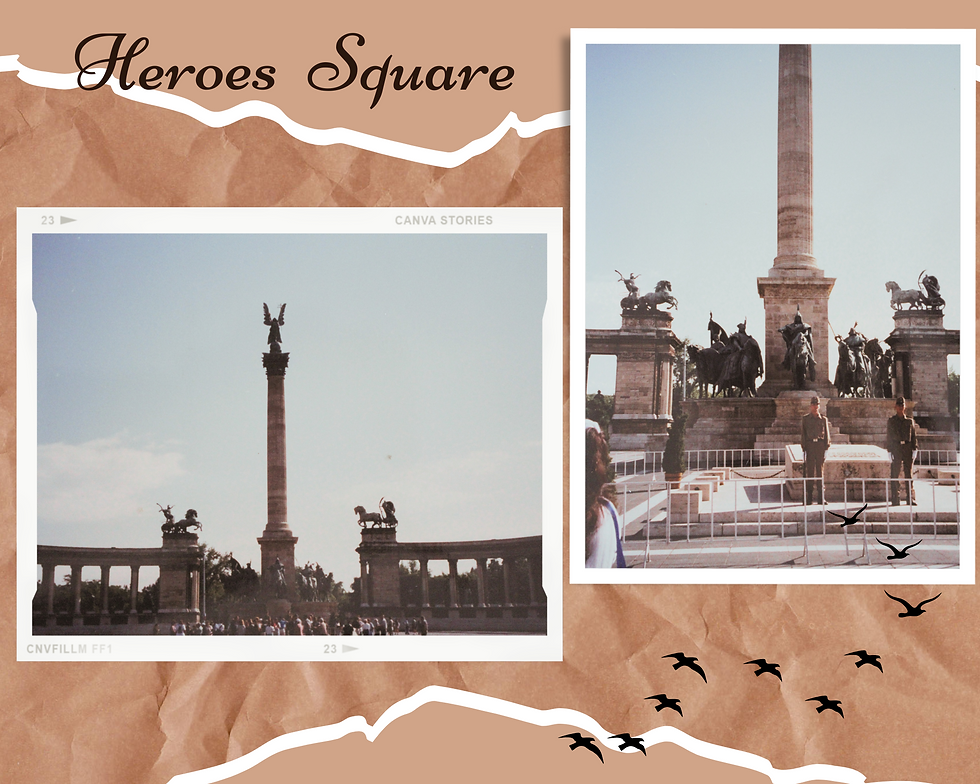
We drove around the city to take in the vibe then stopped at the ginormous Heroes' Square, where we were accosted by book and postcard sellers. Capitalism was alive and well, sadly. The square is a Millennial Monument containing a semi-circular colonnade with the Archangel Gabriel on the high column and carved statues of the Seven Magyar Chieftains who contributed to the founding of Hungary in the ninth century. In front of the monument is a cenotaph bearing a motto in memory of those who died for Hungary's freedom and independence.
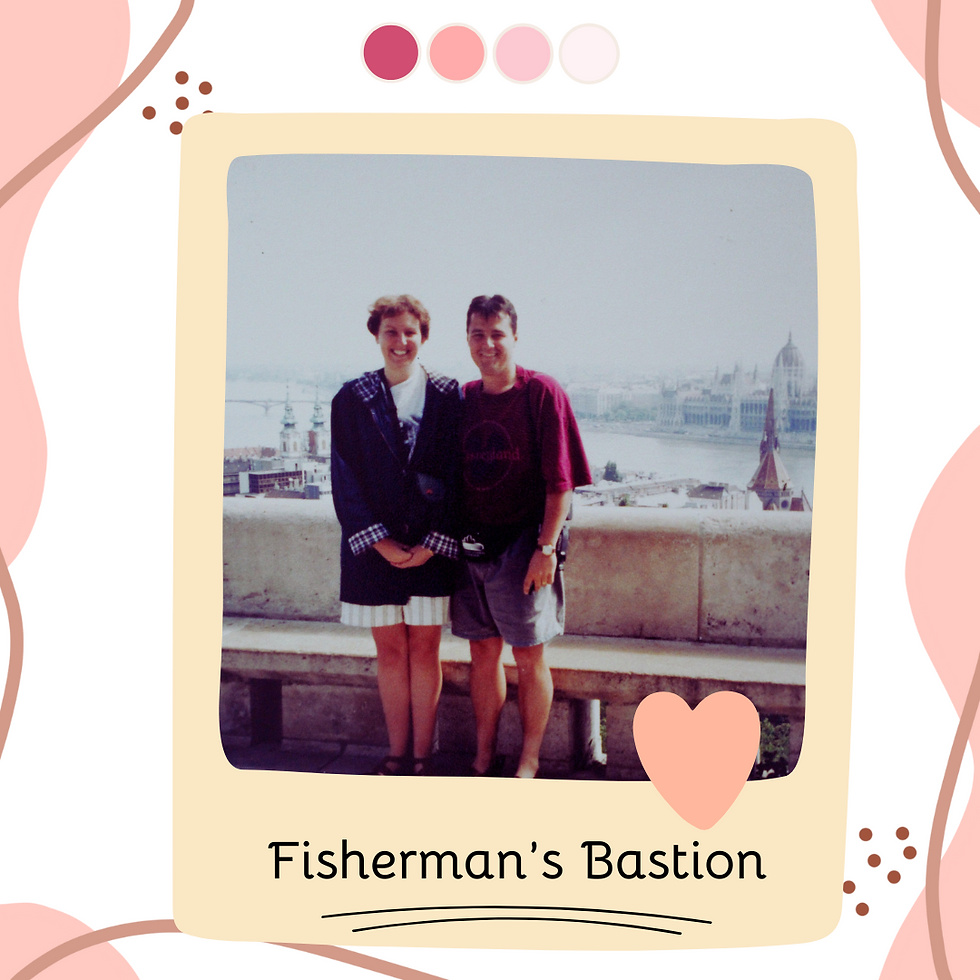
Our next stop was Fisherman's Bastion, a lookout tower near Buda Castle that affords panoramic views of the city. The original walls were built in the 1700s as part of the castle, protected by the guild of fishermen who lived under the walls. The current structure was built between 1895 to 1902. The main façade that sits parallel to the Danube is 140 metres long.

We had a poke around in Matthias Church [Church of the Assumption of the Buda Castle] with its beautiful stained glass windows. The Catholic church is thought to have been first built in 1015 and restored in the late 19th century. That's the church in the bottom right hand photo above.
Then we wandered around Holy Trinity Square where I bought the handcrafted wooden trinket box from a market stall seen below. I still have the box at home and it's one of my most treasured mementos.
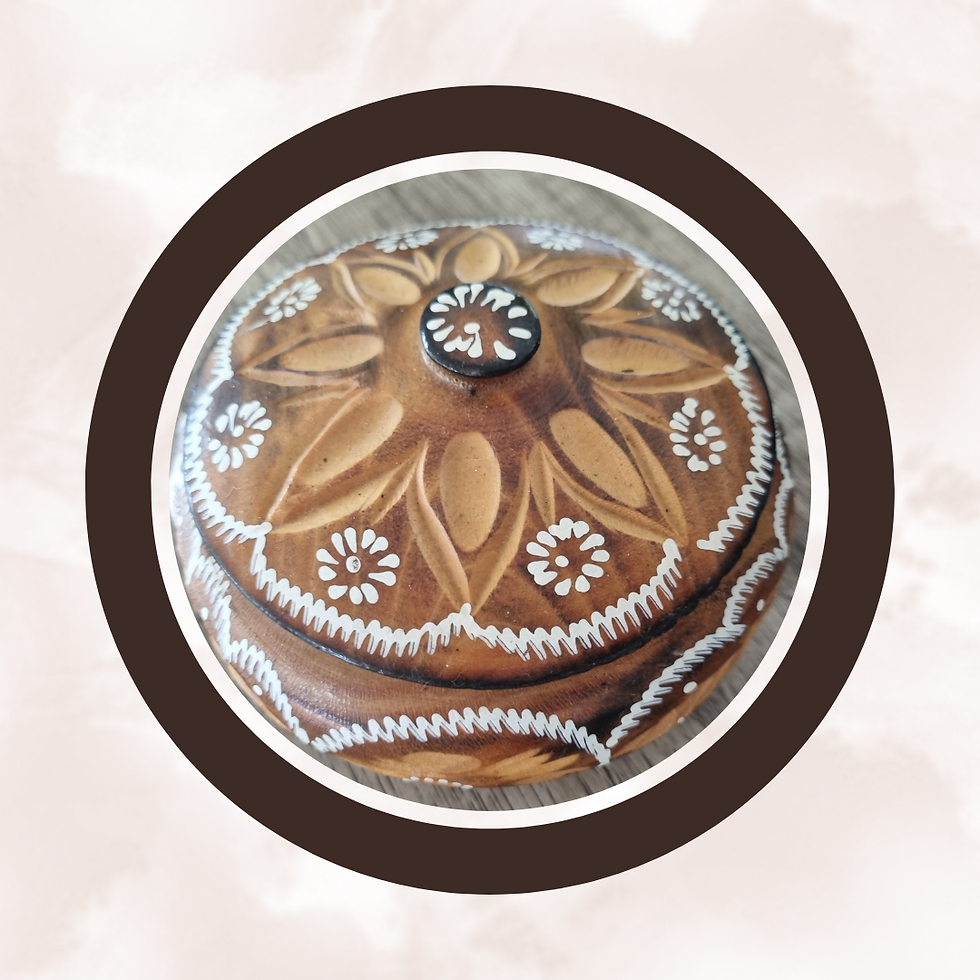
There were buskers playing traditional music as we wandered along the lookout and a strange elderly woman singing in the church. It was a rather surreal experience as we'd never been to such a place before. I loved it!
Fisherman's Bastion is one of the most spectacular parts of the city, I think. The views are stunning. This crummy photo, taken on our now-ancient camera, does nothing to capture the beauty of Budapest and the views from the Bastion, but this is where I fell in love with the city. I would return in a heartbeat and hope to do so one day.
We spent the afternoon on an optional tour to visit the Hungarian Open Air Museum. The museum is modelled on the Swedish concept of skansen, meaning an open-air collection of historic structures [essentially a museum of buildings]. The Hungarian museum was founded in 1967 and is Hungary's largest outdoor collection, showcasing Carpathian folk architecture. We loved the museum as the houses were beautifully set up to show what life was like in medieval times, compete with furniture and everyday tools and implements.

The museum is next to the quaint village of Szentendre with markets of handcrafted goods. We saw so many beautiful things and I have always regretted that we didn't buy something that day. We had a lovely [but heavy] traditional Hungarian lunch then and climbed up a set of narrow stairs for views of the town and the Danube.

We had missed the free time to explore Budapest but we didn't regret our choice to go to the museum as we'd had a lovely afternoon. That said, I'm sure we only scratched the surface in the during our time in Budapest.
In the evening we did the 'illuminations tour'. Remember that is Trafalgar-speak for driving around the city at night. It's very cool, though as European cities are magnificent at night, with the bridges and ancient buildings all lit up. Part of our evening illuminations tour was a cruise on the Danube, one of the highlights of the whole trip.
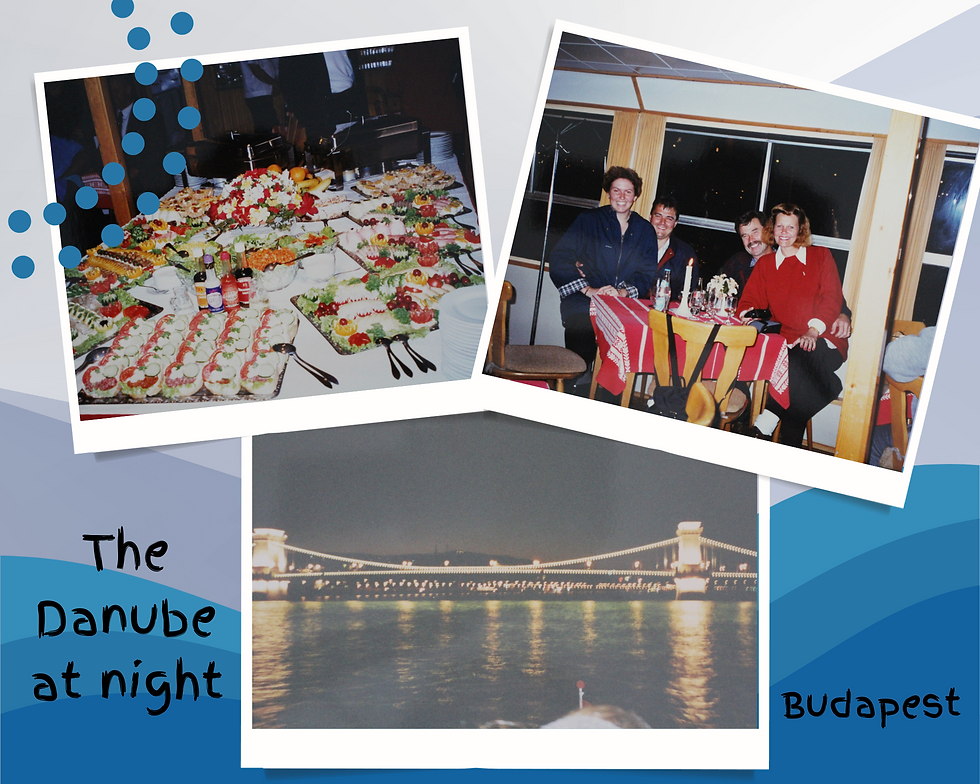
The terrible photos from my old camera do not do the river justice. It was stunning at night and we had a lovely evening. The traditional Hungarian buffet dinner on the boat was enormous, much of the food new and unrecognisable to us. It was super windy on the boat deck where we spent most of our time, hence my crazy hair in the photo above!
The next morning Day 13 we opted for the optional tour to see the neo-gothic parliament building and Margaret Island. The Hungarian Parliament Building sits on Kossulth Square on the Pest side of the city on the eastern bank of the Danube. It was opened in 1902 and has been the largest building in Hungary ever since. It has a symmetrical façade and a central dome and is symmetrical inside, with two identical parliament halls on opposite sides of the building. We were fortunate to be able to see inside, to experience the beautiful elaborate wooden carved ceilings, frescoes and statues of Habsburg emperors.

Margaret Island lies in the middle of the Danube and is a beautiful landscaped recreation park with medieval ruins of past churches and nunneries. We went on a horse and carriage ride [see above photo] around the 2.5km long and 55m wide island, tried the medicinal waters from the island's mineral spas, and tasted a traditional Hungarian fruit cake [more like a cheesecake than what we know as a fruitcake]. The island is named for Saint Margaret [1242-1270], King Bela's 11-year-old daughter who was sent to the convent that was established on the island. The island was originally called Rabbit Island in the Middle Ages as it was a royal hunting reserve. During the siege of Budapest during World War II, the island was the site of combat with advancing Soviet troops.
Our Hungary experience💭🤗
Hungary was one of my favourite countries of the tour. There were plenty of vestiges of the Communist regime evident and it was a privilege to visit in the early days post-fall of the Iron Curtain. Our guide, Erika, was open and honest about life in Hungary and the economic challenges the country faced as it emerged from its past. Capitalism, although in its infancy, was alive and well [sadly], and there were sellers everywhere to tempt tourists to buy stuff, and American fast food restaurants on every corner. At that stage, the local currency was not worth anything outside of Hungary and there was a huge demand for foreign currency, so shops and sellers would accept just about anything as payment. Budapest had a relaxed vibe and I loved the architecture and the stunning Danube river. The countryside was pretty, with sunflowers everywhere, although the rural areas were quite undeveloped.
Leg 8: Budapest to Vienna🚌
We entered Austria again with a relatively problem-free border crossing from Hungary after leaving Budapest from St Margaret's Island late on the morning of Day 13. I do remember the young Austrian border guard, though, with a huge gun on her hip checking our passports as we passed through. We travelled 245km that day, from Budapest to Vienna via Gyor, around a 3-hour journey.

Our final stop in Hungary was in the town of Gyor, close to the border with Austria. Gyor is a lovely medieval town with an ancient vibe. I have a general memory of the town but recall that it was really only a pit stop so we could get lunch. We didn't have much Hungarian currency [forint] left so we pooled our money with our tour buddies, T&D. We managed to scrape together enough for a burger each and a drink at McDonald’s. There were some language barriers, but we twigged that one of the servers spoke enough English for us to bumble through our order.
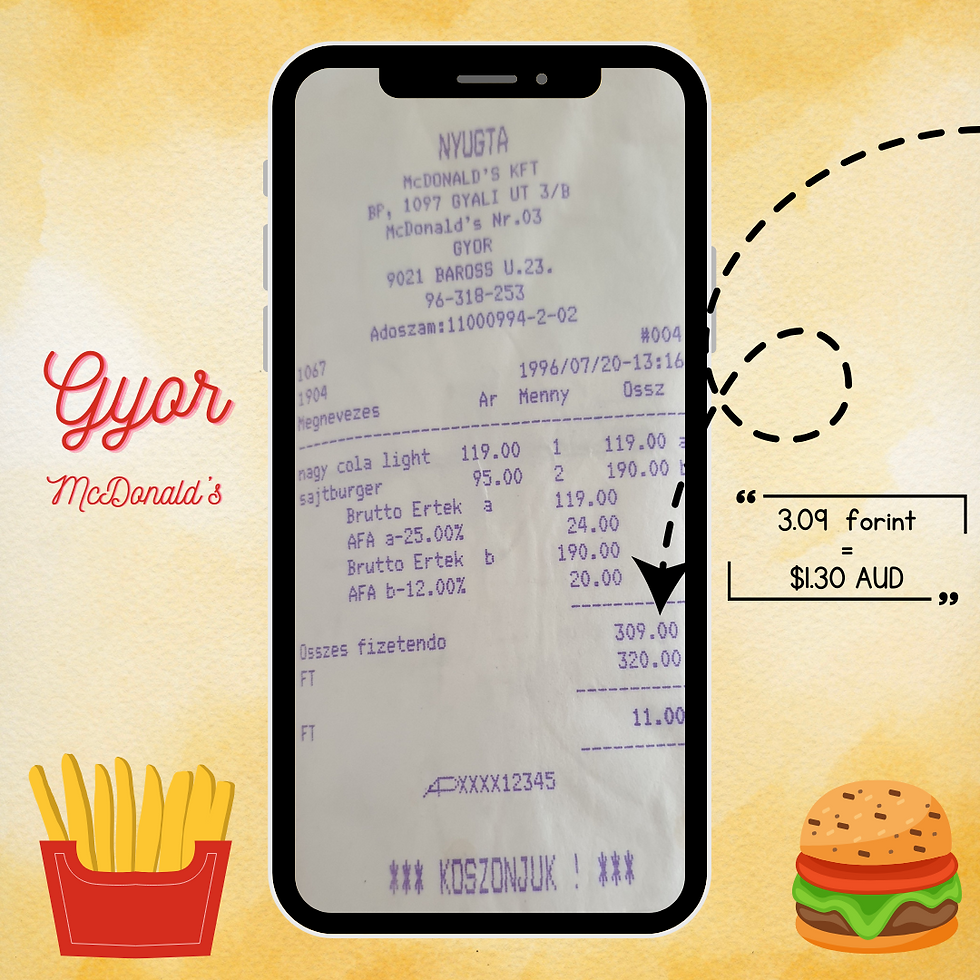
For some odd reason, the McDonald's receipt survived but I have no photos of Gyor! Check out this blog post by Kami to read about Gyor.
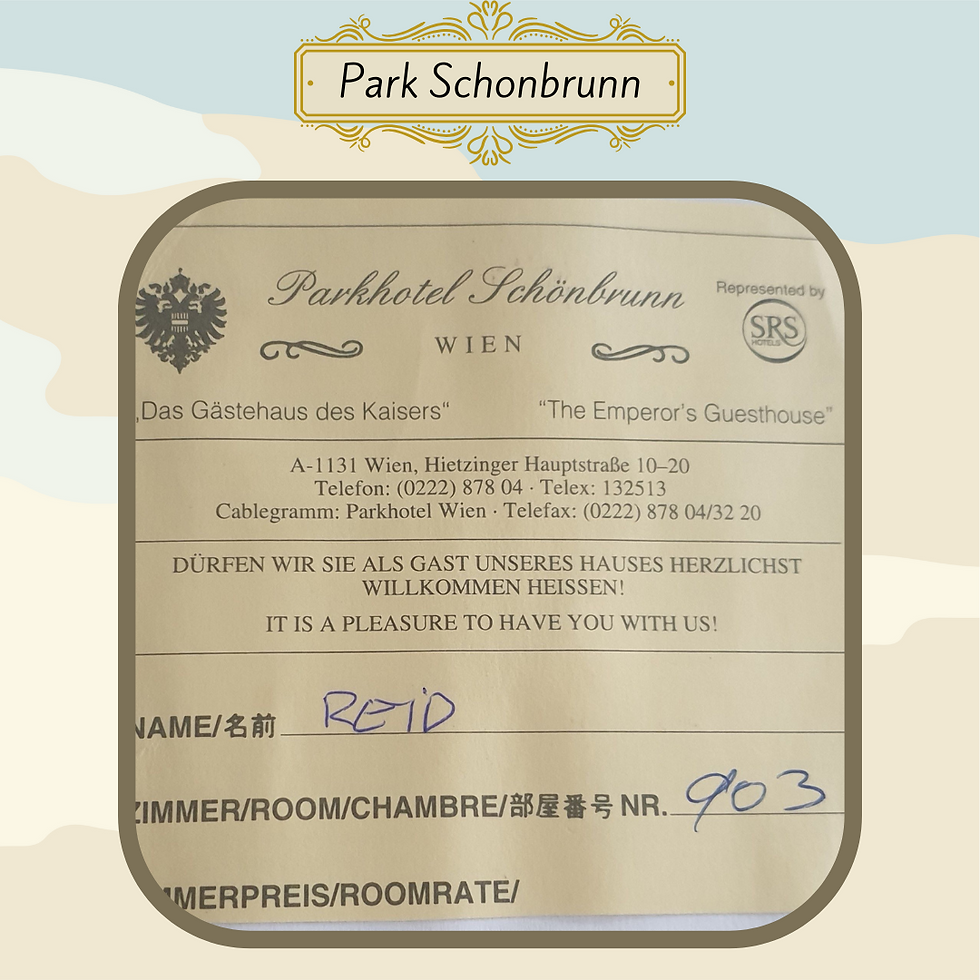
We arrived in Vienna mid-afternoon and checked in our gorgeous hotel, the Parkhotel Schonbrunn, the former guest house of the Emperor Franz Josef. The hotel was originally a rest stop, opened in 1787 and expanded into an inn in 1823.
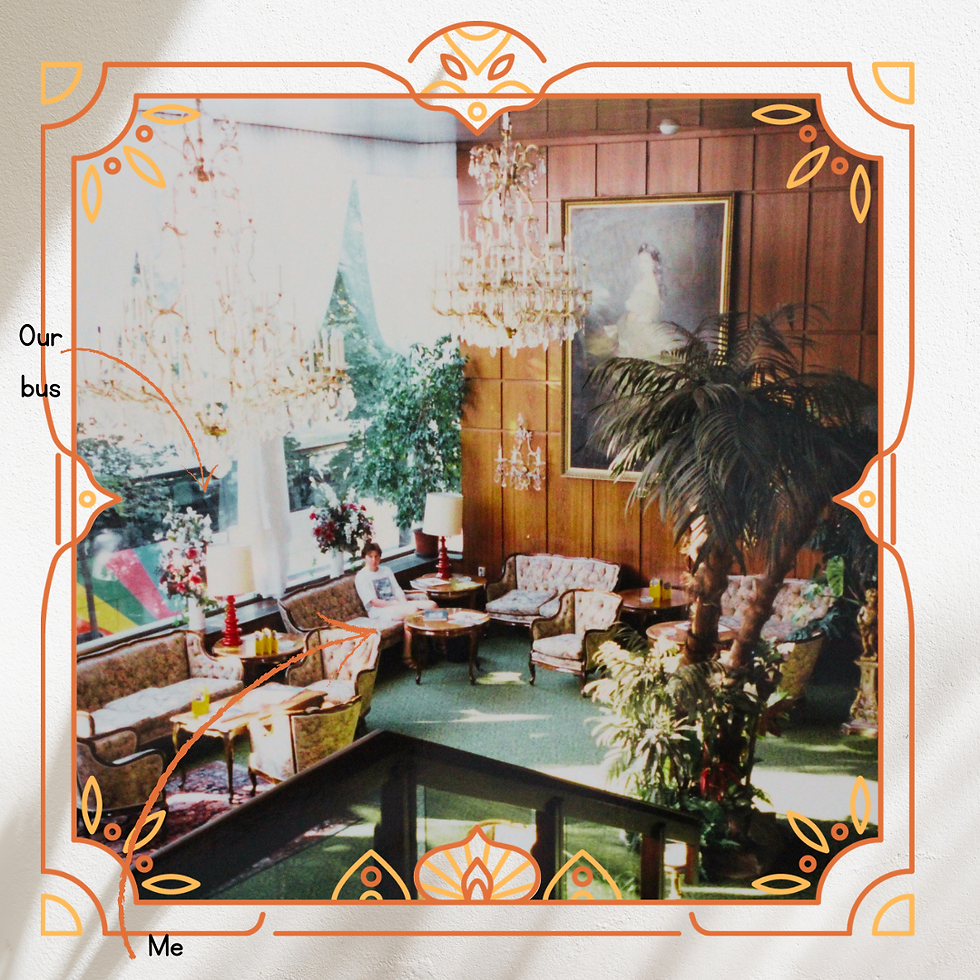
The hotel has a massive reception area, complete with chandeliers. Our room was filled with antique furniture. Many of the Emperor's guests stayed in the hotel, including Thomas Edison in 1911. It was used as a military hospital during WW2 and an officers' mess for the British occupation forces until it reopened as a hotel in 1954. The hotel was modernised and expanded in 2010 but we had the benefit of staying in the older version in 1996. How cool is all that?
There was an evening excursion that included two places of interest and dinner. The first place we visited was the Fischer family distillery, the Old Vienna Schnapps Museum Alter Wiener Destillerie, a family business since 1875. Their front office is resplendent with antique furniture, apparently used in some scenes in Schindler’s list.
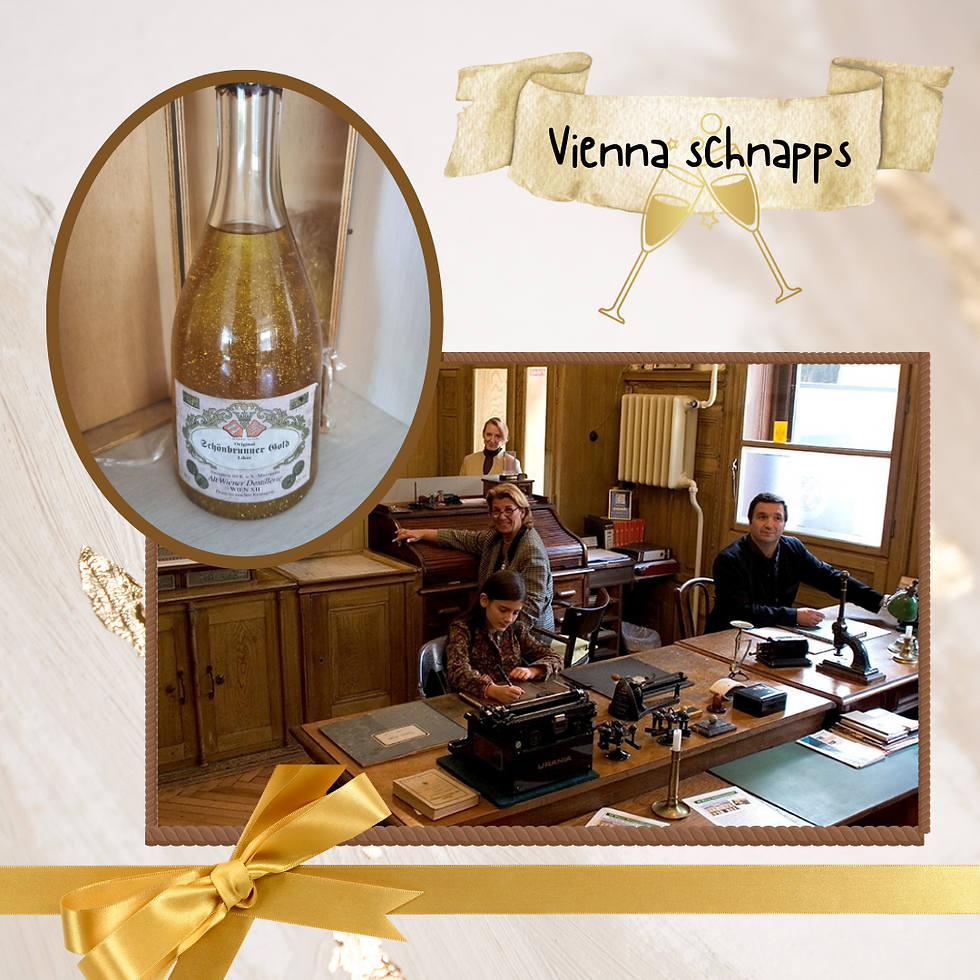
We had a demonstration on the art of making brandies, liqueurs and schnapps by an adorable cuddly Fischer family member [aka the guy in the dark shirt]. We were able to taste some of the products. I’m not much of a drinker and even the small amount I tasted made me feel a bit woozy, especially since I’d not had much to eat that day.
We bought a bottle of strawberry crème liqueur and one of gold leaf liqueur [Schonbrunner gold], more for the bottle and wooden boxes they came in, to be honest. The gold leaf liqueur has survived, and to this day, still sits on a shelf in my house, unopened. That's it in the above collage. Unfortunately, one of our children knocked over the strawberry bottle when they were a toddler and broke it, before we had a chance to drink the contents.
After the schnapps tour, we went to Vienna Prater, an adventure and amusement park. Vienna Prater is home to the Giant Ferris Wheel [Wiener Riesenrad], built in 1897, standing 65 metres tall. The carriages are enclosed and can hold large groups of people in each, so not like a traditional ferris wheel with a seat for two people. The wheel went around slowly, and it was lovely to be able to enjoy views of the city.

After the ferris wheel, Graeme took us to Rosenberger’s for dinner, a Sizzler-style chain restaurant with self-serve salads, pastas, fruits and meats. The place is enormous, spread over two floors.
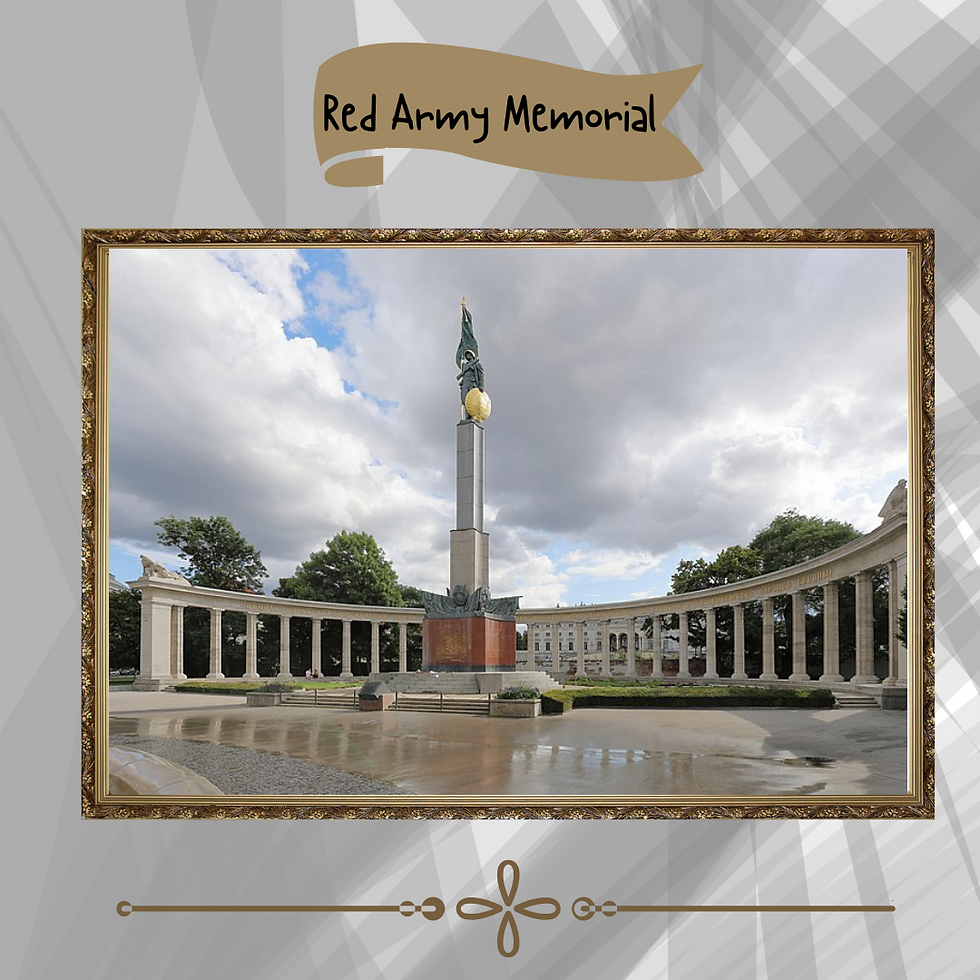
The night would not have been complete without an illuminations tour, of course! Vienna was stunning at night, especially the neo-gothic town hall. We also saw the Red Army Liberation Memorial [1945] with the fountain in front built in 1873. The fountain lights up a night with different colours. This is what it looks like during the day.
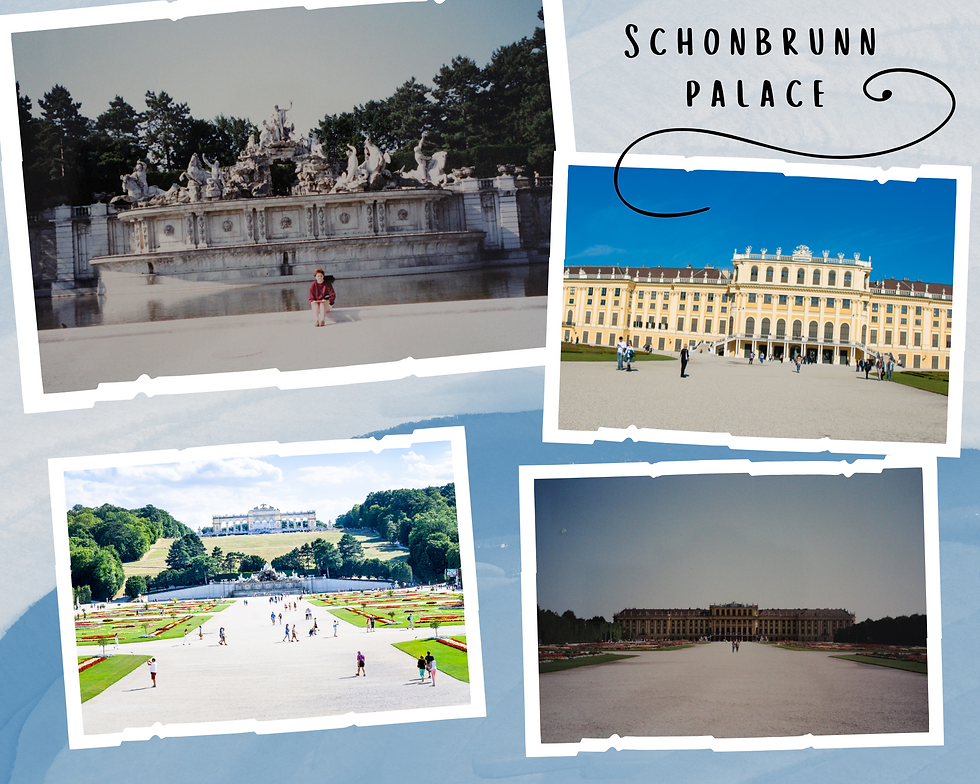
After breakfast on Day 14 in the hotel ballroom [complete with chandeliers!] we visited Schonbrunn Palace, one of the most important monuments in Austria. The Palace is modelled on Versailles and takes its name from its roots in an artesian well from which water was consumed by the court [schonbrunn means beautiful spring]. The Baroque palace has 1440 rooms and spans 300 years of Habsburg history. It was once the summer residence of Maria Theresa Habsburg, who ruled from 1740 to 1780, and Emperor Franz Josef was born and died there. During WW2, the Palace was requisitioned by the British for office space and became a museum in the mid-1950s. The Palace and its gardens were entered into the UNESCO World Heritage List in 1996, the year we visited!
Our guide was Diane, an English woman with an Austrian father who had been living in Vienna for over twenty years. She was easy to listen to and really knew her stuff, so she gave us lots of interesting information about the Habsburgs. I remember thinking that the Palace was ornate, but a little ostentatious, with its gold-plated interiors. Now that I have been to Versailles, I completely get it! I preferred the magnificent gardens to the Palace itself, all beautifully laid out and landscaped. They are huge!
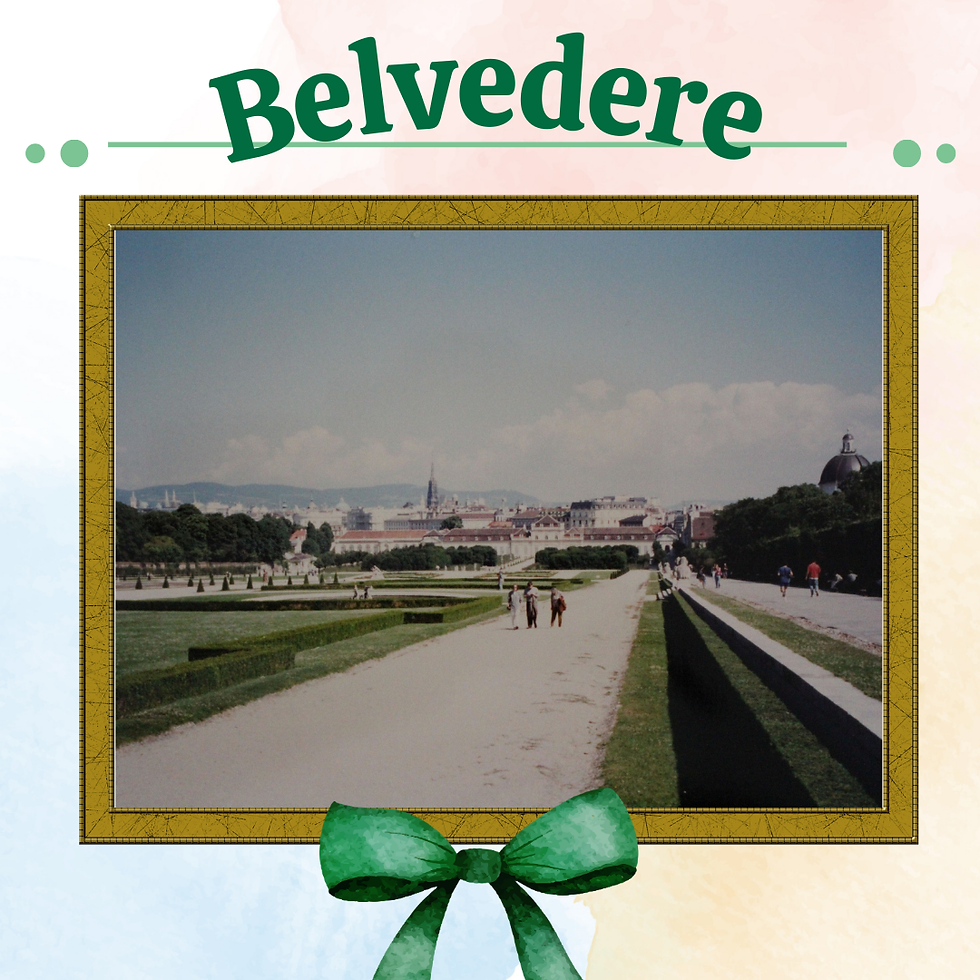
After the tour we joined the rest of the group for a jaunt around Vienna. Again, lots of things seen only from the bus, including the statues of Beethoven, Mozart and Strauss. We were able to get off the bus at Belvedere, the historic building complex that includes two Baroque palaces, an Orangery, and the Palace Stables, dating back to 1697. We really only wandered past the structures, and I wished we’d had more time to explore.
We walked on to the 19th century Heldenplatz [Heroes’ Square], a public space in front of Hofburg Palace where Hitler made his Anschluss speech in 1938. The place where Hitler made that annexation speech can be seen in the below photo. The other building is the Natural History Museum, opened in 1889, that surrounds the square. As a WW2 buff, I couldn't quite believe that I was standing in a place of such historical significance.
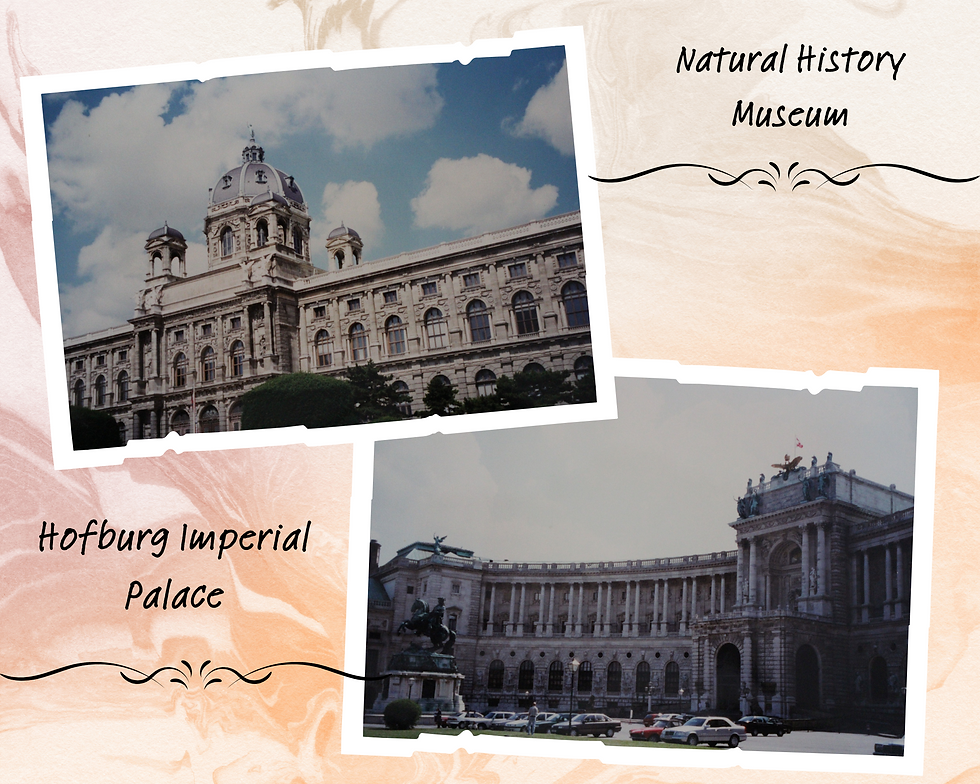
We then took a short wander to see the Maria Theresa monument, nestled between the Natural History Museum and the National Art Museum. The monument was unveiled in 1888 by Emperor Franz Josef. It is a huge monument, towering over four sets of statues, each representing facets of Maria Theresa's rule: her advisers, her administration, the military and the arts and sciences. The side facing the Natural History Museum has Mozart and Haydn statues.

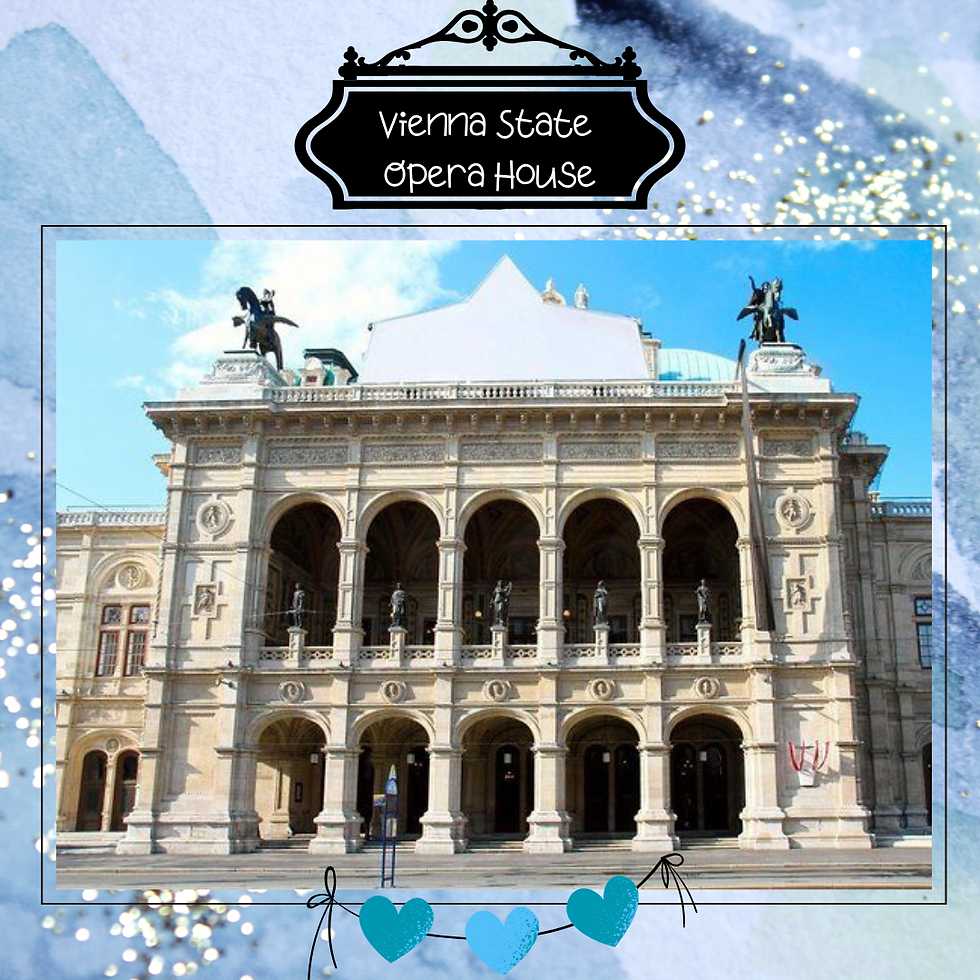
The other notable building we saw was the State Opera House [Wiener Staatsoper]. It is a 1700-seat building that was constructed between 1861 and 1869. We were told that the building was bombed during WW2 after apparently being mistaken for a railway station. It was restored in the 1950s.
We were in Vienna on a Sunday and not much was open. We went to Rosenburger’s again for lunch and then wandered around the massive mall that forms the central city area. We found the Romanesque and gothic St Stephen’s cathedral that dates back to the 12th century at the top of the mall. We had a quick look inside while a service was being held. The photos we took aren't great, sadly.

I wish we’d had more time in Vienna to properly explore and get more of a feel for the place. I say that about everywhere we visited, really, as tours like the one we did are a mere taster.
The morning visit to Schonbrunn Palace was an optional extra and in the afternoon, we did the second part of the tour by visiting the 17th century baroque-style Winter Palace of Prince Eugene [Hofburg] to view the Austrian crown jewels. The jewels aren't as ornate as the British crown jewels we’d seen in London. Super interesting, though, as Diane told us that they were originally constructed to symbolise Austrian history. Housed within the jewels is supposedly the wisdom tooth of John the Baptist and a piece of the Shroud of Turin.

One of the limitations of touring is being stuck with the tour schedule and back in 1996, there were no smartphones or Ubers to help make the most of any free time. We just had to wing it during our rare moments of free time. This time our winging it worked. We were back at the hotel by mid-afternoon and met up with T&D for another walk around Schonbrunn gardens. We climbed up the 60 metre-high hill to the Gloriette, an imperial army monument since 1775 and now a coffee shop. The views of the Palace and gardens were lovely, and it was a glorious afternoon weather-wise. I’m glad we had the opportunity to properly explore the gardens and enjoy some nice weather.

Dinner was not included that evening and we ended up at the little restaurant next to the hotel with T&D. We had pizza and lasagne and giant ice cream sundaes. I remember the waiter, partly because he was handsome and had lovely blue eyes, but also because he thought we could speak German and started asking for our order in German without realising we could only understand the basics. We must have been looking at him blankly as he suddenly paused and started laughing uproariously. Throughout our meal he kept coming back to us, speaking in German, then laughing to himself. We couldn’t help but laugh, too, although he was probably laughing AT us rather than WITH us! All these years later I still remember that meal! Hot Waiter and his colleague waved madly at us as we left so perhaps they were just amused by the communication misunderstanding.
Our Austria experience💭👑
Austria, like Switzerland, lived up to my expectations as a neat and orderly country with spectacular landscapes. Other than our interactions with Hot Waiter, we got on OK with the language barrier. After Hungary, everything seemed expensive. I thought Vienna was a pretty, classical city although without a river as its main feature. The history made me feel connected to Austria and to Vienna, and I loved the historic buildings and our magnificent hotel. The visit to Schonbrunn was a tour highlight, for the unashamedly gaudy palace and beautiful grounds.
Leg 9: Vienna to Prague🚌
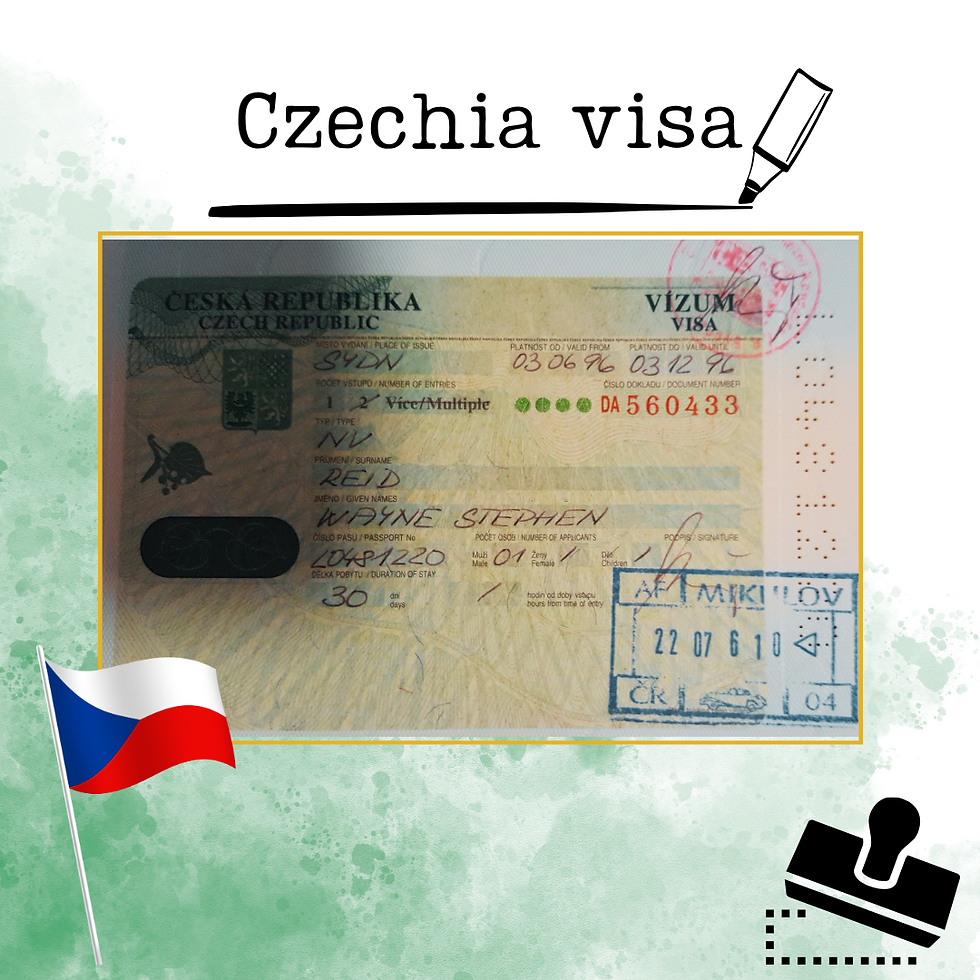
We left early the next morning Day 15 for the border, crossing without incident into Czechia, known as the Czech Republic at the time of our visit in 1996. Below is the visa we required to enter the country, stuck into our passport by the Czech Embassy in Sydney before we left Australia.
Our journey for Leg 9 took us from Vienna to Prague, some 335km and a 4-hour trip. I was so excited to visit Prague! The below map charts our journey that day.

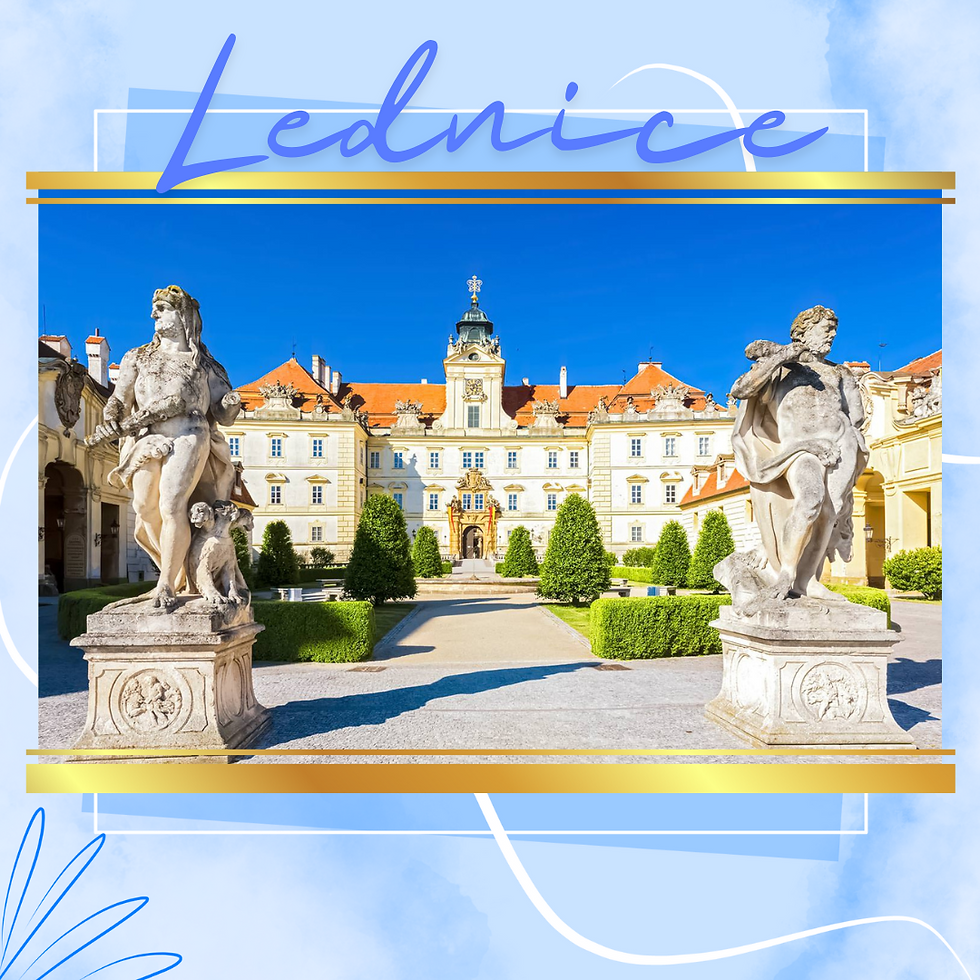
We made a stop along the way at the South Moravian town of Lednice, just inside the Czechia border and around 95km from Vienna. The quaint town has an 18th century castle once owned by a Liechtenstein family that is now a UNESCO World Heritage Site. I noted in my journal that the castle was a bit run down, especially the gardens, but it doesn’t look like that now. I recall that we bought some delicious fresh bread and a drink in the town for the equivalent of $1.20.
We drove another 60km towards Prague, stopping in Brno, a city under massive construction like we’d seen in Berlin. We wandered around the beautiful, cobbled streets and T bought a slice of pizza from what would be called a pop-up shop these days. The server asked him if he wanted tomato sauce on his slice. Ha!
In Brno one of our tour companions had $800USD stolen from her bag while she washed her hands in the loos at McDonald’s. It wasn’t hard to spot the pickpocket gangs loitering around the eating area of the restaurant. Now that I think about it, $800USD was a lot of money back in 1996 [still is!]. I’m not sure why she had so much cash on her. I know we’d eaten at McDonald’s in Gyor [out of necessity more than anything else], but back then it was better to avoid fast food chains, for both the food and the pickpockets.
I wish we'd taken photos on Brno, especially given the year that we visited. I am not sure why we didn't! There is more on Brno here. I do have this [rather bad] photo of the Czech countryside, taken from the bus, though.
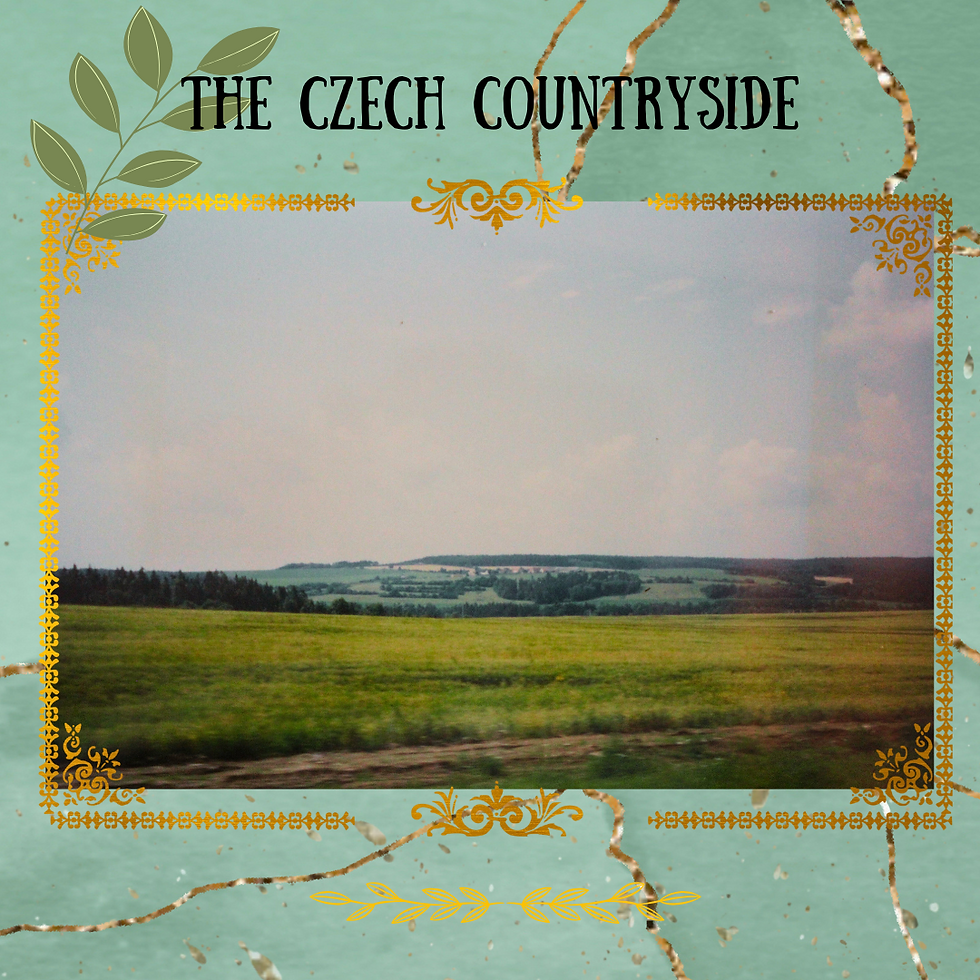
We arrived in Prague around 5pm after a 2-hour jaunt from Brno, checking into the Hotel Diplomat, all shiny and modern after the old world charm of the hotel in Vienna. Both hotels we stayed at in former Eastern Bloc countries were new and fancy, I guess to attract tourists in the early days after the fall of the Iron Curtain. Dinner was less hearty than we’d had in other hotels, but it was actually a nice gastronomic break. I wrote in my journal that we were served a tiny half tomato with some sort of fish paste on it, a small helping of beef stew, and a slice of strawberry trifle.

Day 16 of the tour and we were holding it together...just...We were nearing the finish line! Prague had long been a bucket list thing for me, so I was determined to make the most of our time in the city, even though I was starting to suffer from tour fatigue.
The buffet breakfast at the hotel was huge, and once again we were filled up with food that meant we were hardly in need of much during the day. Our local guide for our trip to the 9th century Prague Castle was Susanne, a lovely woman who unfortunately didn’t have the best English. We all struggled to understand her, and I remember that her information was a little jumbled so it was hard to get a clear picture of what she was trying to say. I felt so bad for her as she could see that communication was an issue.
Not to worry, it was a glorious day, and we had a lovely time wandering around the Prague Castle complex that overlooks the city. The castle is quite extensive [70 000 square metres in area] and hard to discern as a castle – more a series of structures [see below]. St Vitus Cathedral, a gothic church on the site and the most important in the country, was built in the 14th century and features mosaics of The Last Judgement. The church can be seen in the two shots on the top middle and right of the below collage.
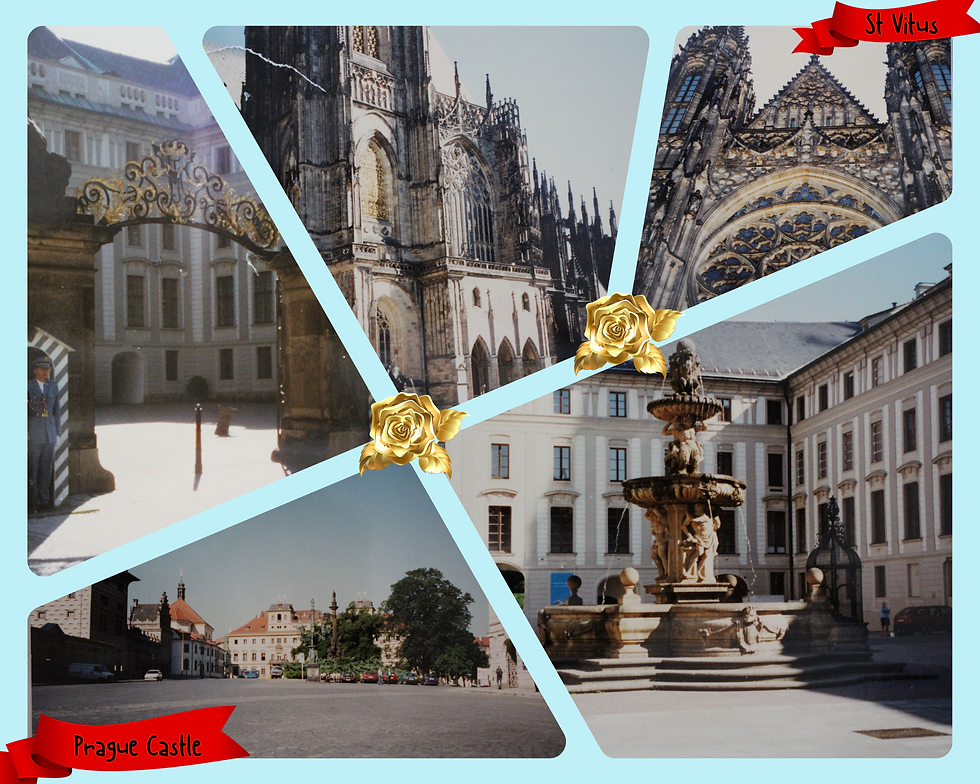
We were on our own after the castle tour and arrived in the Old Town Square at 11am, just in time to see the revolving figures of the apostles of the Prague astronomical clock [Prague Orloj]. The clock is a magnificent piece of art even though our pretty ordinary photo doesn't do it justice. I was so thrilled to have seen it in action. The clock dates back to 1410, and represents the position of the sun and moon in the sky, a bunch of astronomical details, and various Catholic saints. The Walk of the Apostles is an hourly moving of the apostle figures and other sculptures, most notably the skeleton that represents death striking the time, and a calendar dial with medallions representing the months.

The Old Town Square features several gothic buildings, including the 14th century Old Town Hall and Church of Our Lady before Tyn and the House at the Stone Bell. I loved our afternoon in Prague, wandering around and taking in the vibe, exploring little cobbled alleyways off the Square. We also walked to Wenceslas Square in the New Town, headed by the magnificent 19th century National Museum building [top left hand photo below]. Prague, we 💓 you.

We walked across the beautiful Charles Bridge, the medieval stone arch bridge, first constructed in 1357, that crosses the Vltava River. The bridge is 516 metres long and 10 metres wide. It is a bow bridge with 16 arches shielded by ice guards and decorated by an alley of 30 statues. The statues were originally erected between 1683 and 1714 but have since been replaced by replicas, the originals of which are housed in the National Museum.

We rubbed the good luck plaque on the bridge [top left hand photo above], along with every other tourist. The statue and plaque commemorate St John of Nepomuk who was canonised In 1729, and is the only bronze statue on the bridge. I remember that we bought a print from one of the stalls near the bridge. We had it in a frame on our wall for many years until it unfortunately deteriorated. I did buy a book from one of the stores in the Old Square that has survived.

Czechia impressions💭🥰
I thought that Czechia was less in full swing towards capitalism than Hungary, so it felt more unaffected by change and masses of tourists. There didn't seem to be many American fast food restaurants around and there were fewer sellers out on the street than in Budapest. English was less spoken than in Hungary, but I could just imagine Prague in a few years, transformed into a major tourist destination. Again, I was glad we had visited before that happened. I loved the whole vibe of the city: the pretty River Vltava, the stunning Charles Bridge, and all the gothic buildings. The central area of the city is compact and easy to walk around, buildings tightly packed together with quaint, narrow cobbled streets in between. I’d so love to go back one day!
Leg 10: Prague to Munich🚌
We’d been travelling for almost a month by the time we headed to Germany, and on the tour for 16 days. It was all starting to feel relentless and overwhelming. Sixteen days may not sound like much, but it is when hurtling around the continent at a cracking pace!
We were up again early on Day 17 for our 400km, 4-hour drive to Munich, stopping at the beer-brewing town of Pilsen, where we used up our remaining Czech crowns on some fresh bread and muesli bars. The weather had turned cold and dreary, and we found Pilsen a bit depressing, drab and grey as might be expected of an old Communist town. Luc got lost driving the bus out of Pilsen to the border and his arguing with Graeme over directions added an hour to the trip [no Google maps back then!]. Getting lost did give us the chance to see lots of the area in and around Pilsen, though!
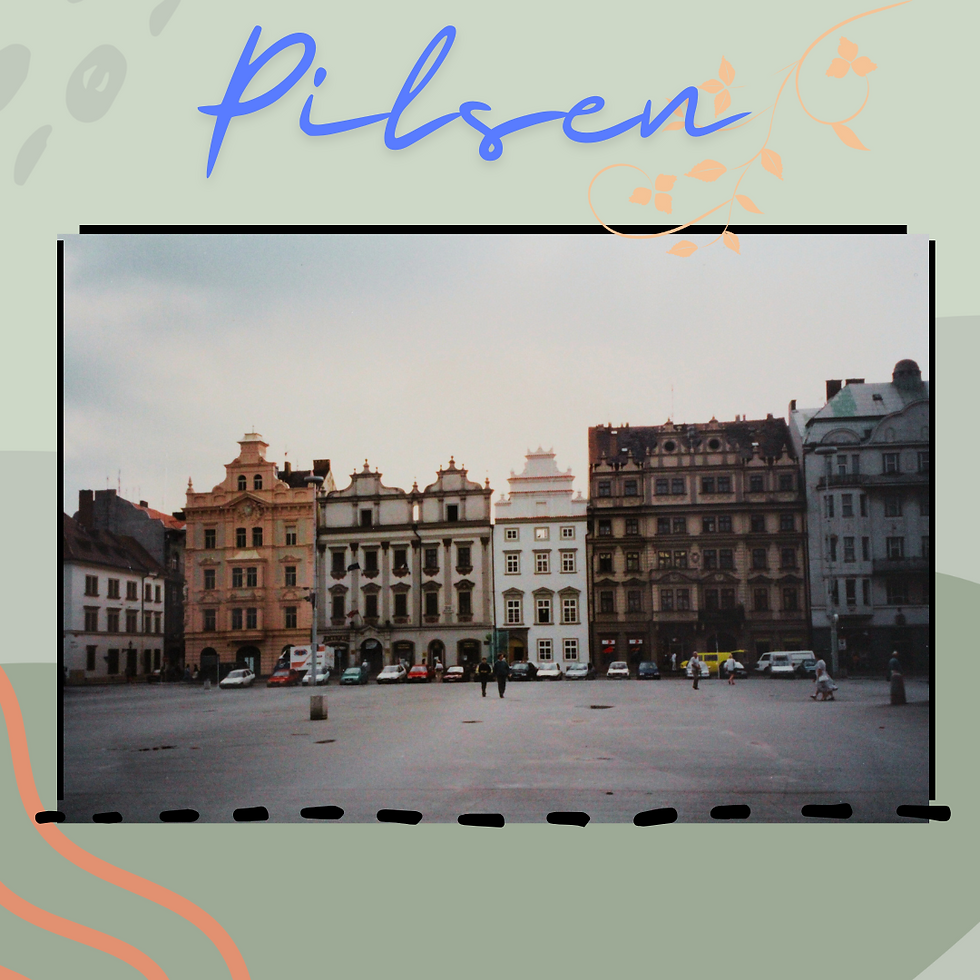
Once Luc found his bearings, we were speeding down the autobahn after a hassle-free border crossing into Germany, breaking at a motorway stop for lunch. We just bought snacks as we had food from the Pilsen stop. Most of our tour companions lined up for a hot meal at the motorway stop; another time when we marvelled at the food these folk were putting away!

We enjoyed the lush green landscapes and quaint orderly villages we could see from the bus as we headed to Munich. The only photo I managed to take doesn't quite capture how pretty the German countryside is, but then we were whizzing past it all day, so...

We arrived in Munich at 5pm, just in time to see the glockenspiel at work in Marienplatz Square. The clock was completed in 1908 and has 43 bells and 32 life-sized figures. It re-enacts two stories from Munich’s history from the 1500s. So cool!

We then visited the famous Hofbräuhaus beer hall for a stein of beer and some German oompah music. Super touristy, I know, but it was a lot of fun. The beer hall was originally built in 1589 but was largely destroyed by Allied bombings during WW2, to be faithfully reconstructed by 1958.
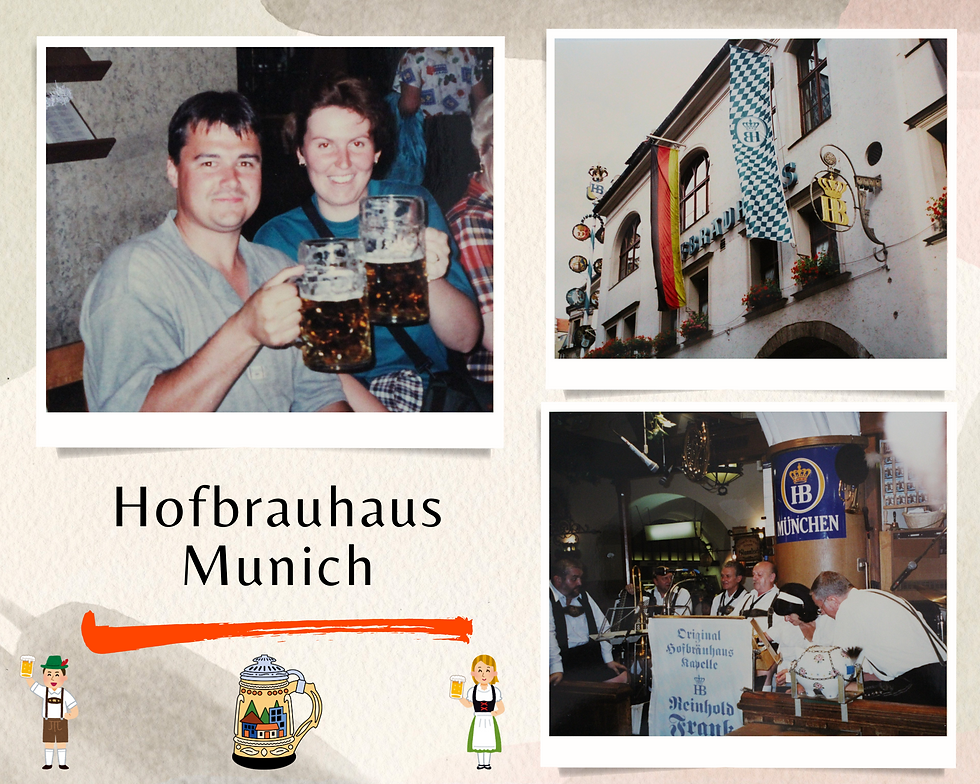
We stayed in the Hilton in Munich which was a bit of a surprise as it was posh, and we felt completely out of place. Ha! As noted above, we didn't know where we'd be stating until the evening of arrival. The hotel is the least interesting part of travelling to me, but what was interesting was the variety of places we stayed in across the trip. We were intrigued to see what the rooms were like at the Hilton but they weren't as posh as the swish lobby. The dinner was an incredible buffet with every food imaginable, though!

Leg 11: Munich to Koblenz🚌
I woke up feeling like I was catching the cold that was circulating the group. That’s another of the cons of touring – being at such close quarters with a large group of people is a sure way to get sick. The weather didn’t help as it was cold and cloudy, and it showered in the afternoon. Day 18 was another long one. We travelled 520km from Munich to Koblenz via Heidelberg, plus a little Rhine jaunt from St Goar.

We’d had no time at all in Munich, just the evening before, and we were off again in the morning of Day 18, driving to the outskirts of the city past the BMW Headquarters and the Olympic Stadium. We had been told the night before that there would be a surprise addition to our itinerary the next day and we guessed it was a visit to the concentration camp memorial at Dachau. I was glad we would visit such an important historic site [and to add to our experience at Sachsenhausen in Berlin], as were many others in our group. Some of the group, however, thought it was a terrible idea and refused to get off the bus when we arrived at the camp. At the time I thought this was a strange attitude, but I assume they had their reasons.
Dachau is quite different to Sachsenhausen as there are more buildings preserved and it is more like a proper museum. Sachsenhausen felt very raw, but at the time, it probably didn't have as many visitors as Dachau. We had quite a bit of time at Dachau, so were able to watch a film on the rise of Nazism and wander through the brilliant but disturbing exhibition of photos and artefacts. Still today I am affected by the two concentration camps we visited, as the horrors of the Nazi genocide become so much more real when standing in the places where it was committed.

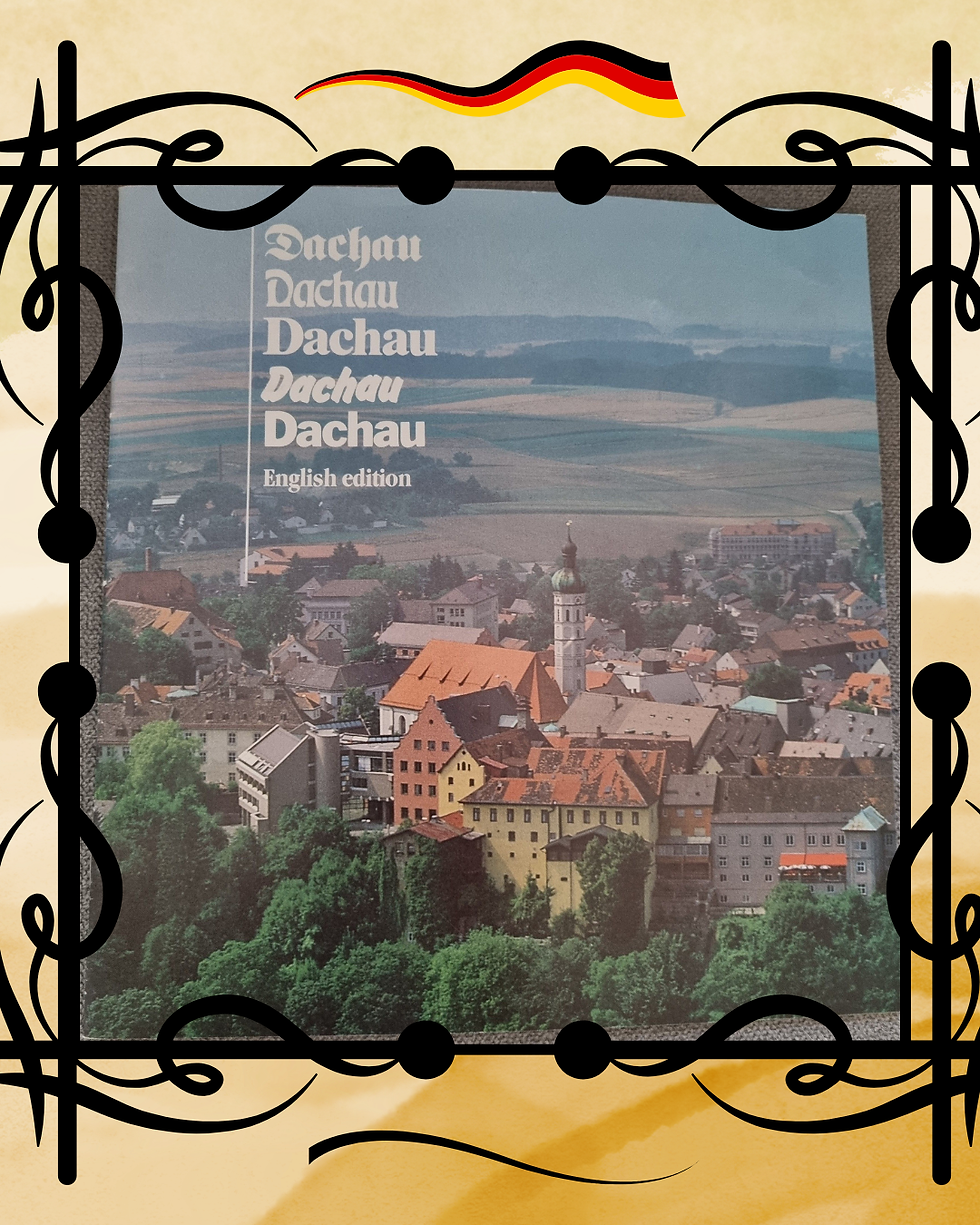
Dachau is around 30km north west of Munich. I bought the below booklet at the museum. It gives the fascinating history of the town, dating back to 500 BC. Interestingly, one page of the booklet is dedicated to the Nazi period. I imagine the town will be forever associated with the concentration camp, though.
After that sobering and thought-provoking visit, we headed along the autobahn again, travelling three and a half hours and 330km to Heidelberg. We broke our journey at yet another motorway rest stop for lunch, this time near Stuttgart. Heidelberg is a special place for me as I’d had a German penfriend, Clara, who lived there when we used to correspond when I was learning German at high school. [Yes, I am old enough to have had a penfriend!]

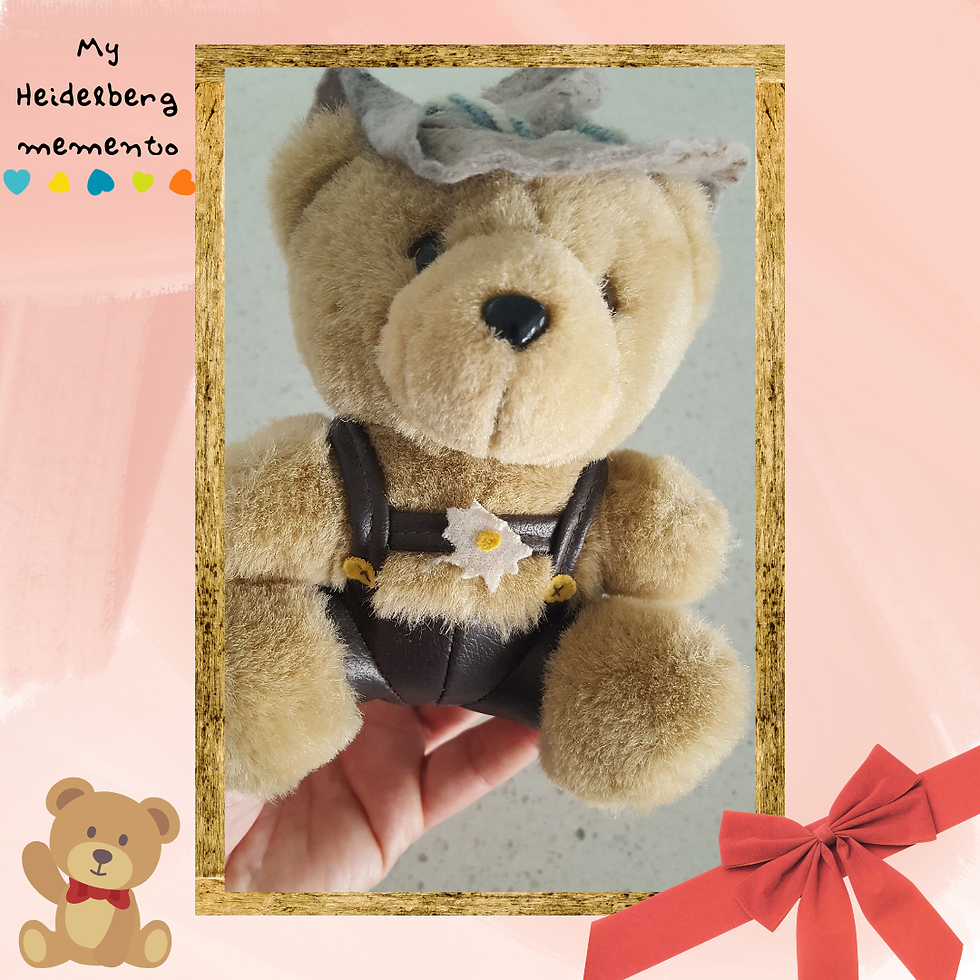
Our visit was hampered by the cold, showery weather [this is summer?], but we still managed a stroll around the main square and glimpses of the ruined castle that looms over the town. We bought this cute little teddy bear wearing traditional lederhosen from some markets and had a drink in a student inn. Fun!
Our day was not over yet, as we then headed a further two hours and 155km north to St Goar to embark on our Rhine cruise. My head cold had really set in by then and I was feeling very under par. The cruise was so cool, though, passing by vineyards, castles and gorgeous hillside homes. The weather improved a little, too, although it's hard to tell from the photos!

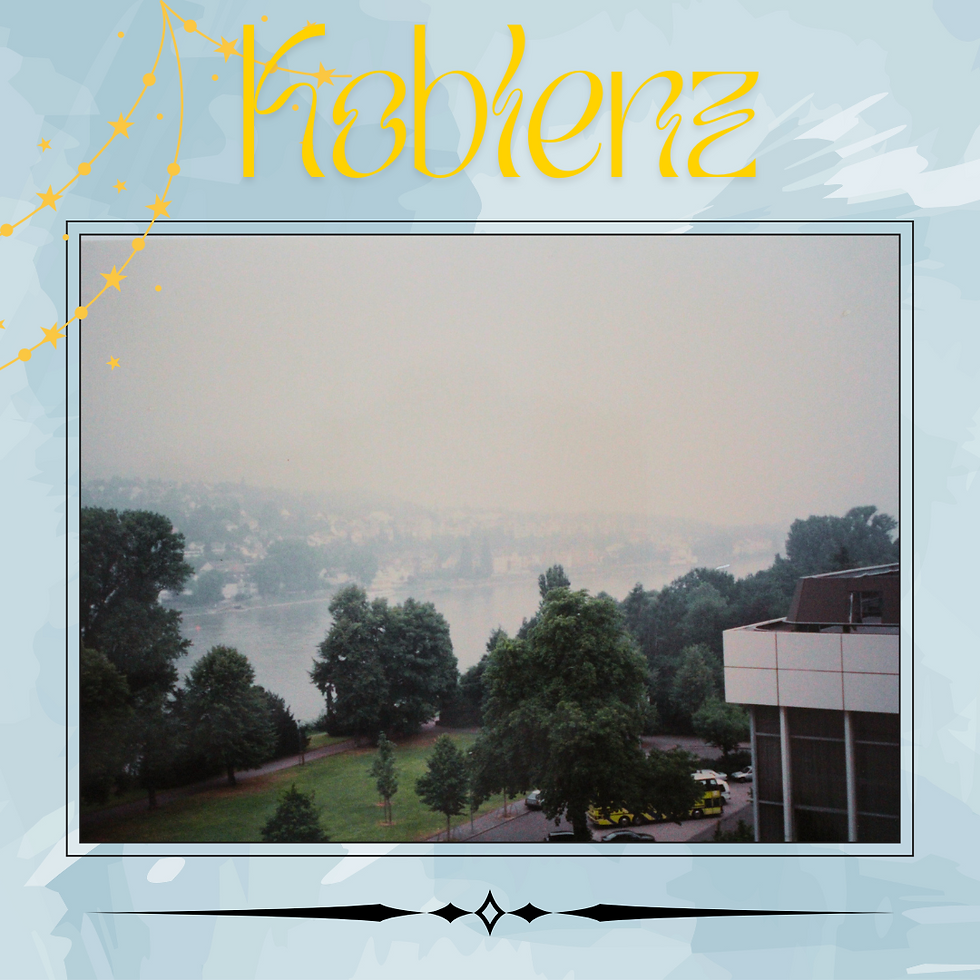
Our rest stop for the night was in nearby Koblenz, in a hotel with a magnificent view of the Rhine - until the fog set in, that is! I remember the hotel dinner was delicious, but I was feeling horrible by then and just wanted to go to bed. The below shot is the view from our hotel room.
Leg 12: Koblenz to Brussels via Luxembourg🚌
Day 19 was our maddest one of the tour. We travelled through three countries, starting in Germany and ending up in Belgium via Luxembourg. We covered 400km that day, around five hours of travel. Most of it is a blur to me, to be honest, as my cold hit a low that day.

We set off in the morning for Trier, the oldest town in Germany and our last stop in the country. I loved Trier – so pretty with its distinct architecture and lovely square. Trier is 130km south west of Koblenz.

We used up our DM on bread and fruit and checked out the UNESCO World Heritage Site Roman gate, Porta Nigra [black gate] in the town with its huge portcullis. It was built in AD 170. How amazing is that?

Our Germany experience 💭🍻
Germany was one of the places on the tour I’d been dying to experience, after learning German at high school and gaining a small taste of it from our Berlin side trip at the start of our adventure. I had dreamed of visiting Europe since I was small and I found Germany to be as I expected, with picturesque green landscapes and a strong sense of order and tidiness. Unfortunately, the itinerary didn’t allow us to take things in with any depth, as each place we visited only gave us a short amount of time to explore. The lousy weather and my equally lousy cold didn’t help matters. That said, the highlights were the glockenspiel in Munich, the Dachau experience, and visiting Trier and Heidelberg. I wish we’d had more time in the country and that our visit had come earlier in the tour when we weren’t so exhausted.
That was it for Germany! An hour after leaving Trier, we were in Luxembourg! It is so weird for us as Australians to comprehend traversing three countries in one day [for we would end up in Belgium by that evening]. I remember thinking, through my cold-addled brain, that Luxembourg was stunning. We wandered around the main square and took in the views from The Rock lookout. Honestly, we were only there for a couple of hours – definitely a whistle stop visit!
Our third country for the day - Belgium - was up next. We were excited to experience Brussels, but we were absolutely ready to be off the tour by then. We stopped at Bastogne in the afternoon, a short drive from Luxembourg just inside the Belgian border. We only had a little bit of free time, and I wasn’t up to much exploring, so we stuck around the Sherman Tank Memorial at the intersection of Place General McAuliffe and Rue de Sablon, commemorating the 1944 Battle of the Bulge.

We arrived in Brussels in the middle of the afternoon after a further 150km, 2-hour drive north. There was the usual rushed drive around the city in the bus. I remember thinking that the city was one of sharp contrasts between beautiful homes on tree-lined streets and quite shabby areas, but I guess that could be said about any city. The Brussels experience is quite a blur to me as we really only had a few hours in the city. I was lucky to return to the city in 2011 for a proper poke around.

We were able to get off the bus and wander around The Grand Place, with its beautiful buildings, unspoilt by fast food restaurants. Graeme took us for a walk to see Mannekin Pis, the 55cm bronze fountain sculpture of a little boy urinating. I know it's a huge tourist drawcard, but it's so weird.

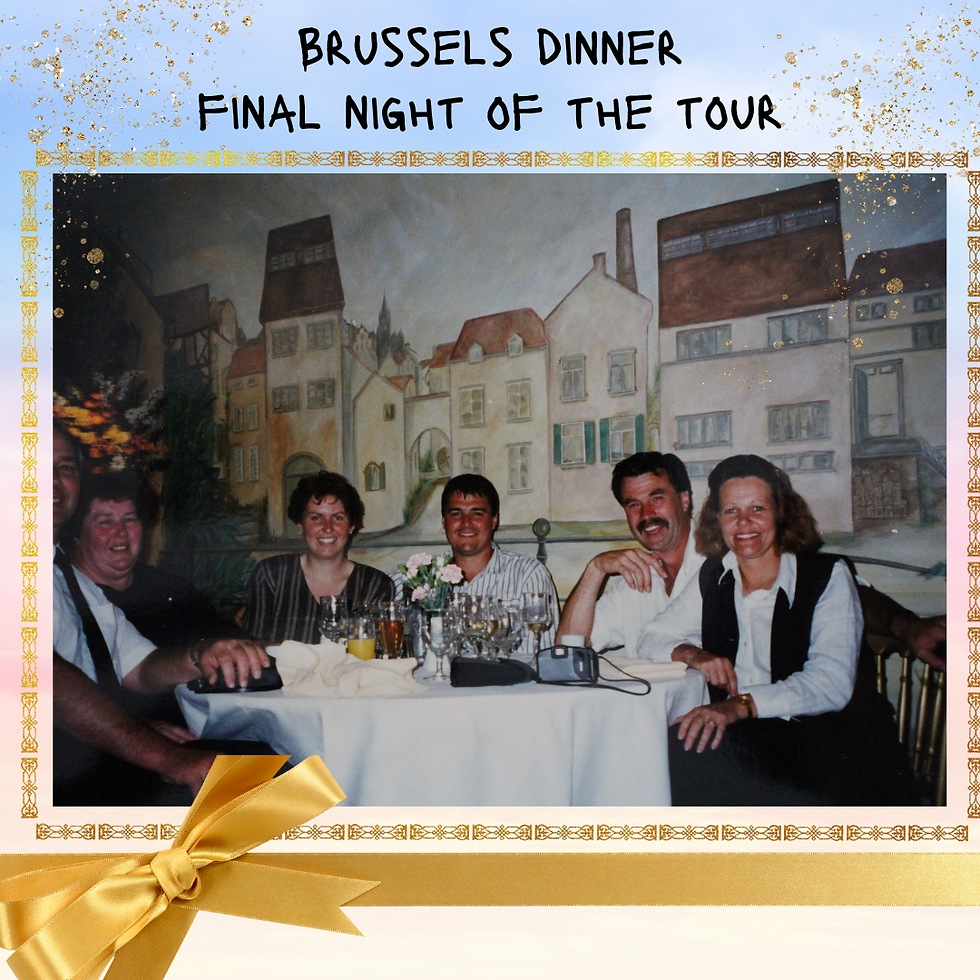
This was our final night of the tour, and we chose the optional farewell dinner at a local restaurant Graeme raved about but then couldn’t find. We were in a seriously dodgy part of town, but the meal was lovely, and we had the best table in the room, right in front of an incredible mural. I had been feeling rotten all day but perked up a bit by the evening.
We stayed at the Renaissance in the centre of the city, complete with the gaudiest carpet I have ever seen in the lobby. I don't have any photos - shame - but below is what the hotel looks like today. I don’t remember much of our stay there as my cold was still bothering me and we’d had enough of being on the tour. I felt better on the final day, but all we wanted was to get back to London and be on our own again.

Leg 13: Brussels to London🚌
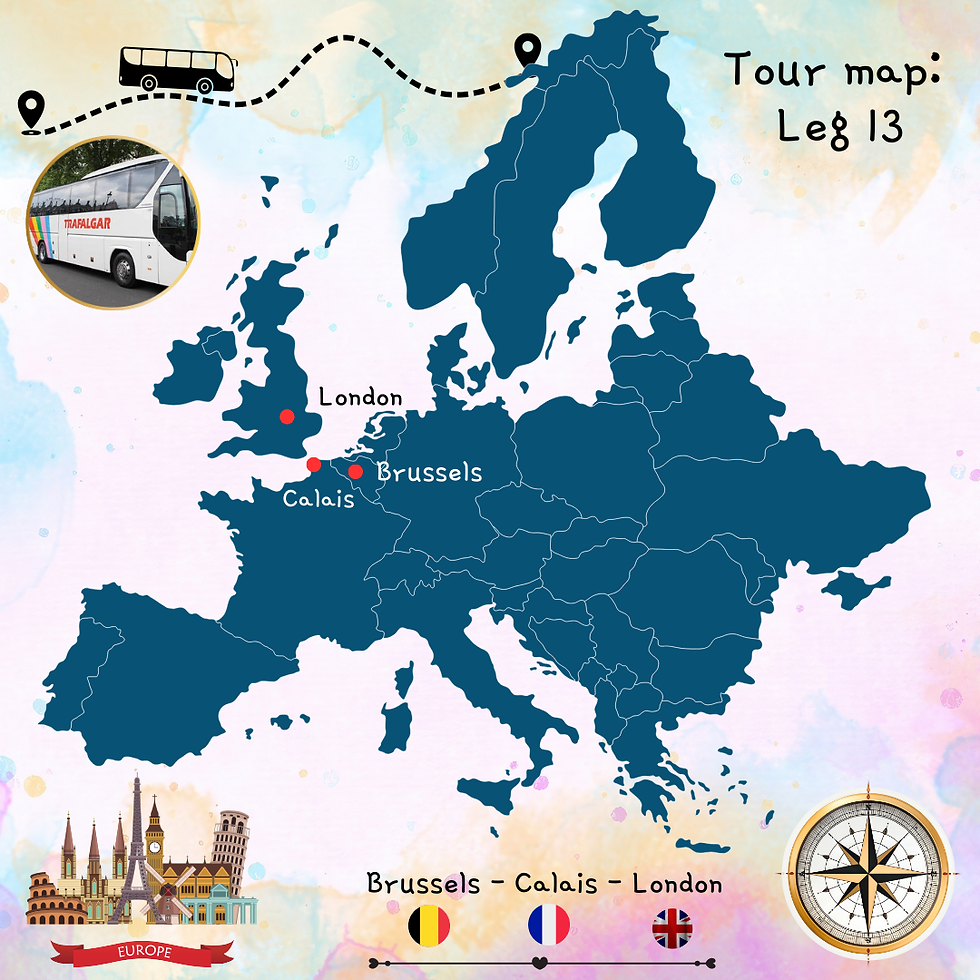
The buffet breakfast on the final day Day 20 was lovely, and we even had toast. Ha! Our final leg took us back to London, around four and a half hours of bus travel plus the return ferry across the Channel.
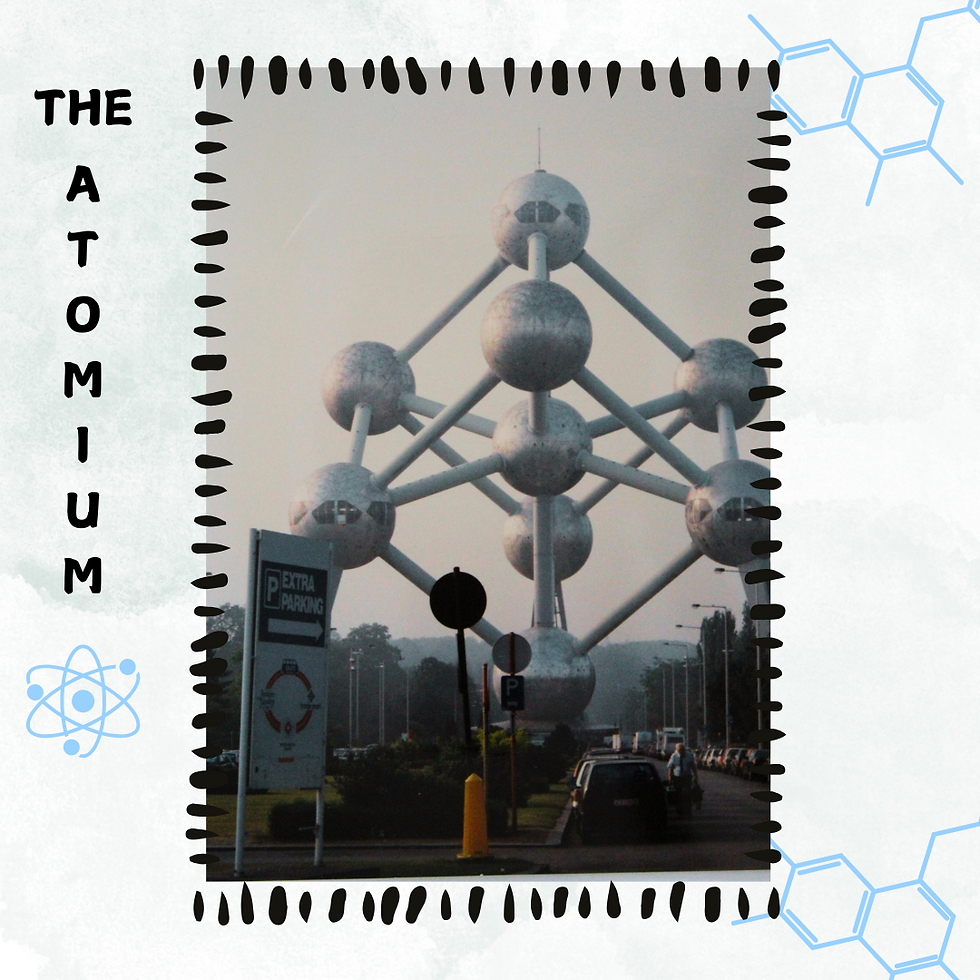
We stopped briefly on the outskirts of Brussels to take photos of the Atomium. The Atomium was built for the 1954 World Expo and was not intended to be permanent, but it has stayed, becoming an international symbol of Brussels. I was able to go inside on my return visit in 2011, but this time, we only had a fleeting glance of the impressive structure on our way to Calais.
Our Belgium experience💭🤧
I remember thinking how flat the Belgian countryside was after the mountainous landscapes of some of the other countries we’d visited. It seemed so familiar after all the war films I’d watched over the years, especially the villages and farmhouses. I loved what I saw of Brussels but wished we’d had more time to explore. The Grand Place is so beautiful. I’m glad I have been able to return to Belgium to truly experience it.
We farewelled Luc in Calais to lots of hugs and cheek-kissing. We gave him a $40 tip as Graeme had given us a stern talking to about how we needed to tip Luc. Tipping is not customary in Australia, so it felt awkward [and expensive to us] to give money to Luc but he was a lovely man and an incredible driver. The things he did with that bus to manoeuvre around European city streets!
I hardly remember the return ferry crossing and I didn’t note anything in my journal at the time. We were met by a charter bus, and everyone was dropped back at their London hotels, although most people were staying at the Tower Thistle, where the tour had begun. Graeme shook our hands, and that was the end of our whirlwind adventure!
We were so relieved to be off that darn bus and away from all the people we’d been stuck with for three weeks T&D were in a room at the Thistle two doors down from us, so we met them later in the evening to stretch our legs and buy dinner at the nearby Safeway’s we’d found the night before the tour began. We went back to our room after dinner and watched the tour footage we’d shot on our video camera. It was hard to comprehend all that we’d seen and done over the course of the tour.
T&D were heading to Amsterdam in a few days, but we were off in the morning to Heathrow to collect our hire car for the final two weeks of our Grand Adventure, a road trip around England, Scotland and Wales . We were sad to say goodbye to T&D as we’d grown close to them during the tour, but completely and utterly relieved to be on our own again.
Our tour experience: The positives👍🏼
Let’s start with the positives. We experienced so much in a brief time, seeing and doing things we’d never have been able to do on our own in 19 days. Touring with a group is a timesaver purely by avoiding having to line up at key sights. This advantage was evident at the Eiffel Tower and the Sistine Chapel where we would have waited for half the day had we been on our own. Today that is less of an issue, though, as tickets can be pre-purchased online for set entry times.
Having Graeme or local guides to take us around was also a bonus, and we learned lots of interesting things from all of them. Graeme always gave us valuable advice about local customs, shopping, food, and places to check out during our free time. He had over 20 years of experience as a guide and it showed, as his knowledge was endless. His dry wit made him fun to listen to and we never tired of his stories. These were the pre-Google days, too, when information wasn’t as accessible. Nowadays, having a local guide is not as important, I suppose.
Other Trafalgar perks included access to restaurants and last minute changes to the itinerary all taken care of – essentially it was a hassle-free experience. We didn't have to worry about where to sleep at night and most morning and evening meals were covered. Being driven everywhere was pretty cool and our bags were even deposited to our room each evening! The optional excursions were all worth it, too, despite our budget taking a nosedive. We’d paid a lot for the tour in the first place and a huge chunk of money added to that initial price made the total cost high. Again, paying for the convenience. If food is your thing, tours are great. For us, as nice as all the included meals were, we could have done a cheaper tour as food definitely isn't our thing.
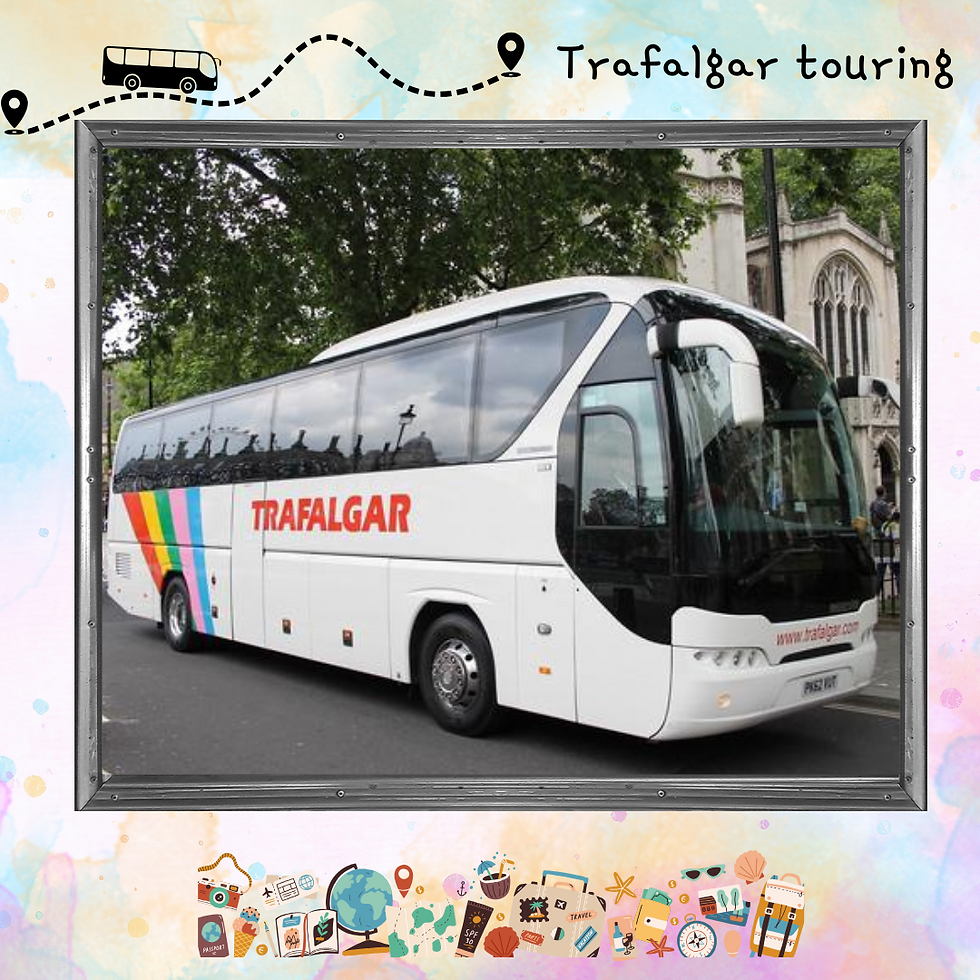
I was glad we had chosen an open-age tour, despite being considerably younger than most of our fellow travellers, as the general vibe suited us. We'd avoided the post-partying hungover crowd that we saw when we ran into Contiki groups [who were wearing “I partied in x places” t-shirts] as it’s just not our thing. I guess that meant we did fewer ‘fun and adventurous things’ and more things of historical and cultural interest but that was perfect for nerds like us! We had so many unforgettable experiences from the extensive itinerary. Even all these years later it is hard to comprehend all that we saw and did.

Our tour experience: The negatives👎🏼
Now for the negatives. There were 46 people in the tour group, made up mostly of Americans and Australians and a few Canadians and New Zealanders. This was our first Big Adventure, so we’d not been in a tourist situation before. There sure is a lot to learn about human behaviour!
Some of our fellow travellers were a bit loud and obnoxious, failing to listen to instructions and follow directions, and asking what we thought were kind of dumb questions [only dumb because they weren't listening properly]. There was a lot of complaining about things we didn't think mattered. We were just happy to be there! There was stuff that bothered us [the tight schedule and having to wait for other people, for example], but we didn't dare complain.
As introverts, we just struggled with having to be at close quarters with such a large group of people for an extended period. The socialising was exhausting. We were glad to have found our tour buddies in T&D and we kept in touch with them for some years afterwards. We did have a few laughs at some of our tour companions' antics, even making up pet names for some of them. That probably sounds mean, but I'll have to be honest and admit that a lot of people were irritating.
There were several people who stood out with their quirkiness, and I still remember them to this day. There was a couple from San Francisco who were elderly; Mrs G had dicky knees, I recall. They were slow - and I get it - but they complained a lot and we wondered why they'd even done the tour. They also refused to get back on the bus until the exact time we’d been told to reboard, so we often sat in our seats, watching them hover outside before they finally got on the bus.
There was another American couple who were super nice, but I felt kind of bad for them as they didn’t seem to have much money to spend. We didn't, either, but enough to do a good selection of the optional extra trips. They didn’t do any of the optional extra tours and we noticed them taking food off the buffet table each morning to eat during the day.
There was a solo female traveller from Atlanta, and she told us she was renting her house out for an exorbitant price during the Olympics. She said she was desperate to be out of Atlanta! Another solo American woman was from NYC; she told us her husband was a pro golfer and she was on the tour on her own as compensation for being a golf widow. She was quite nice but seemed unwilling to step out of her comfort zone or think for herself, even to the point where she’d thrust a heap of currency at us constantly and ask us to tell her how much money she had. I remember her asking us one day, "Do I have enough for an ice cream?" I mean, really, just count it!
There were two married women on the tour, one of whom was travelling with her senior mother and one with her 20-something daughter. One ended up involved with the tour director and the other flirted with all the men on the bus, including my husband [who was pinched on the butt at one stage]. You do you, but I was embarrassed for both of them as their behaviour was a little cliched. The woman who was flirting had people's attention. I'd be mortified if I knew the group was watching me like that. I’m not sure whether the others noticed the woman who was involved with the tour director, but we did and so did T&D. She looked exhausted the longer the tour went on. I have no idea how she kept up a relationship with the tour director, on top of the tour activities.
[Reading my comments on our travelling companions again, they sound a bit petty and judgy, but is in my nature when in situations like these - stuck on a bus with a group of people - to notice things. Even slightly irritating behaviour got on my last nerve after a while. We were also young and naïve!]
The hardest part of the tour was the hectic pace and the stress of constant clock-watching to keep to the schedule and to manage any free time. The amount of time allocated to wander around on our own didn’t always align with our expectations especially since the emphasis often seemed to be on shopping. There were lots of instances where we wished we’d had more time to soak up a place and others where we wish we’d had less. Without the benefit of Google and mobile phones and pre-knowledge of the free time, we couldn't plan for it, so it was sometimes a challenge to make the most of non-scheduled periods.
The relentless pace and whiplash experienced from seeing so much so quickly is exhilarating but also exhausting. There's no down time to process all that you have seen and experienced. While we felt it was an incredible experience, there is something less adventurous about being on a bus tour and not having to fend for yourself. I’ve had so many amazing experiences since then where I’ve been on my own and had to navigate unfamiliar places.
The fun bits🎉
Even though I've written a lot about the negatives, we did have an amazing adventure. I still can't believe I have been to all those countries! This guy, whose name I can't remember, was originally from Italy, living in Melbourne at the time of the tour. He was adorable and entertained us singing in Italian as we drove to dinner in Florence.
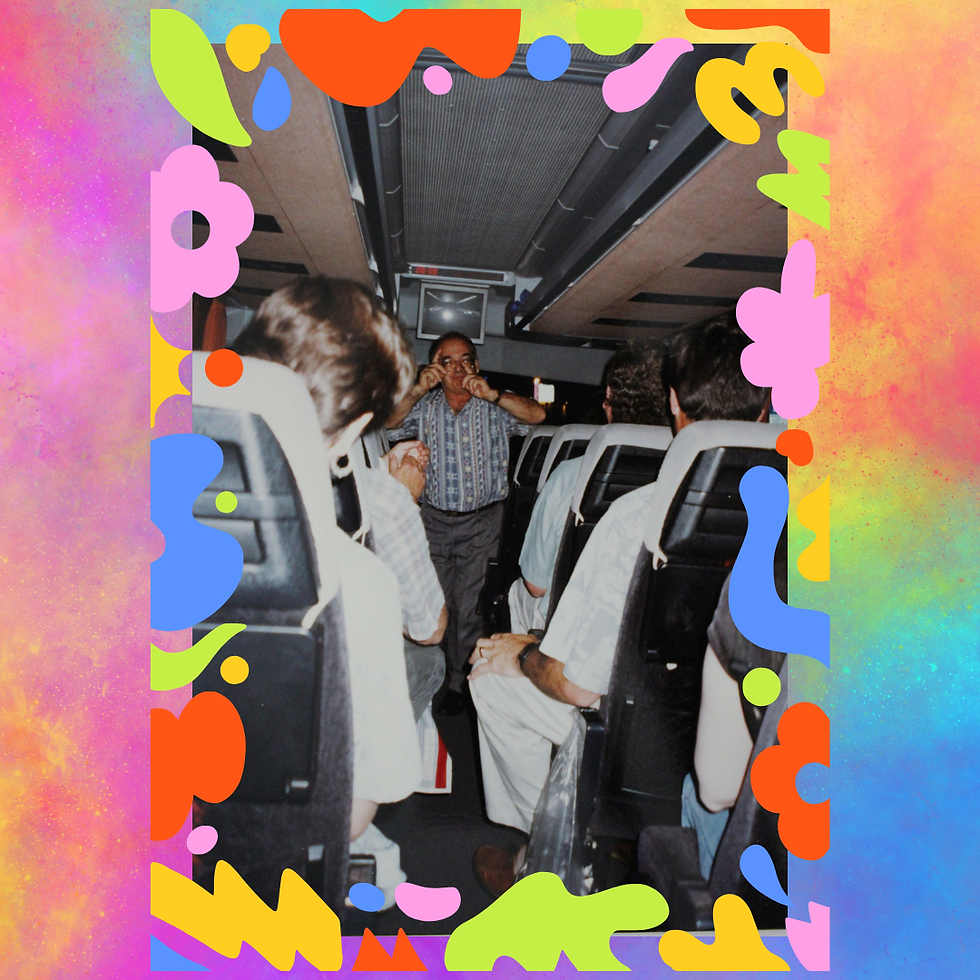
Graeme was super knowledgeable and fun to be around. We thought he'd be stricter with punctuality, though. He seemed reluctant to answer tricky questions and deal with complaints. His lecture about tipping Luc was a bit much, too. Just ask us politely to tip the guy, mate, without making us all feel shamed into doing it! He ignored us because we caused him no problems, but that was OK with us.
Even though others complained, we had no issues with the hotels as a nice bed and warm shower are all we need. We had expected from the tour information that the hotels would be more centrally located, as we’d imagined wandering around at night on our own. That said, there were often included night-time tours or dinners at local restaurants, so we didn’t have much free time in the evenings. On top of that, we were always knackered from the day’s activities.
From my experiences since the European tour, day tours are a great option, as you can mix up independent travel with the safety and ease of seeing things that would be harder to experience on your own. I have done lots of such trips in the years that have followed that have given me amazing memories. I've visited places on day tours I never would have gotten to on my own, for example Transylvania in Romania, and Gallipoli in Türkiye. Shorter tours with more time to explore places are also great, as was my experience in Morocco in 2007.
Travel tip🌏
If you want to do an extended tour, my advice is to choose wisely. Pick something that will allow you a nice mix of guided excursions and free time or at least one that has a quieter pace so that you have time to truly immerse yourself in unfamiliar places and spaces, not dash madly from one place to another. I realise reading this post how many things we either drove or walked by and didn't have the chance to even go inside, let alone explore in any depth.
Footnote ℹ️
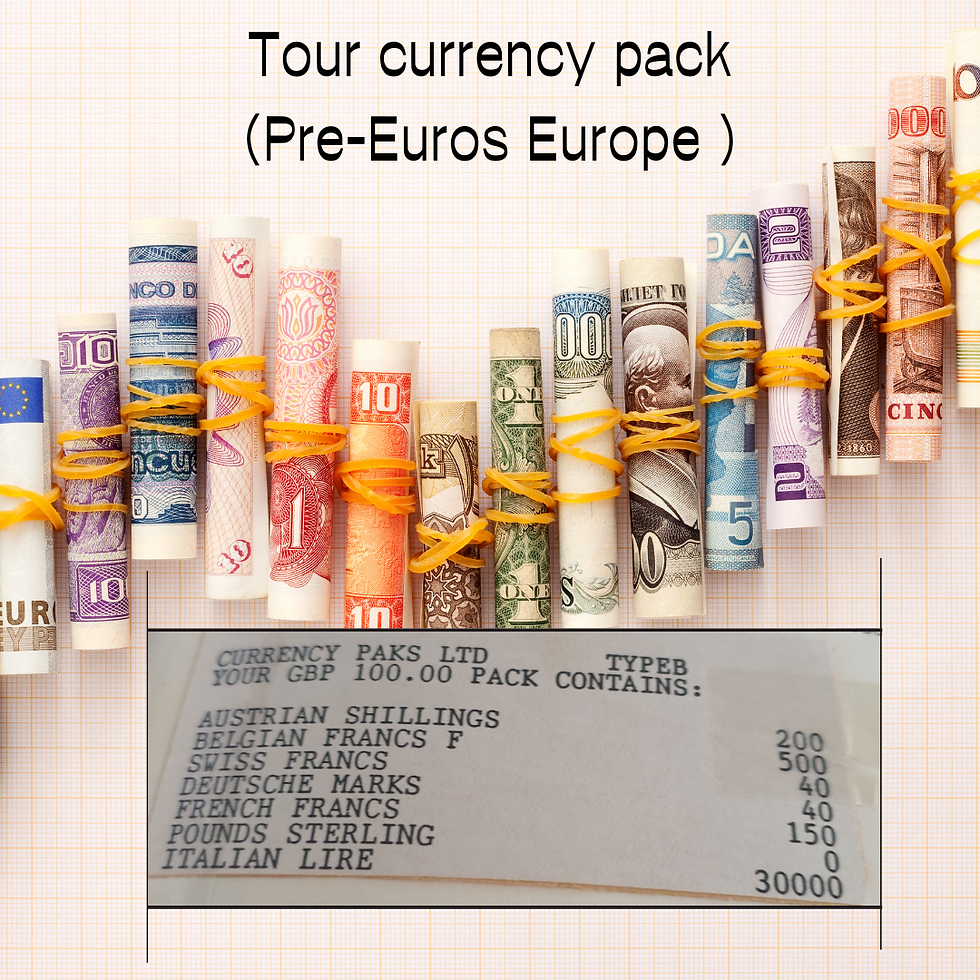
I've included below a picture of the currency pack we were given, in exchange for 100 GBP, to see us through the tour for small purchases. How funny it is to think of this now, with credit cards and Euros the norm.

Whew! This post is MEGA, but so was the tour! Here are my reflections on what the experience meant to me and my most vivid and lasting impressions of it..

Do I regret taking the tour? No. Would I do it again? Also, no. I felt that way at the time, and I still do, even though I acknowledge that the tour was a good option for us for our first experience of international travel. The tour was a safe way for us to gain confidence to travel outside of Australia and explore places beyond our own borders. The tour was also a wonderful taster to help us see for the first time all that Europe has to offer and which places we'd like to experience again, and in more depth.
I fell in love with Europe as a concept on the tour and it marks the beginning of my enduring love for that part of the world. The tour also ignited my wanderlust and I have been privileged to be able to feed it ever since.

The relentless pace: It's exhausting being on the go so much and whizzing past so many new, unfamiliar and intriguing places. It makes your head spin. I also wish that seeing Europe meant truly seeing it, not just driving or walking by an historically or culturally significant place.
The tour schedule: While being escorted around is easy, it also limits your freedom to spend your time according to your interests and preferences.
The food: So much food! I have a complicated relationship with food and the abundance of it on the tour was overwhelming.
The people: It's just not my thing to be at such close quarters with a large group of people for a long period.
Europe: The history, the landscapes, and the architecture. The tour was an absolute feast for my senses. It was also a privilege to visit Hungary and Czechia only a few years after the fall of the Iron Curtain and witness, even for a short spell, the dawn of a new era.
What next?
After we finished the tour we picked up a hire car at Heathrow and did a self-drive for two weeks around the UK [minus Northern Ireland]. Read my post about our car trip around England, Scotland, and Wales to complete the posts on our 6-week first foray into the world. We eventually had the chance to visit Northern Ireland, and the Republic of Ireland, too, but not until our 25th wedding anniversary.


Comments