More Spanish bookends to our Portugal wanderings
- Jul 21
- 18 min read

A little bit of background 📝
This post documents our second experience of Spain as two bookends to our Portugal wanderings. The bookends again took the form of a Brisbane-Madrid flight and a hire car journey into Portugal from Spain and back again.
Why fly into Madrid again as a gateway to Portugal? We wanted to take advantage of Qatar Airways membership and our air miles, however the airline doesn’t fly directly from Brisbane to Lisbon. My experience of Qatar Airways over multiple flights for work and for personal travel has been super positive, so we stuck with them for this trip. The flights for the two of us were only slightly more than a single flight to Europe from Australia and we had points to purchase leg room seats. Bonus!
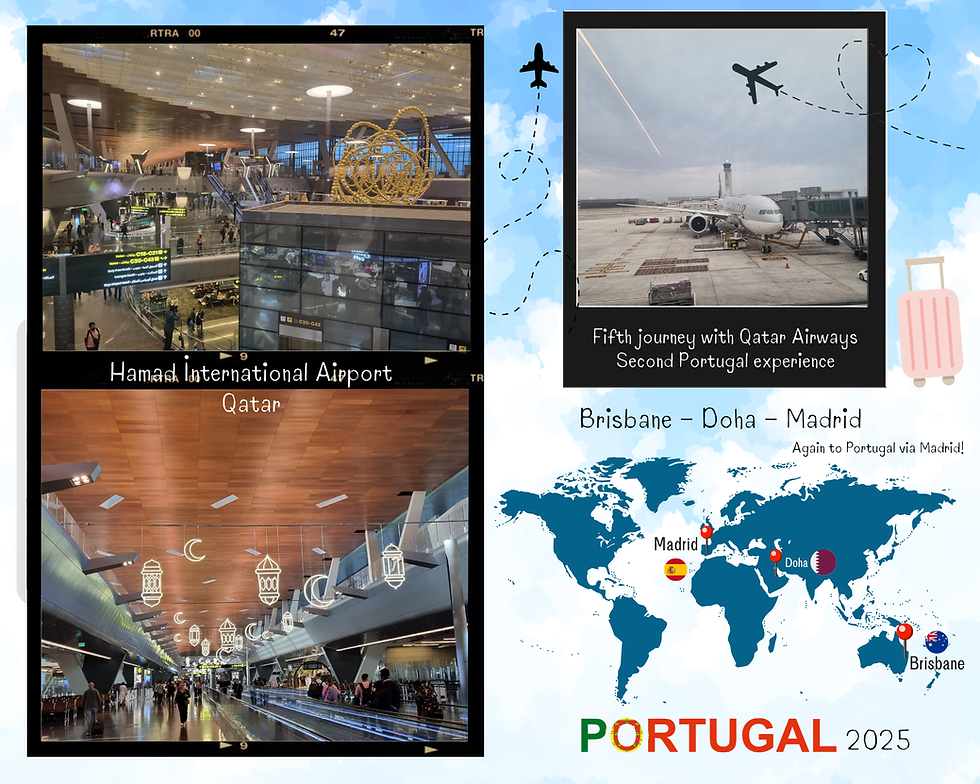
We had planned a winter expedition to Portugal for February 2025, to flesh out our experience the previous May. Portugal is where we are considering spending blocks of time at some point. We’d already fallen in love with the country on our first visit. You can read all about our previous year's first Portugal wanderings here and our first bookend experience of Spain.
I’ve made a map that shows the routes we took into Portugal from Madrid, in May 2024 and again in February 2025. Our first journey took us southwest of Madrid to overnight in Talavera de la Reina and into Portugal at Evora via Badajoz. This time, we drove further on from Madrid, to Plasencia near the border, crossing into Portugal at Castelo Branco before our reaching our eventual destination, Caldas da Rainha. We returned to Madrid on that second trip from Amarante in Northern Portugal via Salamanca and Avila.


Our journey to Portugal: But first, Spain again 🫒
Our second experience of landing in Madrid and making our way through border patrol to collect our hire car was just as smooth as the first time. It was even easier the second time around, actually, as we knew what to do. Travelling for me has always been in part about building my confidence. I feel good about myself knowing I can navigate travel experiences in different environments. I also feel so grateful for these experiences. The familiarity that I have with airport processes now makes me feel like a seasoned traveller!
I was a little concerned about the longer drive this time for W (my husband), though. Again, we’d come off the long flight from Australia and wanted to progress towards Portugal and make the most of the rest of the day. The previous year we had only driven around an hour from Madrid to our overnight pit stop at Talavera de la Reina. This time W drove 250 kilometres to Plasencia, near the Portuguese border. He handled the drive like a champ!

Plasencia was all about choosing a town fairly close to the border and to create an even-ish split of the 600 kilometre distance over our first two days. This 600 kilometres trek would take us from Madrid to Caldas da Rainha, the base for the first part of our Portugal wanderings.

We arrived at Plasencia around 6pm, having been treated to a lovely drive through the Spanish countryside after leaving Madrid. The flat, brown landscape is familiar to us now. I know Spain has mountains, but what we’ve seen on our highway travels is such an expanse of flat land. I assume that a deliberate (and sensible) decision was made by Spain to build the highways in such spaces. Undulating mountains and valleys are a bit hard to avoid in Portugal!
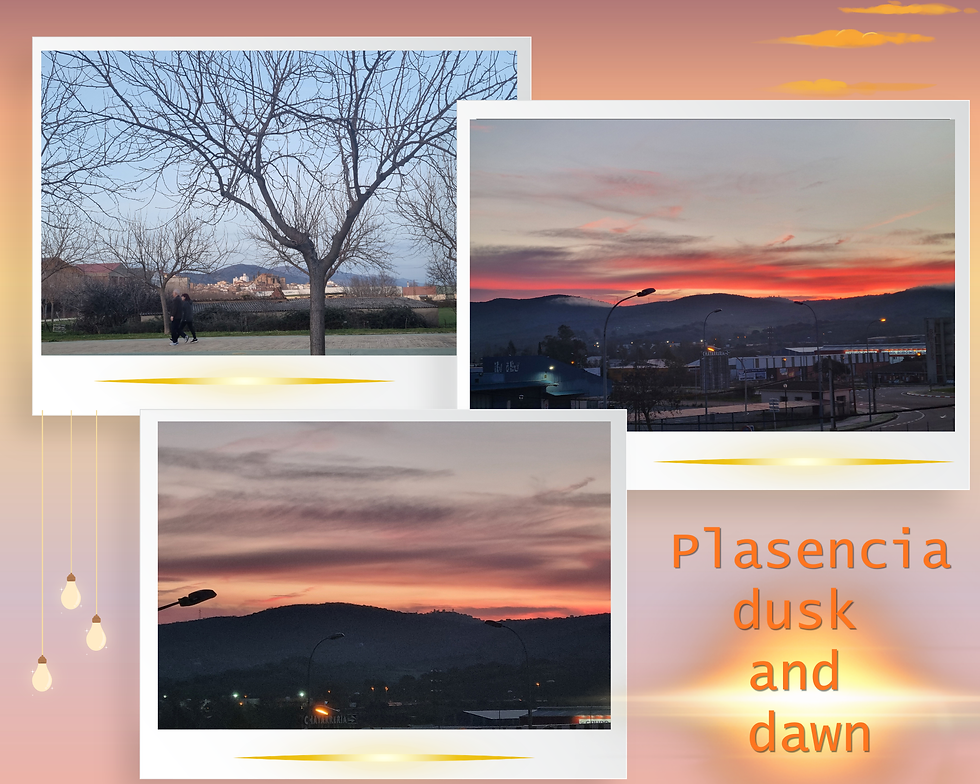
What we saw of Plasencia was a little sad as were staying on the outskirts and it felt quite industrial in that part of the city. That's probably an unfair impression as I understand there is a pretty old town in Plasencia. We didn't have the time or energy to explore it on a winter's evening after coming off a long flight.

Plasencia is located in the northern part of the province of Caceres in Extremadura.
It was founded in 1186 by King Alfonso VIII of Castile. Today, the city's economy is primarily based around the service sector and a wide range of major commercial activity.
Plasencia was a strategic location for French troops during the early 19th century Spanish War of Independence.
The city walls have protected the old town since the city's founding, allowing access to through its gates.
I found a basic hotel for the night as it was really just a place to rest and decompress. The Hotel Ciudad de Plasencia only cost us $107AUD so we weren’t expecting much. Our hotel room was actually pretty good for a cheap place. It was big, modern and clean. The person we spoke to on the desk was super friendly as well.

We were pretty knackered and travel fatigued so we weren’t inspired to go exploring. The only part of Plasencia that was saw was the Aldi 😄as we went in search of a supermarket for supplies. That said, poking around in foreign supermarkets is totally our jam!
The first proper day of our wanderings began with a cold, early start the next morning as we headed off to Castelo Branco. We were treated to a magnificent sunrise in Plasencia first, as the balcony of our hotel room afforded us stunning views of the mountains at dawn. What we saw of the outskirts of the town may not have been all that pretty, but Plasencia is surrounded by three magnificent mountain ranges: the Sierra de Gredos, Sierra de Gata, and Las Hurdes.
Our drive that morning took us 150 kilometres into Portugal to Castelo Branco (map point 3) to our eventual destination of Caldas da Rainha (map point 4). That was it for the front bookend of Spain! You can read about Castelo Branco and all our Portuguese winter wanderings here.
Our journey from Amarante to Madrid 🚗
We sadly said adeus to Portugal at the end of our winter expedition and headed back to Madrid for the long flight back to Australia. It was Thursday, 27 February when we left Amarante in Northern Portugal that morning (map point 1). Our flight was due to depart from Madrid at 9.35pm the following evening. That gave us pretty much two full days to get back. Our final stop in Portugal on that first return-home day was in Braganca, right near the Spanish border (map point 2). You can read about Braganca in my Portugal winter wanderings post.

Our Spanish bookends the second time around gave us the opportunity to visit Salamanca and Avila on the way back to Madrid. Crossing into Spain after leaving Braganca on the Portuguese border then meant a 175 kilometre two-hour drive to Salamanca. We had our penultimate picnic lunch that day, so pleased to find an actual rest stop along the highway. They don't seem to be a common thing in Spain and Portugal. They are everywhere in Australia!

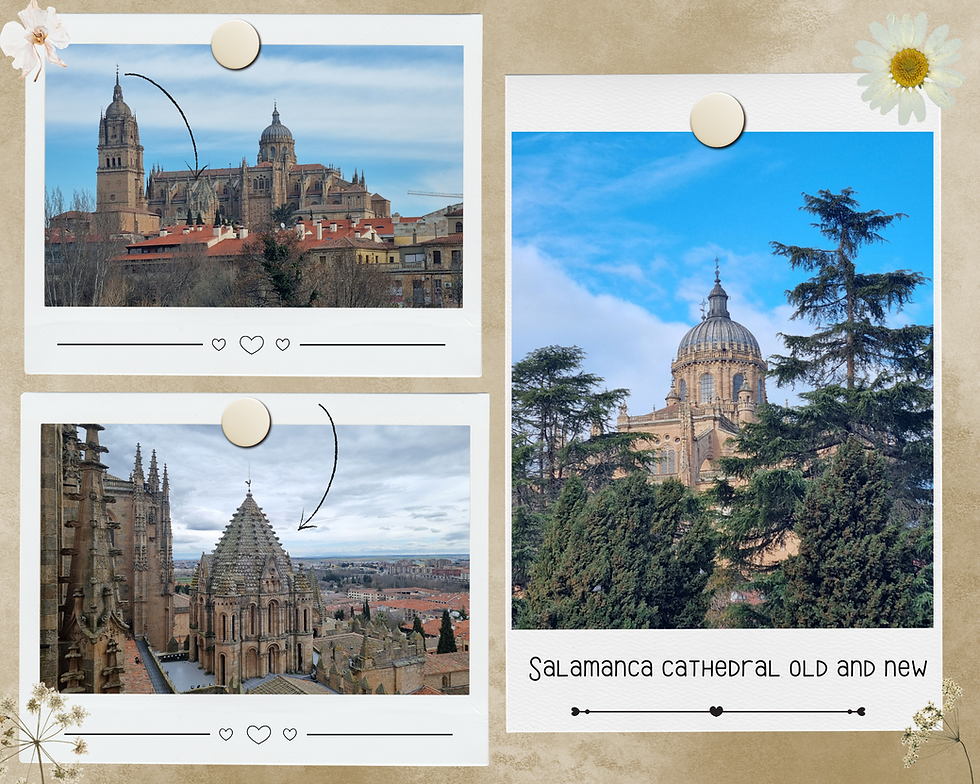
I loved coming into Salamanca, driving through the modern part then crossing the Tormes River as the magnificent sandstone buildings of the Old City came into view. Looming large over the landscape is Salamanca Cathedral, an imposing piece of architecture that combines two historic places of worship. The cathedral’s towers are one of Salamanca’s best-known landmarks, rising an impressive 100 metres over the city skyline. More on the remarkable twin cathedrals below.
Salamanca dates back many hundreds of years BCE, named Salamantica by early Roman settlers. Today Salamanca is known as La Dorada (The Golden City) from of the glow of its sandstone buildings.
The Tormes River flows through the city. The river begins in the Gredos mountains and stretches 284 kilometres to connect with the Douro, the largest river on the Iberian Peninsula. (The Douro flows into the Atlantic Ocean at Porto in Portugal.)
The Old City was declared a UNESCO World Heritage Site in 1988.
I had booked a night in an apartment on Avenida de los Reyes de Espana, only a short walk from the centre of the Old City. We found the street easily enough, but it is a main thoroughfare through the centre and down to the river. Several loops later we finally found a parking building across the street from the apartment. Access to the apartment building was via a door code so it was a smooth check in. We decided to leave the car in the parking building overnight for a €20 fee. That actually seemed easier than trying to shift it to the free parking that supposedly came with the apartment (that I think may have been on the street anyway).
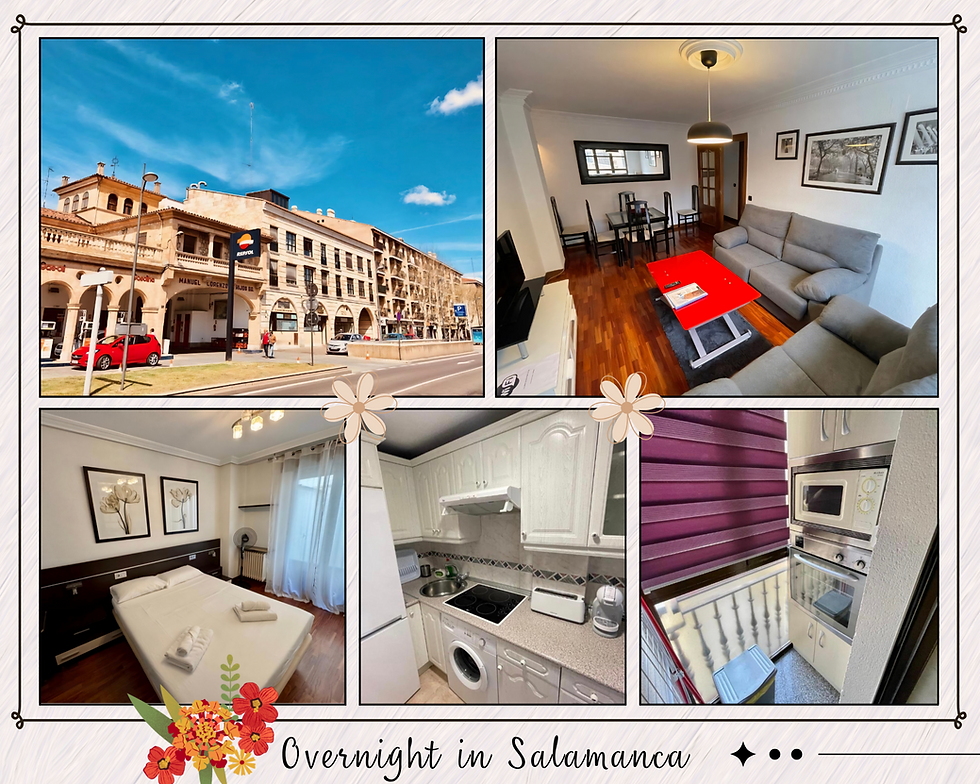
I chose the apartment for its location, and it is perfect for that, especially given we only had a short time to explore Salamanca. The cost was $162AUD for the night but it was worth it for the location. The décor is pure Spanish! The proportions in the place are a little odd, though. There’s a massive entrance hall, a substantial living area and large bedrooms, but the kitchen is tiny. I've included two shots in the above collection to show some sense of the space. The sink is hidden in the corner of the small kitchen so it’s very difficult to use. The microwave and oven are on the balcony. Mad!
We had most of the afternoon to explore the Old City, an elegant historic centre full of honey-coloured sandstone architecture. It truly does feel as if you’ve stepped into a golden forest of ancient buildings and churches. There are many churches, buildings and other landmarks that speak to its architectural, cultural and academic place in Spain’s history.
The buildings do blend into one another a bit and we only stumbled across Salamanca Cathedral by chance really, even though it is absolutely ginormous and one of the largest cathedrals in Spain. At the entrance we came to, the attendant directed us to the €4 ticket for access to Ieronimus, the Cathedral Towers of Salamanca. It is also possible to have the full cathedral experience (at the time of writing, €10) to see properly inside, including the cloisters.

Salamanca Cathedral is actually two cathedrals joined together, known as the Old and New Cathedral. The Old One was built in the 12th century to Romanesque design. The New One was constructed over two centuries, between 1533 and 1733, in Gothic, Plateresque and Baroque styles.
Instead of tearing down the 12th-century Old Cathedral, builders constructed the New Cathedral right against its north wall. The two cathedrals share a wall, allowing visitors to walk seamlessly between two completely different eras of architecture.
Exploring the cathedral towers is a cool thing to do if you love a bit of climbing and poking around in old buildings. All that climbing provides spectacular views of the city. This link provides further information on what's included in the cathedral towers ticket.
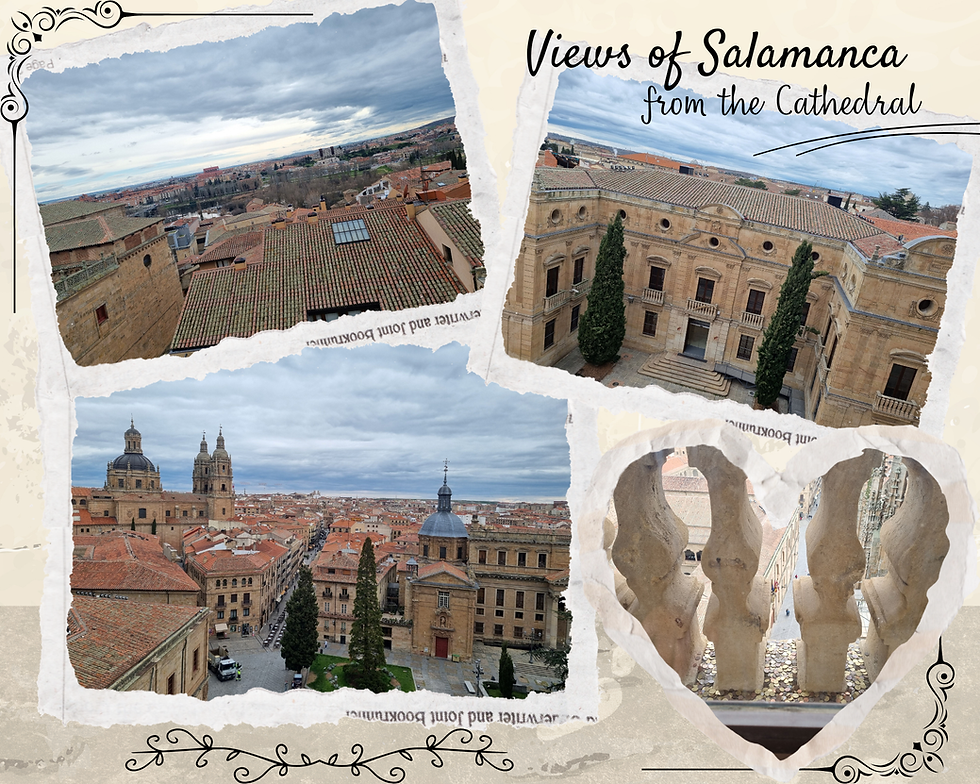
There’s an upper platform in the New Cathedral that allows visitors to walk among flying buttresses, pinnacles, and gargoyles. It is also possible to walk on the roofs of the New Cathedral on a metallic footbridge at the point where the two cathedrals merge. Access to these platforms gives a sense of the whole cathedral complex. That’s the Torre del Gallo (Rooster Tower) of the Old Cathedral (officially named the Cathedral of Santa Maria) in the below bottom middle shot, joining the Old and New Cathedrals.

There are a few dodgy bits still, as my photos below show. The stone passage in the right had photo was taken quite high up inside the cathedral. I just had to take the left-hand shot to show some of the wall instability. Eek.

Dodgy bits aside, I was absolutely in my element exploring the ancient passageways. Below is a sample of the interior stairs. The right-hand shot shows how modern platforms have been added to provide accessibility. So cool!
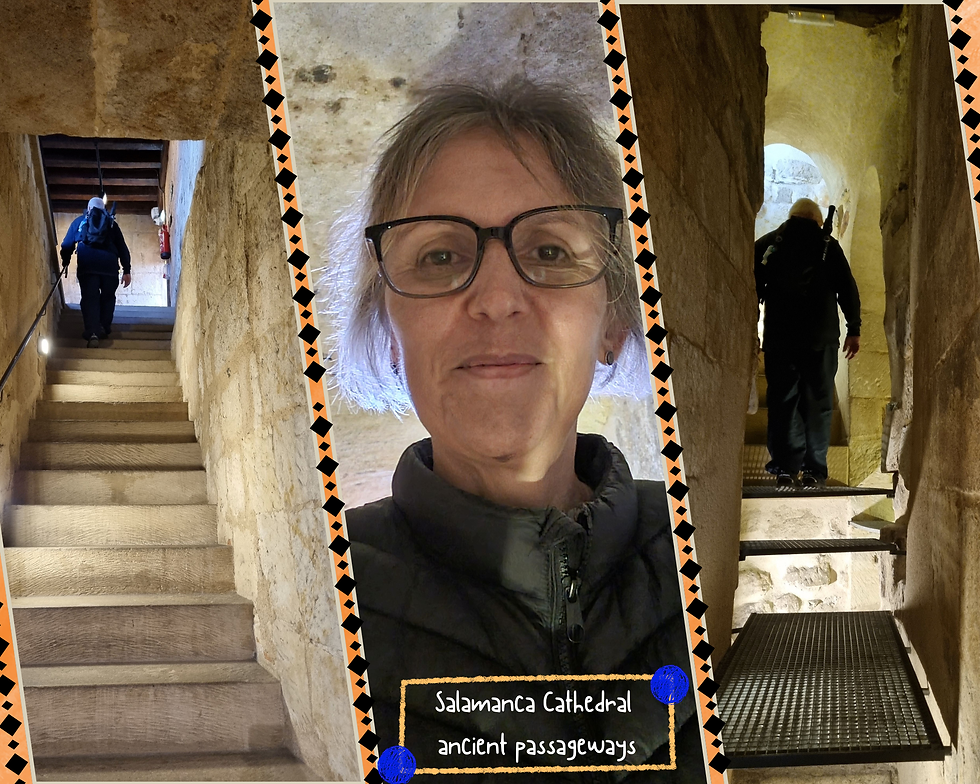
The below collection is my favourite of our exploration of the cathedral’s towers. I love spiral staircases in old buildings! The distinctive set of narrow stone steps that spiral around a central stone pillar are way cool.

The uppermost vantage point of the cathedral is, understandably, the 92-metre tall bell tower. It is one of the highest historic towers in Spain. I believe that when the bells ring they play over 100 notes. The bell tower is one of the most spectacular of its kind that I have seen. It was structurally compromised in the 1755 Lisbon earthquake, tilting slightly and leaving a crack. Fortunately, massive buttresses were added to reinforce the structure.

The space up the top is vast and the little archways where the bells are housed are just beautiful. The bell tower is the best place to appreciate the dome that sits atop the transept. Its dramatic Baroque design can be seen in the above collection.
I previously mentioned that we paid the €4 to do the Ieronimus tour that allows access to the cathedral towers. The ticket doesn’t allow for wandering around the cathedral’s interior but does provide the chance to peer down on the central nave of the New Cathedral. I actually rather like the view from up on the inside platform. I reckon the cathedral towers ticket is the best €4 I’ve ever spent!

Below are some more shots of the central nave of the New Cathedral. The new place of worship was designed to contain ceremonial spaces, and its Gothic design provides a moody, subdued atmosphere.

Inside the Torre Mocha room there are ancient documents on display, many of which relate to the construction of the New Cathedral. I’ve indicated the dates of some of the documents in the below collection. Fascinating! I’ve also included two ancient inscriptions I noticed on the stone walls. I love the juxtaposition of the old and new in the top right photo!

The cathedral is 100% worth a visit! What a unique complex it is, with the two cathedrals joined together. Below are two shots of us up on the viewing platform of the New Cathedral. Apparently, the cathedral complex has been significantly restored to allow for visitor access. Many of the spaces that are now open were once in ruins, damaged, walled off, or inaccessible. The afternoon was wearing on and we didn’t have a lot of time, so I am sure we didn’t see everything.

I was on a mission to check out the University of Salamanca, but that is easier said than done in historic European cities as the universities tend to blend into the urban landscape. I was just happy to wander around what I thought was the "campus", marvelling at the concept of a university founded in the 13th century.
Salamanca University was founded in 1218 by King Alfonso IX. It is the oldest university in the Spanish-speaking world and the fourth oldest in the world by continuous operation (after Bologna, Oxford, and Cambridge).
For four hundred years from its founding, the university was one of the leading centres of learning in Europe. Francisco de Vitoria lectured there from 1526 until 1546, proposing some of the foundational principles of international law.
Salamanca University occupies a rather important place in Universal History. Christopher Columbus stayed in a convent in Salamanca while he planned his voyages. His plans were judged by scholars at the university and he later lectured at the university on his discoveries. Mathematicians from the university put forward a concept to Pope Gregory XIII that later became the Gregorian calendar.

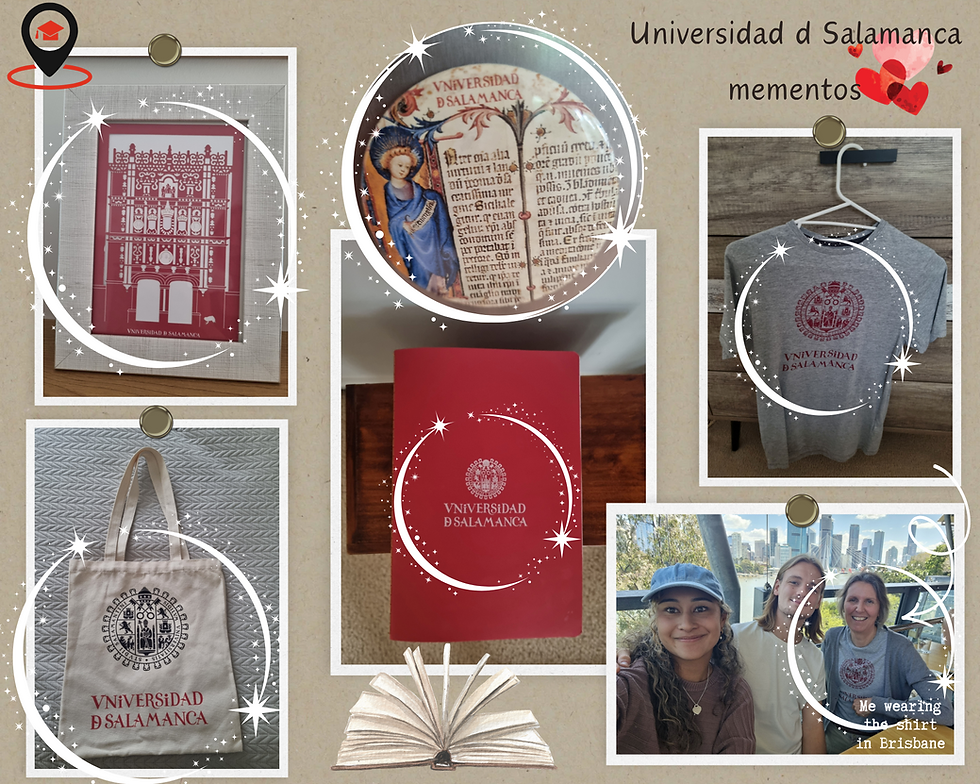
I found the university bookshop and store. Yay! I’ve been to quite a few universities in the UK and Europe, having spent over twenty years myself working in three different institutions in my home state in Australia (and with five degrees to my name...). I just had to buy something to take with me as universities in Australia are nowhere near as old as European and British ones.
It was around 5pm by the time we took a break. It had been a rather cold and bleak day, and we were both feeling chilly. I hate myself for giving money to Starbucks but I knew we’d be able to get a chai latte (my beverage of choice at the time) to warm ourselves up. The Starbucks has a fab view of the Plaza Mayor so it was worth leaving my ethics at the door just for once. The square is massive and beautifully framed by a gorgeous arcade.
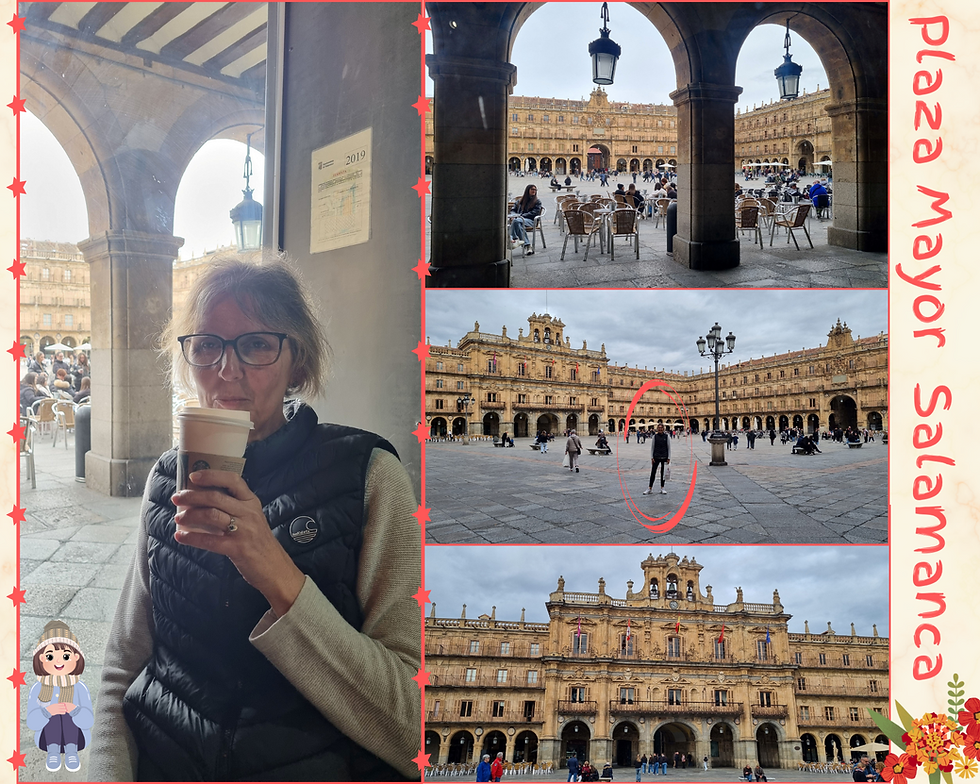
Plaza Mayor is the heart of Salamanca, considered to be one of the most beautiful plazas in Spain.
The large public square was built in traditional Spanish baroque style. Construction began in 1729 and was completed in 1755.
The square is surrounded by an ornamental arcade, set out in an irregular square. None of its facades measure the same height.
The original purpose of the plaza was bullfighting.
We wandered around for a bit longer, drinking in the stunning sandstone vibe before going in search of a supermarket for dinner supplies. I remember we walked for ages trying to find something suitable and then had to trek all the way back to the apartment. It had been a big day, but I was so glad we’d made the journey to Salamanca.

Our final full day of our winter Portugal wanderings with another Spanish bookend dawned. It was time to head to Madrid for the flight home that evening. I was not looking forward to the evening flight, even though I know the airfares were cheap. I much prefer to flight out first thing in the morning when returning to Australia as it feels better to get up and go and do the short flight first during the day. That leaves the long flight to feel like night time. I also think it seems like such a long journey home, especially without a shower.
We didn’t rush to get up that morning, knowing it would be a long time until we were back in our beds at home. It was lovely to have the chance to wander around Salamanca again before packing up for the last time, freshening up, and heading off. We took a different route this time, giving us the chance to see more stunning sandstone buildings.
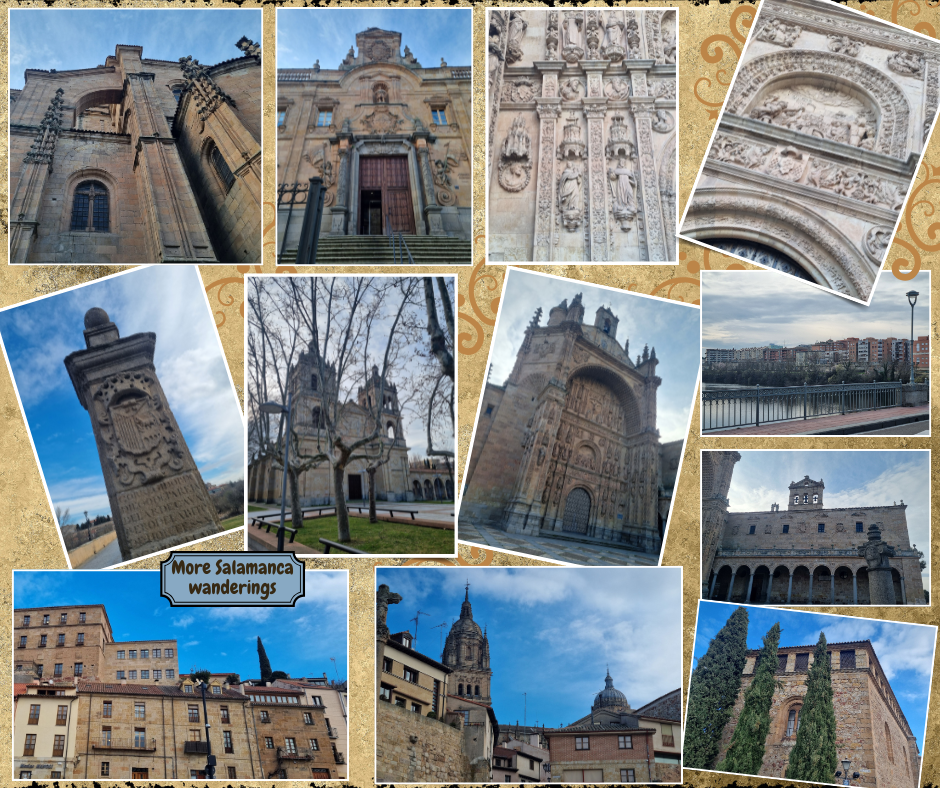
Our final day wanderings also saw us crossing the Roman bridge. The top shot below was taken the previous day as we drove into the city. The other shot shows the view of Salamanca Cathedral that we were treated to as we crossed the bridge that morning.
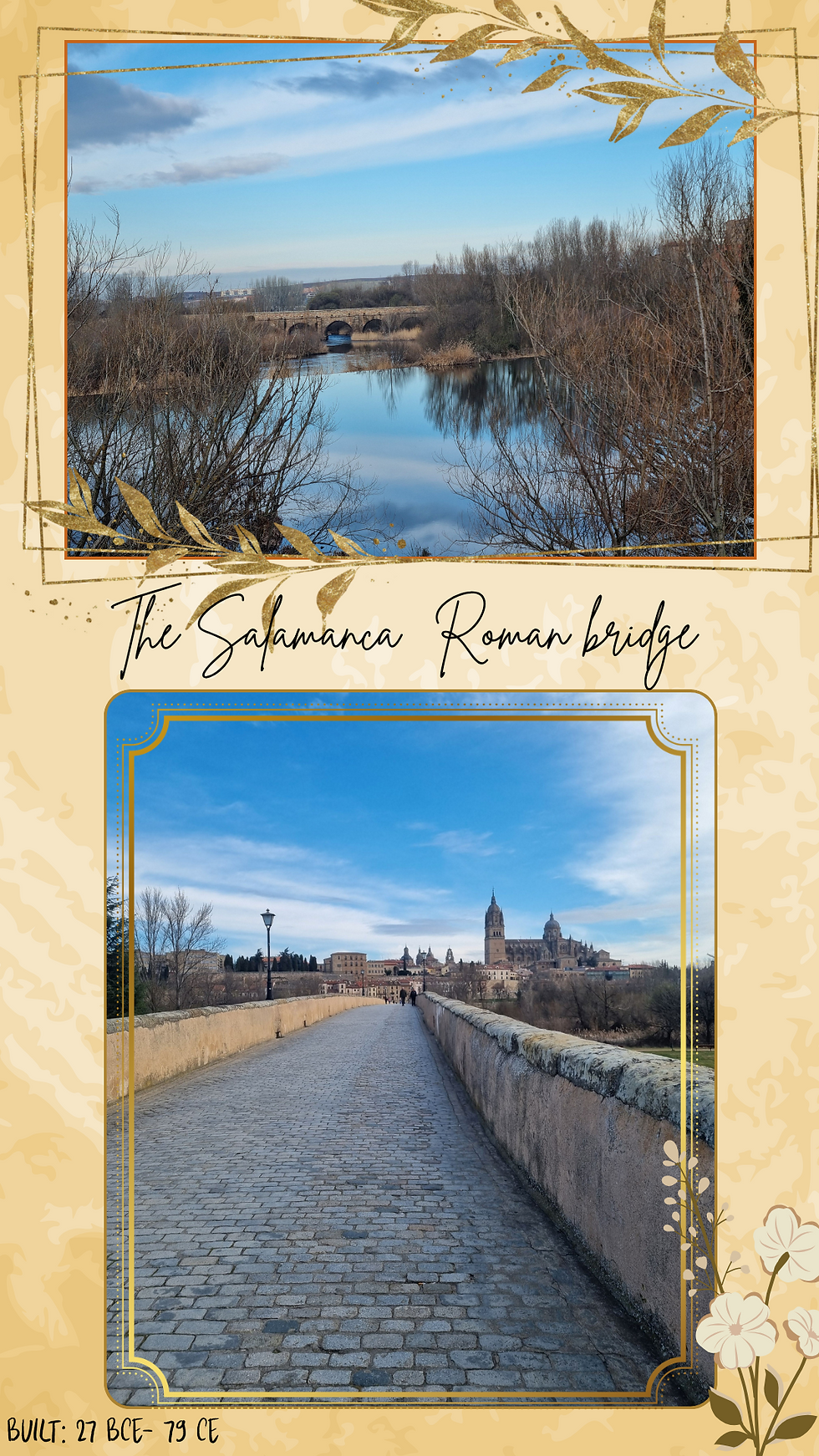
The bridge dates back to between 27 BCE and 79 CE. Well old!
It spans the Tormes River and serves as a significant historical and symbolic landmark of Salamanca. The bridge is part of the city’s coat of arms.
The bridge is part of the historic Via de la Plata pilgrimage road of the Camino de Santiago. The road begins in Seville and winds north for over 1000 kilometres before joining the main route in Galicia.
We made a decision the night before to stop at Avila on our way back to Madrid on our final day of wanderings. There was plenty of time as it was only an hour’s drive from Salamanca and then a further hour to Madrid. I hadn’t heard of Avila, but a quick Google search saw me plenty excited about visiting the walled town. What an incredible sight as we drove into the town!
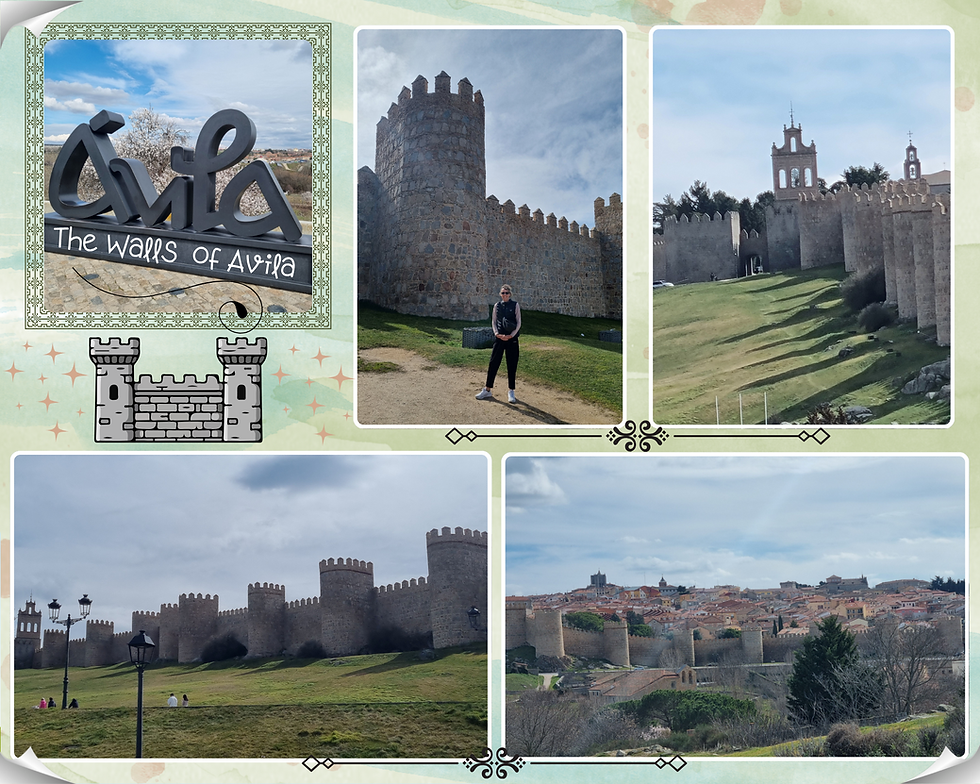
Avila's walls were built between the 11th and 14th centuries to defend the town of Avila during the Reconquista when Christian kingdoms fought to reclaim land from the Moors.
The walls are one of Spain’s most complete and best preserved medieval fortifications. To this day, they still form a complete circuit around the old town.
The Old Town, including the walls and its extramural churches, was declared at UNESCO World Heritage Site in 1985.
The walk across from the car park gave us such a vivid appreciation of the enormity of the walls. We did have a little trouble finding the entrance to the walls themselves, and I think we must have walked a good section of the town before we located the right place. The Walls of Avila can be accessed from three different gates, as it turns out. Tickets at the time of writing are €8. Below are some shot of us walking the walls.
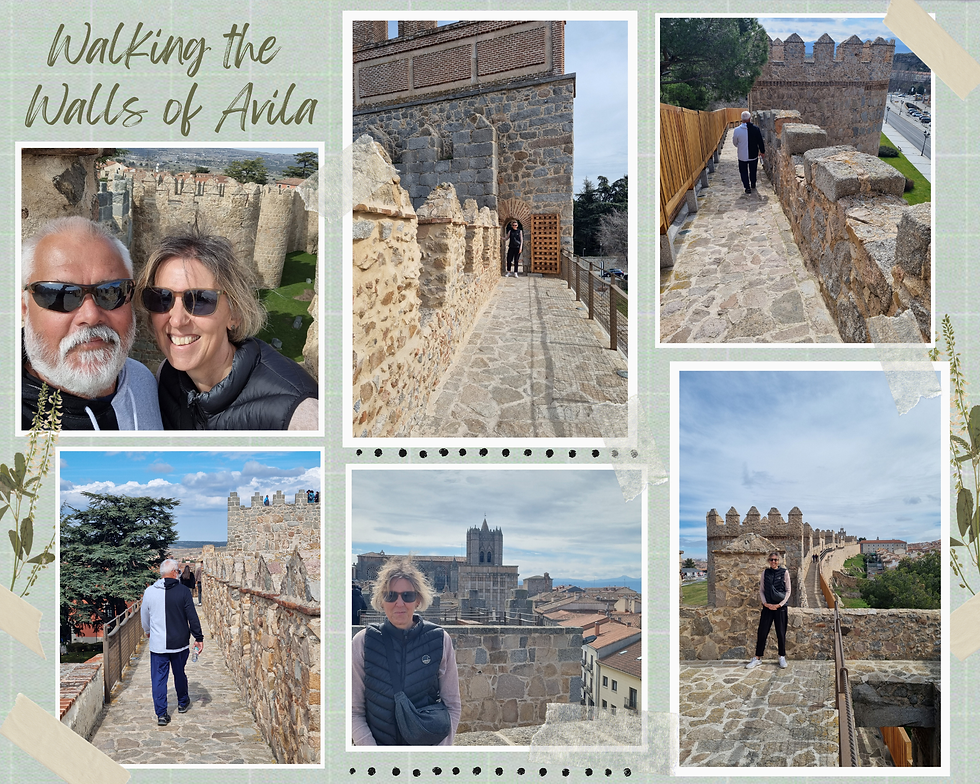
I took so many photos that day! It was such an incredible experience and so different from the ancient walls we’d walked in Portugal. We were struck by how safe it was in comparison with our Portugal experiences. Sure, there’s a bit of climbing, but the stone pathways of the ramparts are all walled off and easy to walk along.

The Walls of Avila dimensions
The enclosed irregular rectangle covers 31 hectares with a perimeter of 2516 metres.
The average width of the walls is 3 metres. The the average height 12 metres.
There is a semi-circular turret every 20 metres (87 in all), standing 8 metres above the height of the walls.
Noted above is the average height of the walls at 12 metres. As you can imagine, walking the walls affords spectacular views. Our two Portugal experiences with Spanish bookends had really been all about ancient structures and stunning views!
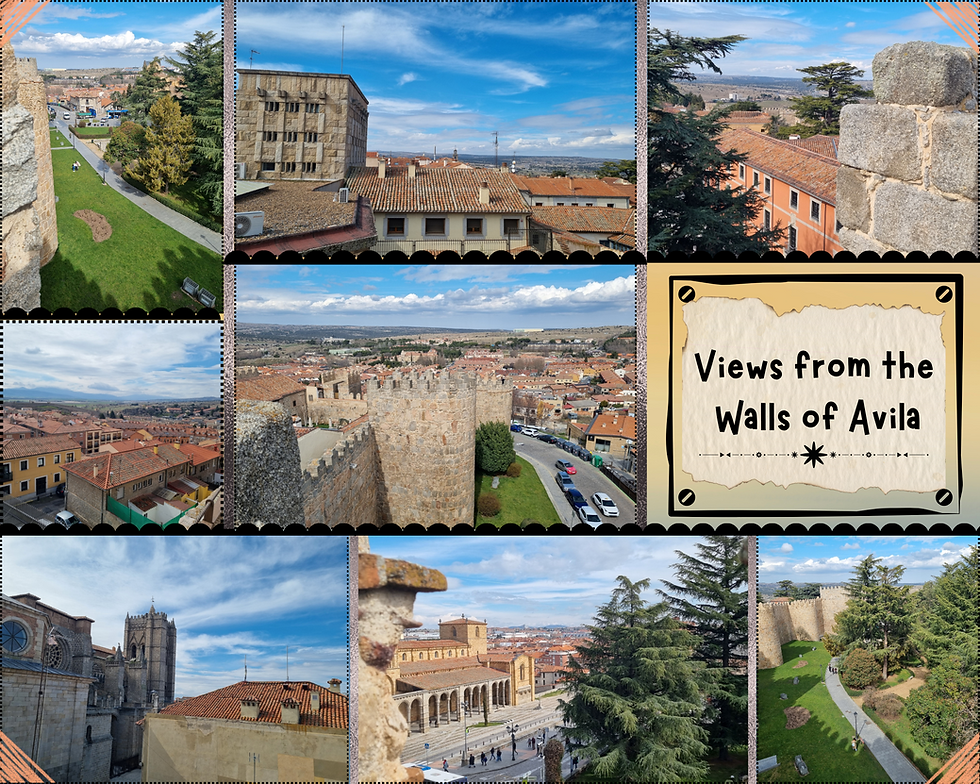
I love the top left-hand shot in the below collection as it gives a nice perspective on the old town of Avila enclosed within the walls. Avila is known as the City of Saints and Stones and is the birthplace of St Teresa, a prominent 16th century mystic and spiritual reformer.
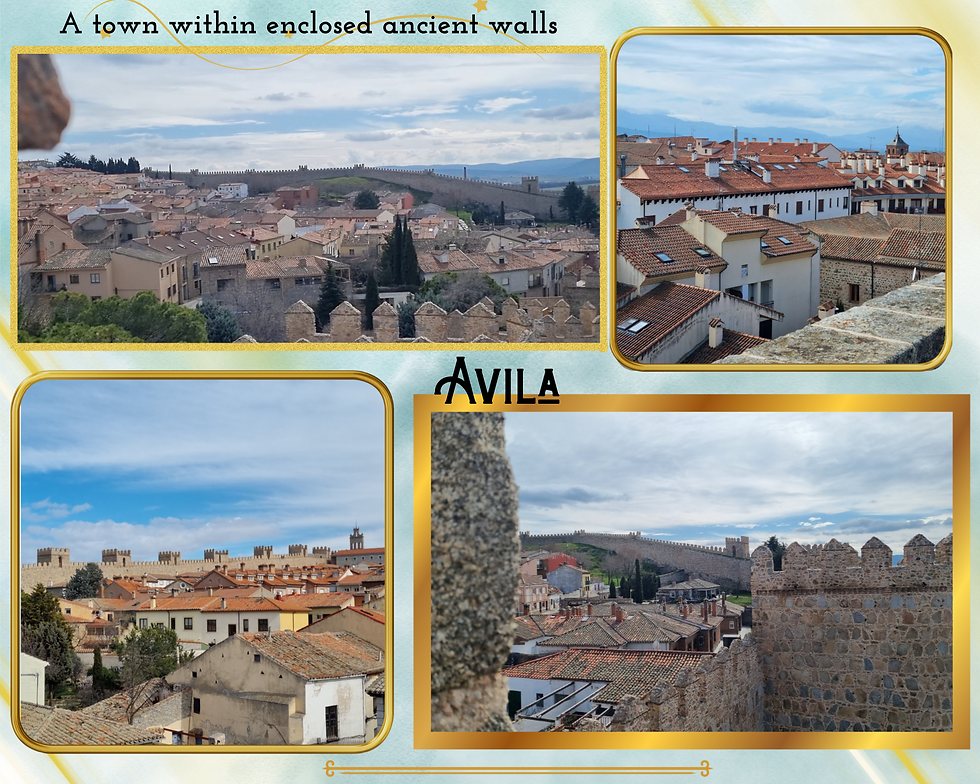
The complete circuit is a 2.5 kilometre trek, but at present, it is only possible to walk half the length in two separate sections. That is still a 1.5 kilometre stretch! The other half of the walls is still not safe for pedestrians.

What makes the Avila walls so unique, I think, is how well preserved they are considering they are almost one thousand years old in places. That the complete enclosure of the town is still standing, even if not all accessible, is also pretty special. The town’s elevation and accessibility of the wall’s perimeter means it is possible to completely appreciate the fortification, the incredible stonework and sturdy construction, and the sheer size of it all.
We walked as far as is possible from the primary gate, Puerta del Alcázar, and back again so I could buy some mementos. Another lowkey gift shop at a major tourist drawcard, but I managed to buy some cute little items by which to remember our experience.

That was it for our Portugal winter wanderings with a side order of Spain! I'm placing the map I made for this post here again, as a reminder of the end part of our wanderings and our journey from Amarante to Madrid.
The extremely long trek back to Australia ✈️
I noted earlier in this post that we flew again with Qatar Airways and used air miles to purchase two cheap flights, leg room seats, also taking advantage of my remaining lounge passes. With the benefit of hindsight, this did not make up for the tortuous journey back to Australia. Qatar Airways is, in my opinion, a top class airline but it’s just not a practical option for us to travel from Brisbane to Lisbon without a direct connection from Doha to Portugal.
Our second Portuguese wanderings with a Spanish bookend was a long journey home for us. We had to fly this time via Barcelona as well, adding so much more travel time to our trek back across the globe. We left Madrid at 9.35pm and landed in Barcelona at 10.50pm. I’d done some research and figured it was fine for us to hang out in the airport overnight as the terminals don’t officially close. A hotel for a few hours was going to be too expensive to make it worth our while, plus the hassle of it all.
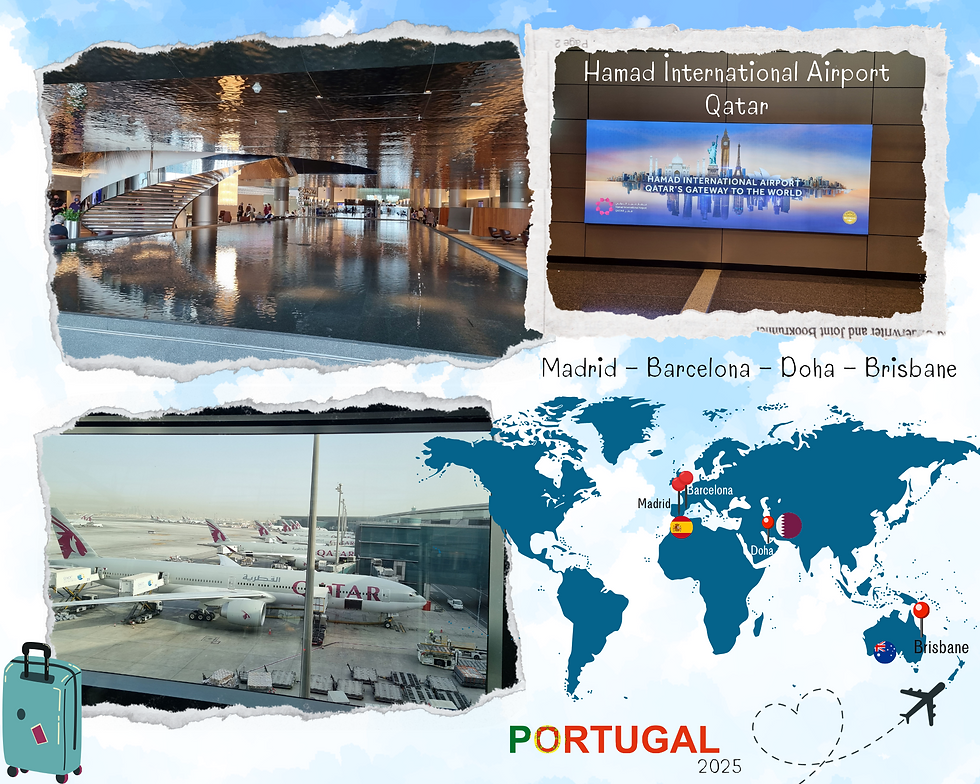
We camped out in the airport until our flight to Doha the next morning at 8.35am. It actually wasn’t as bad as it sounds as the time passed quickly enough, but we stayed in the departure area on the advice of an airport representative (as he told us nothing was open upstairs after border control). The chairs weren’t very comfortable! We later discovered much nicer ones after border control and we didn’t need to eat anything anyway after buying a snack at the Costa in departures.
There was also a huge amount of anxiety for me as when we checked in at Madrid, we only received a boarding pass for the first flight even though our bags were checked all the way to Australia. Looking back now I should have questioned that. The gate only opened a short time before the flight was due to depart so I was panic mode by then. Lesson learnt! And, yes, we were so relieved to be back home the next night. At the risk of sounding completely and utterly privileged, that is the last time I am going for the cheapest option that means a tortuous journey one or both ways!

Our second opportunity to experience a bit of Spain was such a lovely bonus to our Portugal wanderings, despite the complication of flying in and out of Madrid again and driving to and from Portugal. The Iberian Peninsula is a unique part of Europe and I love that Spain in such a contrast to Portugal. The parts we have seen of Spain so far have well and truly inspired us to return to see experience more of the beautiful country.

A second chance to experience Spain!
Feeling relaxed with the familiarity of Spain and the comfort of accumulated travel experiences.
Another confidence boost from navigating our way to and from Madrid and battling the crazy roundabout at the airport to refuel and return the hire car.
Taking a slightly different route in and out of Spain to experience the incredible cities of Salamanca and Avila.
Wandering around one of the oldest universities in Europe.

Stunning Salamanca and the beautiful golden sandstone buildings of the Old City.
Exploring the towers of Salamanca Cathedral: Climbing winding stone steps to take in the magnificent views of the twin cathedrals and the city.
The ancient walls of Avila looming large as we drove into the town: Walking along the ramparts was an unforgettable experience.
A border control representative in Madrid assuming olive-skinned W is Spanish. Ha!
As I write this post I am planning our third trip to Portugal, in September-October 2026. This time we are flying with Emirates with a short stopover in Dubai before flying directly into Lisbon. So no Spain bookends this time. I do hope we can one day see more of Spain. Until then, Nosotras te amamos, Espana💖.



Comments